Dumbbell Frog Reverse Hyperextension (On A Bench)
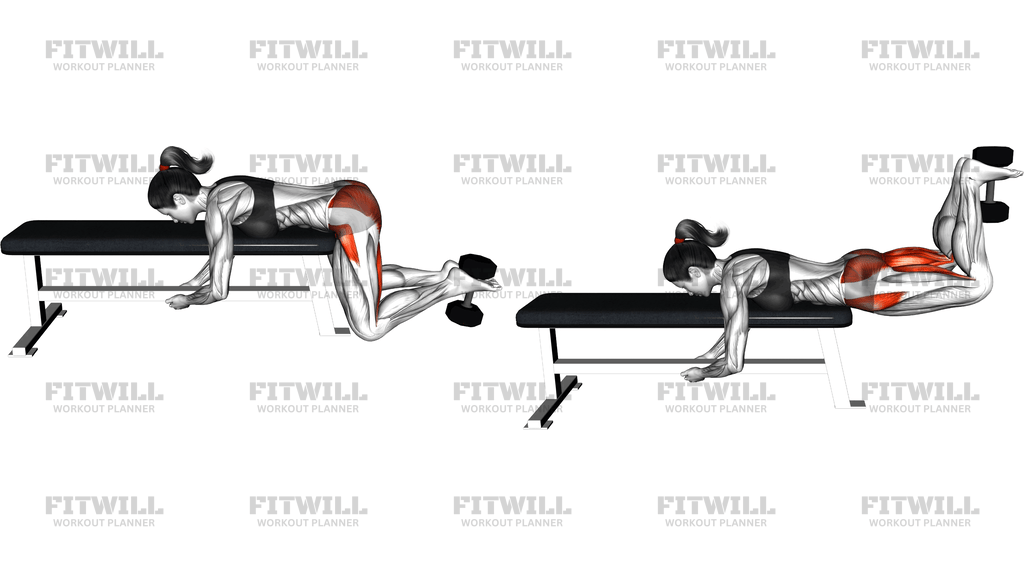
The Dumbbell Frog Reverse Hyperextension (On A Bench) is a hip extension exercise performed lying face down along a flat bench with your hips right at the edge of the pad. Your knees stay bent and your legs hang down toward the floor, with a dumbbell clamped securely between your feet. From there, you drive your legs upward by squeezing the glutes until your thighs rise to or above the level of your torso, then lower them back down under control. The bent-knee, splayed "frog" leg position shortens the hamstrings slightly and shifts more of the work onto the glutes, which is what separates this variation from a straight-leg reverse hyperextension.
This movement is especially useful for lifters who want direct glute and hip extension work without loading the spine the way a barbell hip thrust or deadlift does. Because your torso is fully supported on the bench, your lower back only has to stabilize rather than support a heavy external load, making it a good choice for people rebuilding training after lower back irritation, or for lifters who want extra glute volume on days when heavy hinging is not appropriate.
The setup matters more here than in most bench exercises. If your hips are too far back on the pad, your legs will hit the bench frame before you reach full hip extension. If your hips are too far forward, you lose the stable torso anchor and the movement turns into a lower back swing. Get the hip crease right at the edge of the bench, grip the underside or sides of the bench firmly, and let the legs hang freely below you before each rep.
Execution should come almost entirely from the hips. Brace your trunk, squeeze the dumbbell between your feet, and think about driving the soles of your feet up toward the ceiling rather than just swinging your legs. Pause briefly at the top when your thighs reach torso level or slightly above, then resist the weight on the way down instead of letting gravity drop your legs.
You will see this exercise used as a glute accessory after squats or deadlifts, as a warm-up activation drill before lower body sessions, or as a stand-alone posterior chain builder in minimalist home setups where a single adjustable bench and a pair of dumbbells are the only equipment available.
Keep the rep range moderate and the dumbbell conservative at first. The weight sits on a lever — your whole leg — so even a light dumbbell creates meaningful resistance at the hip. Start light, own the top position, and only add load when you can complete every rep without your lower back arching or your legs swinging.
[ Workout Log & Planner ]
Put your next workout in Fitwill
Keep your plan and training log ready when you are.


Instructions
- Set a flat bench in clear space and place a light dumbbell on the floor next to the end of the pad.
- Lie face down on the bench with your torso and upper thighs supported and your hip crease exactly at the edge of the pad.
- Grip the sides or underside of the bench firmly with both hands and rest your face comfortably on the pad.
- Bend your knees to roughly 90 degrees and clamp the dumbbell securely between the arches or soles of your feet so it cannot slip.
- Let your legs hang down toward the floor, brace your trunk, and exhale before starting the first rep.
- Squeeze your glutes and drive your feet up toward the ceiling, keeping the knee bend constant so your thighs rise together as one unit.
- Stop when your thighs reach the level of your torso or slightly above, and hold the top position for a beat while your glutes stay tight.
- Lower your legs slowly back to the hanging start position, resisting the weight of the dumbbell instead of dropping it.
- Exhale as you lift and inhale as you lower, resetting your grip and brace between reps if your position has shifted.
- When finished, carefully bring your legs under control, then step one foot down to the floor and release the dumbbell by hand rather than dropping it.
Tips & Tricks
- Most people either swing the legs or arch the lower back to help the weight up — if your torso lifts off the bench during the rep, the dumbbell is too heavy or the range is too big.
- Check that your knees stay bent at the same angle throughout; letting the knees drift as you lift turns the movement into a leg curl instead of a hip extension.
- If the dumbbell slips, use a lighter dumbbell with a hexagonal head or place a small towel between your feet and the weight for friction.
- Squeeze the dumbbell deliberately with your feet for the entire set — a loose grip on the weight costs you stability and risks it falling.
- Keep your hips pressed lightly into the edge of the bench; letting them rise off the pad shortens the range and takes tension off the glutes.
- Start with a very light dumbbell or no weight at all for your first few sessions — the leg acts as a long lever, so the load feels much heavier than it looks.
- If the bench frame blocks your legs at the bottom, adjust your position so the hip crease is at the very edge; a bench without cross-bracing at that end works better.
- Pause for one to two seconds at the top of each rep rather than bouncing — the pause is where most of the glute work actually happens.
- Do not turn your head to the side repeatedly during a set; keep your face down on the pad and your neck relaxed to avoid unnecessary strain.
Frequently Asked Questions
What muscles does the Dumbbell Frog Reverse Hyperextension (On A Bench) work?
The glutes are the primary mover, with the hamstrings assisting in hip extension and the lower back muscles working to keep your trunk stable on the bench. The bent-knee frog position emphasizes the glutes more than a straight-leg version.
Why are the knees bent in the frog variation instead of kept straight?
Bending the knees shortens the hamstrings over the knee joint, so they contribute less to hip extension and the glutes have to do more of the work. It also makes the dumbbell easier to hold between the feet.
Is the Dumbbell Frog Reverse Hyperextension (On A Bench) suitable for beginners?
Yes, as long as you start with no weight or a very light dumbbell and master the hanging leg position first. The bench supports your torso, so the movement is easier to control than many standing hip extension exercises.
How far up should my legs go at the top of the movement?
Raise your thighs to roughly the level of your torso, or slightly beyond if you can do it without your hips or lower back lifting off the bench. Going higher usually means you are arching your lower back rather than extending your hips.
What should I do if the dumbbell keeps slipping out of my feet?
Hold it between the arches of your feet rather than the toes, and consider placing a small towel around it for grip. If it still slips, switch to a lighter hex dumbbell or an ankle strap attached to a light plate.
Can I do this exercise without a dumbbell?
Absolutely. The bodyweight version is a solid glute activation drill, and many people use it as a warm-up before squats or deadlifts. Add the dumbbell once you can control the full range with a pause at the top.
Where exactly should my hips be on the bench?
Your hip crease should sit right at the edge of the pad so your legs hang freely below the bench. Too far back and the bench frame blocks your range; too far forward and your torso becomes unstable.
How heavy should the dumbbell be?
Start with something you could lift 15 to 20 slow, controlled reps with. Because the weight sits at the end of your whole leg, it creates far more hip torque than the same dumbbell in your hand would.
Is the Dumbbell Frog Reverse Hyperextension (On A Bench) safe for people with lower back issues?
It is often easier on the lower back than loaded standing hinge variations because the bench supports your torso, but individual tolerance varies. Start unweighted, keep the range short of any discomfort, and check with a qualified professional if you have a current or recent injury.
How should I breathe during the exercise?
Exhale as you drive your legs up and inhale as you lower them back to the hanging position. Keep your trunk braced throughout rather than fully relaxing between reps.