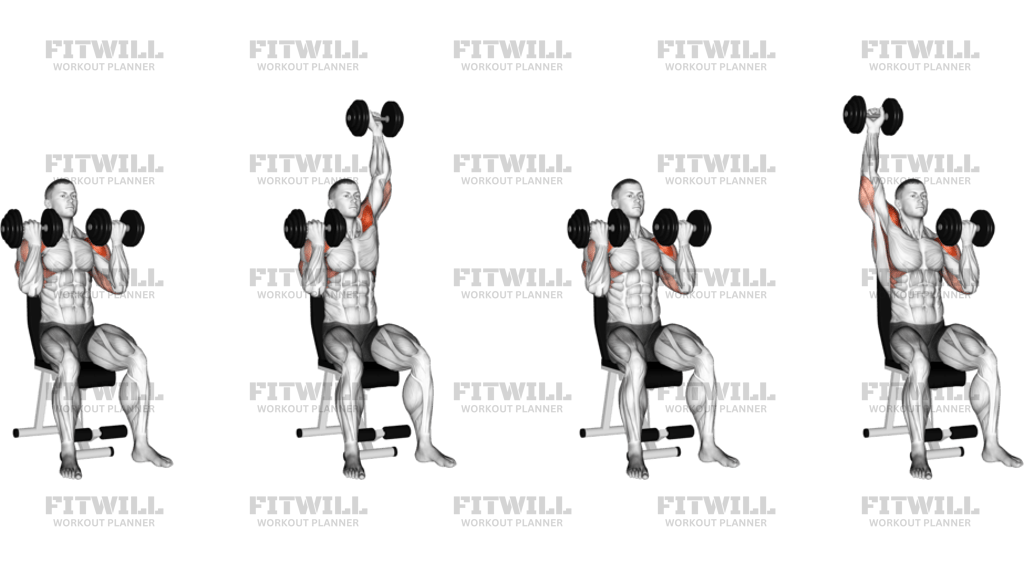
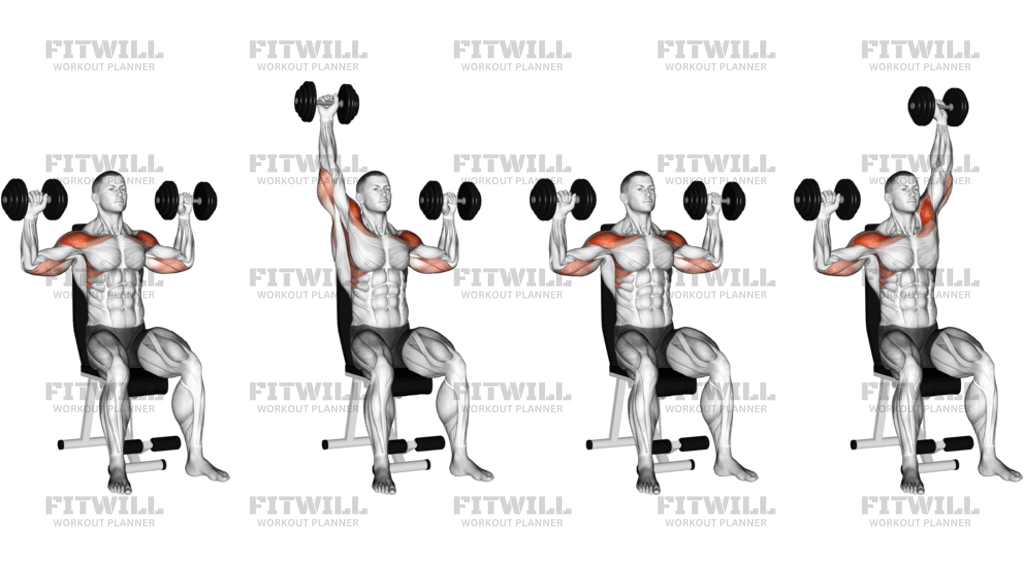
Dumbbell Seated Alternate Press
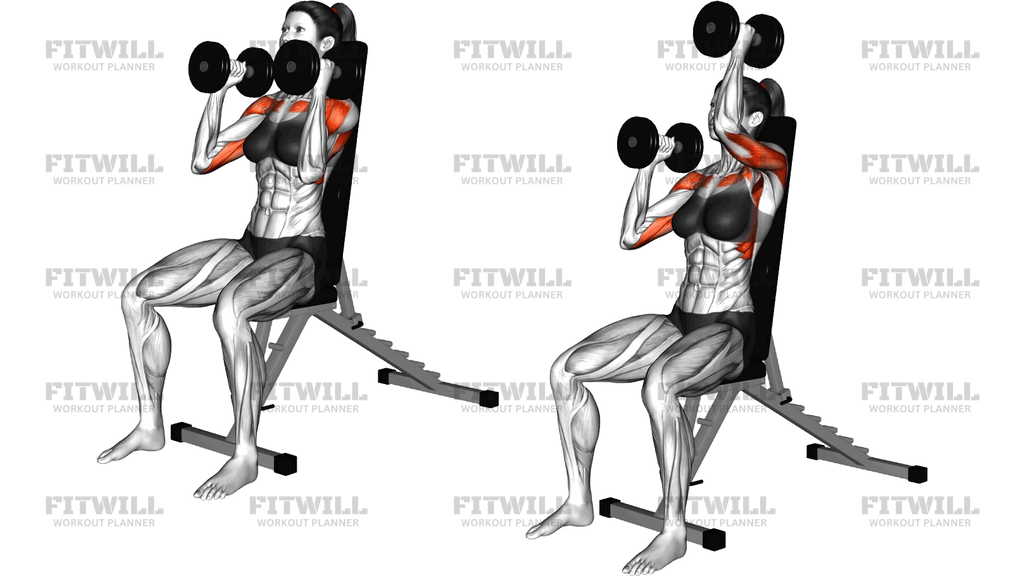
Dumbbell Seated Alternate Press is a seated overhead pressing exercise built around one arm working at a time while the other dumbbell stays parked near the shoulder. The backrest reduces body sway and gives you a clearer view of shoulder mechanics, so the lift is easier to control than a standing press when the goal is to train the delts with cleaner reps.
This movement primarily trains the shoulders, with the triceps helping finish each press and the upper back and trunk stabilizing the torso against side-to-side drift. Because only one arm moves at a time, the exercise also exposes left-right differences in shoulder strength, scapular control, and ribcage position. That makes it useful when you want more control than a bilateral press without losing the strength-building value of a dumbbell overhead pattern.
The setup matters. Sit tall on the bench with your feet flat, glutes and upper back supported, and both dumbbells held at shoulder height before the first rep. From there, press one dumbbell upward in a smooth arc until the elbow is nearly straight and the weight finishes over or slightly in front of the shoulder, then lower it with control before switching sides. Keep the non-working arm quiet so the torso does not twist toward the pressing side.
Dumbbell Seated Alternate Press is often used in shoulder-focused strength sessions, accessory blocks, or upper-body hypertrophy work because it gives you a strong overhead stimulus without needing a barbell rack or machine path. It is also useful when you want to keep one arm working while the other recovers briefly, which can help maintain output across a longer set. The alternating format usually encourages cleaner repetition quality than rushing both arms together.
Keep the movement honest by avoiding a big lean back, shrug, or flare of the ribcage as the dumbbell rises. Lower each rep under control to shoulder level, breathe out as you press, and stop the set if you can no longer keep the dumbbell stacked over the elbow and shoulder. When performed with moderate loads and disciplined posture, Dumbbell Seated Alternate Press is a practical shoulder builder that rewards precision as much as effort.
[ Workout Log & Planner ]
Put your next workout in Fitwill
Keep your plan and training log ready when you are.


Instructions
- Sit on an upright bench with your upper back supported and both feet flat on the floor.
- Hold a dumbbell in each hand at shoulder height with your elbows slightly in front of your torso and your wrists stacked over your forearms.
- Set your ribs down, brace lightly through your midsection, and keep your head tall against the bench backrest.
- Press one dumbbell upward in a smooth arc until the arm is almost straight and the weight finishes over or slightly in front of the shoulder.
- Keep the opposite dumbbell fixed at shoulder height while you press so your torso stays square to the bench.
- Lower the working dumbbell back to shoulder level under control without letting the elbow drop behind your body.
- Exhale as you press and inhale as you lower, keeping each rep steady rather than explosive.
- After one side returns to the start, press the other dumbbell and continue alternating for the planned repetitions.
- Finish the set by bringing both dumbbells to shoulder height, then lower them safely to your thighs or the floor.
Tips & Tricks
- Keep the backrest doing the work of stabilizing you; if you start leaning hard into the dumbbells, the load is probably too heavy.
- A slight inward angle of the elbows is usually friendlier on the shoulders than flaring them straight out to the sides.
- Park the non-working dumbbell at shoulder height instead of letting it drift forward or down between reps.
- Stop the press just short of locking the elbow aggressively if your shoulder feels pinched at the top.
- Lower each dumbbell to the same shoulder-height start point every rep so the alternating pattern stays even.
- If one side is much weaker, begin the set with that arm and match the stronger side to the same rep quality.
- Use a lighter pair than you would for a strict two-arm press because the alternating pattern makes torso control more demanding.
- Keep your feet planted and your glutes on the bench so the press comes from the shoulder instead of a hard torso bounce.
- If the dumbbell drifts behind your head, bring the path slightly forward so it finishes over the shoulder joint instead of behind it.
Frequently Asked Questions
What muscles does Dumbbell Seated Alternate Press train?
It mainly trains the shoulders, especially the front and side delts, with the triceps helping finish each press. The upper back and core also work to keep the torso from twisting.
Should I use the bench backrest for Dumbbell Seated Alternate Press?
Yes. The backrest helps keep the ribcage and torso steady so the alternating press stays strict instead of turning into a lean-back press.
Do both dumbbells move at the same time in Dumbbell Seated Alternate Press?
No. One arm presses while the other stays fixed near the shoulder, then you switch sides. That alternating pattern is what makes the exercise different from a standard seated dumbbell press.
How low should I bring the dumbbell between reps?
Lower it back to shoulder height with control, not all the way down to your lap. The goal is to keep the shoulder loaded and ready for the next press without losing posture.
Is Dumbbell Seated Alternate Press good for beginners?
Yes, if you start light and keep the bench-supported position strict. Beginners should prioritize smooth reps and even shoulder level over pressing heavy weight.
What is the most common mistake with this alternating press?
Letting the torso twist or lean toward the working side is the biggest error. Keep both hips and shoulders square to the bench while the non-working dumbbell stays quiet.
Can I swap in a standing dumbbell press instead?
You can, but the standing version demands more balance and trunk control. The seated alternate press is better if you want to reduce body swing and isolate the shoulder work more cleanly.
Where should the dumbbell finish at the top of the rep?
It should finish over or slightly in front of the shoulder, with the wrist stacked over the elbow. If it ends too far behind your head, the shoulder position usually gets less comfortable.