Standing Gluteus Medius Press Against Ball
The Standing Gluteus Medius Press Against Ball is a simple isometric-style exercise where you stand side-on to a wall with a stability ball trapped between the outside of one hip and the wall, then drive your bent knee and hip outward into the ball. The ball provides just enough give that you have to actively push to hold your position, which loads the gluteus medius on the outside of the working hip without any weights, bands, or machines.
This movement is most useful for people who need targeted gluteus medius work: runners and hikers dealing with weak hip stabilizers, anyone rehabbing general hip weakness after clearance from a professional, desk workers whose hips have adapted to long hours of sitting, and lifters who want to wake up the side glutes before squats or single-leg work. Because it is performed standing on one leg, it also challenges the stance leg and trunk to keep you level, which is exactly what the gluteus medius does in walking, running, and stairs.
The setup matters more than it looks. The ball should sit at the height of the outside of your hip and upper thigh, and your body should stay stacked over the standing foot. If you lean your torso into the wall or let your hips drift toward it, you take the work away from the pressing hip and turn the exercise into a passive lean. Keeping the press honest, with your trunk tall and pelvis square, is what makes the outer hip do the job.
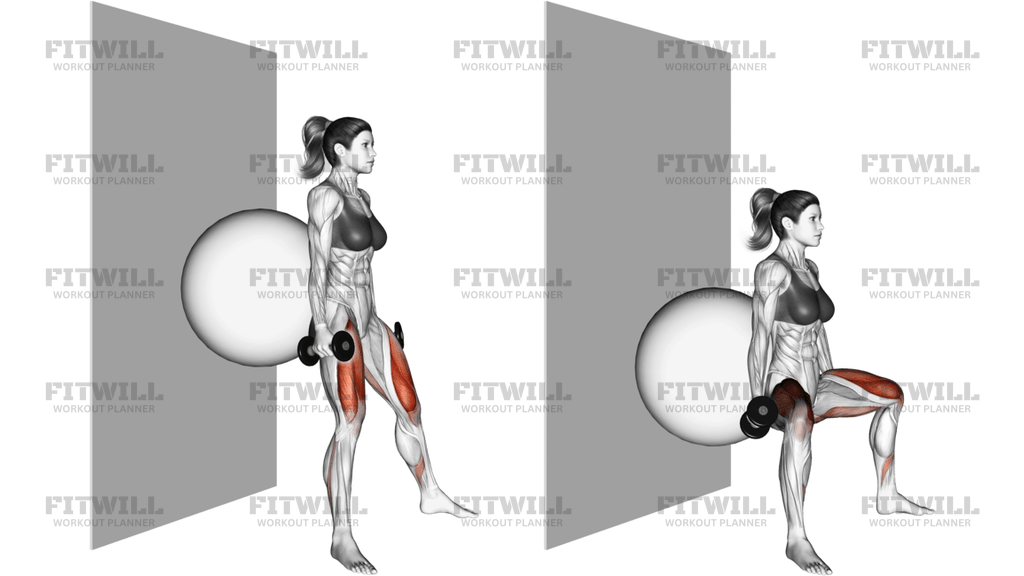
To execute it well, place the inside leg closest to the wall with the ball between that hip and the wall, bend the knee of that same side so the foot lifts off the floor, and press outward through the side of the hip and thigh. Hold the push for a few seconds, breathe steadily, and release the pressure slowly rather than letting the ball shove you back. The standing leg stays soft at the knee, and your hand can rest lightly on your raised knee or a stable surface for balance.
Common use cases include warm-up activation sets, between-set filler during lower body days, and standalone hip-stability circuits. Because the load is self-generated, intensity is controlled by how hard you push and how long you hold, which makes the exercise easy to scale from very gentle to genuinely demanding.
For safety, keep the movement slow and avoid jamming into the ball at full speed. If you feel pinching at the front of the hip, reduce the knee height slightly and keep the press coming from the side of the hip rather than driving the knee straight up. Stop if you feel sharp pain, and note that this exercise complements but does not replace professional assessment if you have an ongoing hip issue.
[ Workout Log & Planner ]
Put your next workout in Fitwill
Keep your plan and training log ready when you are.


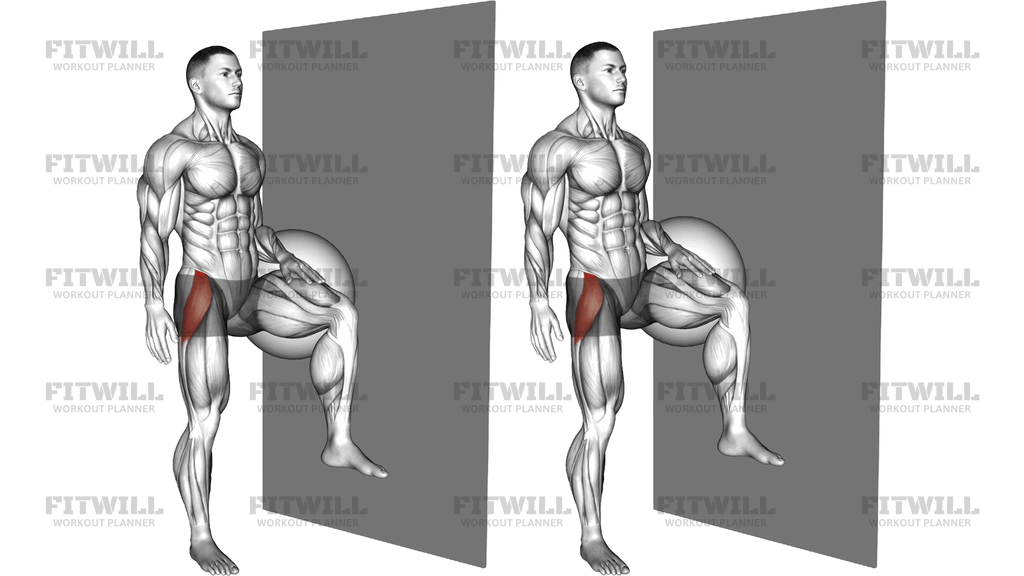
Instructions
- Stand side-on to a clear wall with your feet about hip-width apart and place a stability ball between the wall and the outside of one hip and upper thigh.
- Shift your weight onto the leg farther from the wall so it becomes your standing leg, and keep a soft bend in that knee.
- Bend the knee of the leg closest to the wall and lift that foot off the floor so only the standing leg supports you, resting one hand lightly on your raised knee or a nearby stable surface if you need balance.
- Tighten your trunk and keep your ribs stacked over your pelvis so your torso does not lean toward the wall.
- Press the outside of your hip and thigh outward into the ball, pushing with steady force rather than a quick jab.
- Hold the press for three to five seconds at the effort level you can sustain without your torso twisting or your hips dropping.
- Slowly ease off the pressure, letting the ball stay lightly compressed rather than releasing all contact, then press again for the next repetition.
- Breathe out as you press into the ball and inhale as you ease off, keeping your breathing continuous throughout the set.
- Complete all repetitions on one side, then switch so the ball is against the opposite hip and repeat on the other side.
- Step away from the ball carefully at the end of the set, since it can roll once you release the pressure.
Tips & Tricks
- Check the ball height before your first press: it should contact the outside of the hip and upper thigh, not the ribs or the knee, or the gluteus medius will not be the main driver.
- A frequent mistake is leaning the torso into the wall to fake pressure. Keep a small gap between your ribs and the ball and generate the push purely from the hip.
- If the standing knee keeps drifting inward, think about pressing that foot gently into the floor and spreading the toes, which steadies the stance side.
- Aim for pressure you could hold for a slow five-count. Cranking to maximum force usually recruits the thigh and trunk instead of the outer hip.
- If you feel the work in the front of the hip, lower the raised knee slightly so the lift comes more from the side of the hip than from hip flexion.
- Do not let the raised foot touch down between reps unless you lose balance; if it happens every rep, hold a wall or doorway frame with your free hand until your stability improves.
- Start with shorter holds and more repetitions rather than long maximal pushes, since the gluteus medius responds well to repeated moderate holds.
- Use this before squats, lunges, or single-leg work as a two-set activation, and expect the weaker side to fatigue noticeably faster when you compare sides.
- Softer, less inflated balls make the press easier to feel but harder to hold steady; firmer balls amplify feedback, so adjust inflation to match your control level.
Frequently Asked Questions
Which muscles does the Standing Gluteus Medius Press Against Ball work?
The main muscle is the gluteus medius on the outside of the pressing hip, with support from the tensor fasciae latae and other small hip stabilizers. The standing leg's hip and your trunk muscles also work to keep you upright and level.
Why use a stability ball instead of just pushing against the wall?
The ball gives slightly under pressure, so your hip has to generate and continuously adjust force to hold position. Pushing directly on a hard wall tends to become a stiff brace with less active muscle work.
Is the Standing Gluteus Medius Press Against Ball suitable for beginners?
Yes, it is beginner-friendly because the resistance comes from your own push and there is no external load. Start with light pressure, use a hand on a stable surface for balance, and master the position before increasing force.
How hard should I press into the ball?
Press with moderate, sustainable force, roughly what you could hold for a five-second count with steady breathing. Maximal pushes usually shift effort into the thigh and trunk and reduce the quality of the hip activation.
Why does my standing hip shake or fatigue during this exercise?
Standing on one leg while pressing means the stance-side hip stabilizers are working hard too, so some fatigue there is expected. If shaking is excessive, shorten the holds or lightly touch the raised foot down between repetitions.
Should my knee be bent or straight when pressing the ball?
Keep the knee of the pressing leg bent with the foot lifted, as this frees the hip to push sideways into the ball. A straight leg turns the movement into more of a leg-dominant lean and reduces the gluteus medius focus.
What can I use if I do not have a stability ball?
A soft medicine ball, a cushioned pad, or a rolled towel between your hip and the wall can substitute, though the feedback is less consistent. Resistance band side-steps or wall-press isometrics are also reasonable alternatives.
How many repetitions and sets should I do?
A common starting point is eight to twelve presses of three to five seconds per side for two sets. Adjust the volume based on how quickly the outer hip fatigues rather than chasing a fixed number.
Is it normal to feel this more in one hip than the other?
Yes, side-to-side differences are common because the gluteus medius is often weaker on one side. Note the difference, train both sides equally, and expect the weaker side to improve over consistent weeks of practice.
Can I do the Standing Gluteus Medius Press Against Ball if my hip hurts?
Mild muscle effort is fine, but sharp pain, pinching at the front of the hip, or pain that lingers afterward are signals to stop. Reduce the press intensity and knee height first, and consult a qualified professional if symptoms persist.