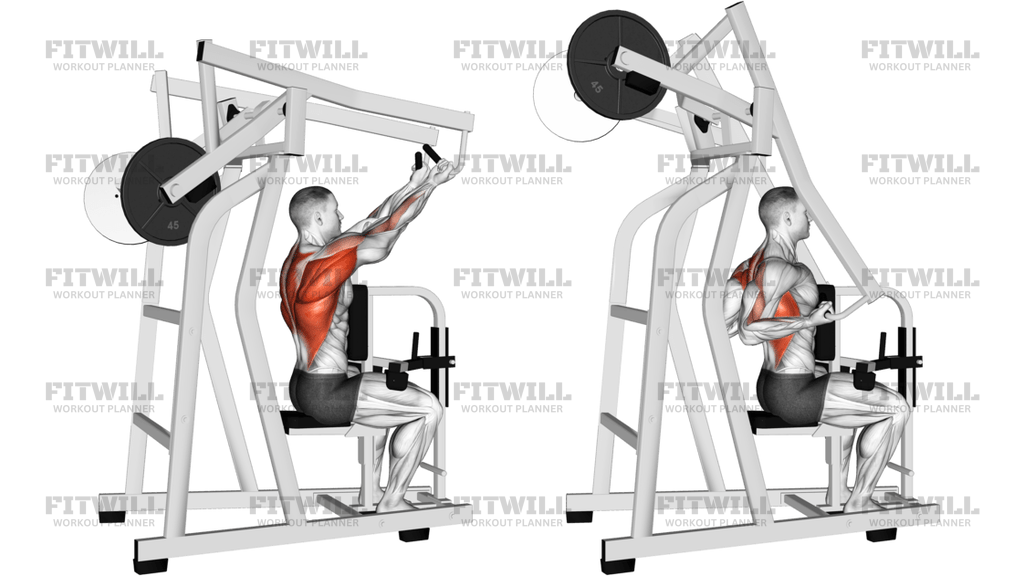
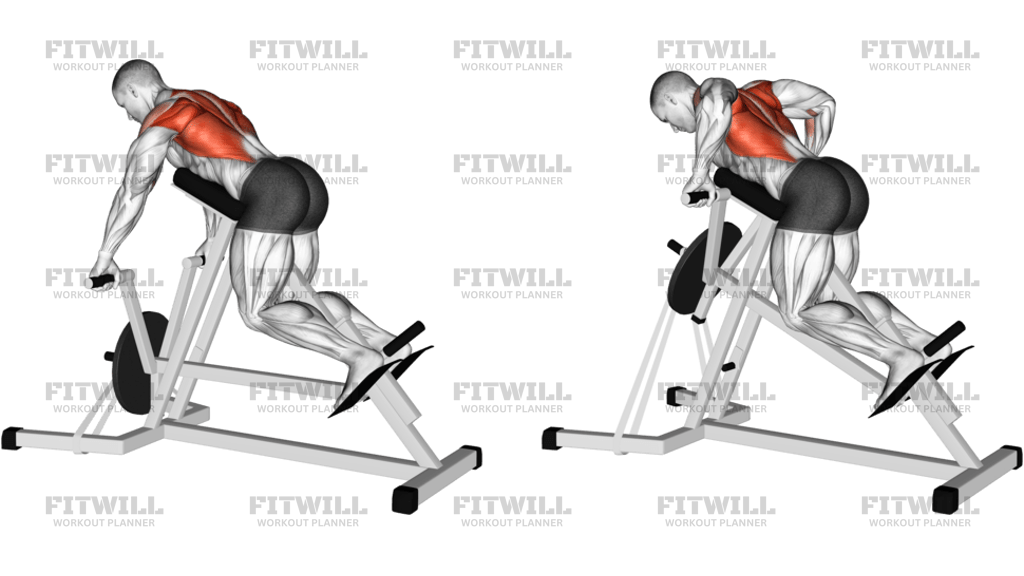
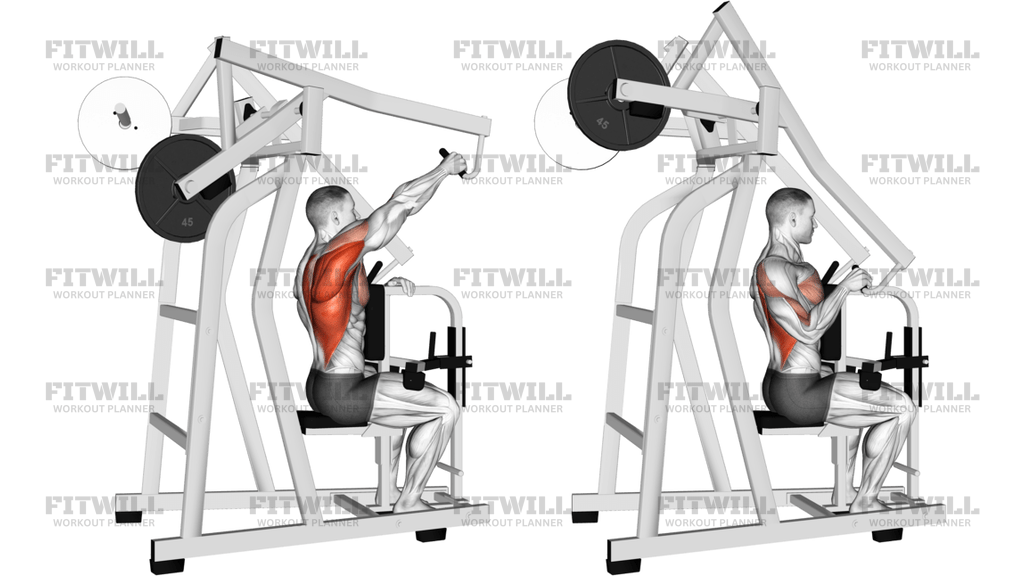
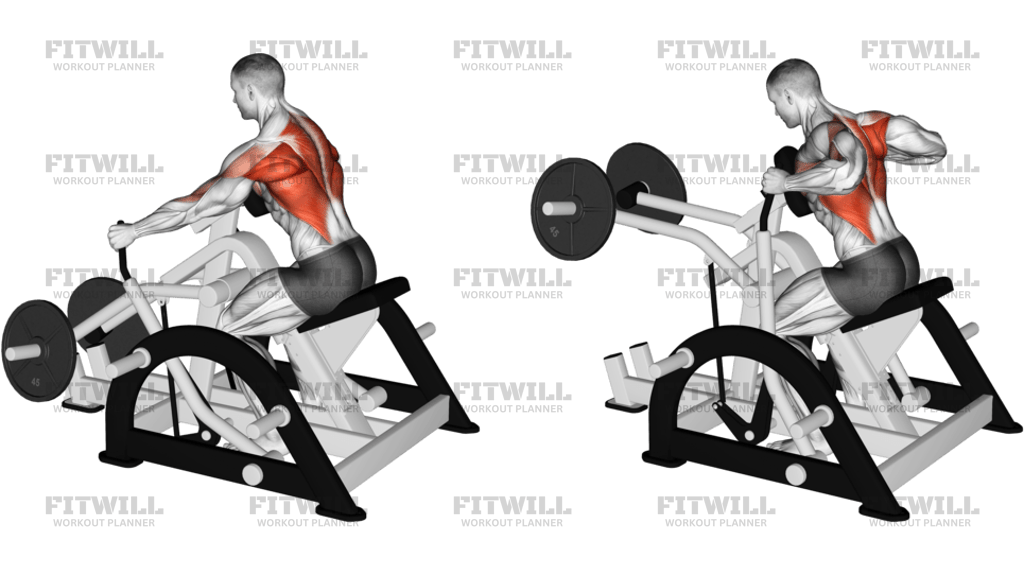
Lever Linear Row
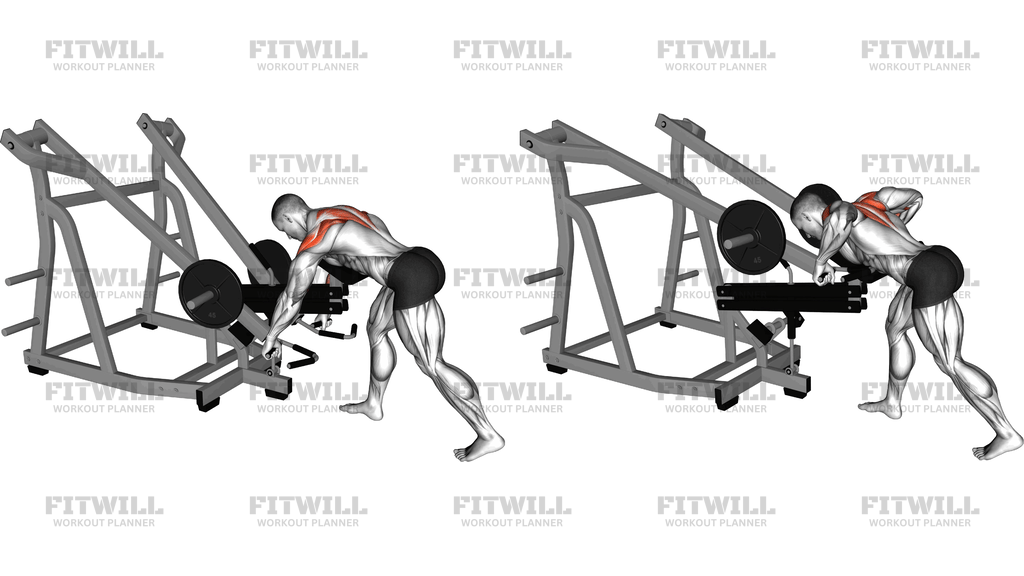
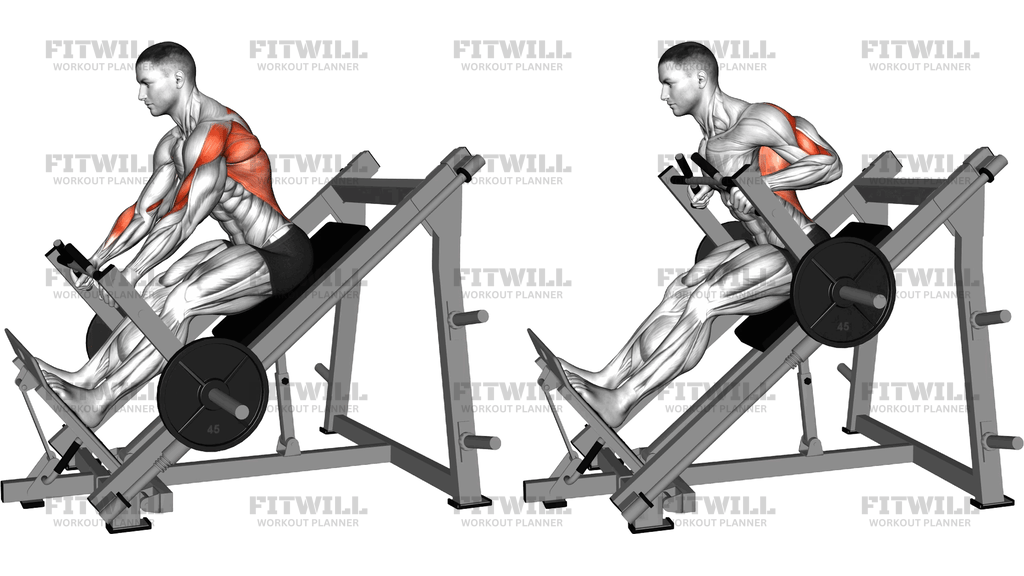
The Lever Linear Row is a plate-loaded machine row performed from an inclined seated position, with the handles moving along a fixed linear path roughly parallel to your thighs. Unlike a cable row, where the resistance comes from a stack via a flexible cable, this machine rides on leverage arms loaded with weight plates, which gives you a smooth, consistent pull with no cable slack or sudden stack drop. The angled seat and foot platforms place your torso slightly forward of vertical, so the pull travels up the diagonal of the machine rather than straight back.
The movement targets the lats as the prime mover, with strong contributions from the rhomboids, mid traps, and rear delts as the shoulder blades retract at the top. The biceps and forearms handle much of the grip and elbow flexion work, which is why you will often feel your arms working harder than expected on heavier sets. Because the machine fixes the path of the pull, stabilizing demand at the spine is lower than in a free-weight bent-over row, making it a solid choice for building back thickness without fatigue from balancing the load.
This exercise suits a wide range of lifters. Beginners appreciate the fixed path and the chest-forward position, which makes it hard to turn the pull into a standing body-english heave. More experienced lifters use it as a heavy secondary row after barbell or dumbbell work, since the leverage arm lets you load substantial weight and push close to failure without a spotter. It is also a practical option for anyone managing lower back fatigue who still wants a loaded horizontal pull.
Setup matters more on this machine than most people assume. Your foot placement on the platforms, seat height, and starting reach all determine whether the pull hits your back or turns into a partial arm row. Sit tall with a slight forward lean from the hips, keep a natural arch in your lower back, and make sure you can reach the handles with a small bend in the elbows at full stretch rather than having to lunge forward for them.
Execution is straightforward once the setup is right: drive the elbows back and down toward your torso, pull the handles to your lower ribs, pause briefly with the shoulder blades drawn together, then let the arms extend under control until the lats are loaded at the stretch. Resist the urge to rush the return, because the eccentric is where a lot of the back-building stimulus lives. Two to four working sets of eight to twelve controlled reps covers most goals, with heavier fives and sixes workable for stronger lifters.
[ Workout Log & Planner ]
Put your next workout in Fitwill
Keep your plan and training log ready when you are.


Instructions
- Sit on the angled seat with your feet planted firmly on the foot platforms and your knees softly bent, not locked out.
- Grip the handles with a neutral palms-facing grip, reaching forward until your arms are nearly straight and your torso leans slightly ahead of your hips.
- Lift your chest, set a natural arch in your lower back, and brace your abdominal wall before the first pull.
- Initiate the row by driving your elbows back and down along the machine's linear track, keeping them close to your ribs.
- Pull the handles in toward your lower torso until your hands reach roughly the level of your hips and your shoulder blades squeeze together.
- Hold the contracted position for a beat, feeling the work in your upper back rather than shrugging your shoulders up.
- Extend your arms slowly along the same path until your elbows are almost straight, letting your shoulder blades spread and your lats load at the stretch.
- Exhale as you pull the handles toward you, and inhale as you release them back to the start.
- Complete your reps with consistent tempo, then let the weight settle fully and reposition your grip and posture before the next set.
Tips & Tricks
- If your shoulders creep up toward your ears as you pull, drop the weight slightly and focus on driving the elbows down first — the shrug means your upper traps are stealing the row from your lats and rhomboids.
- Reaching too far forward at the start rounds your upper back and puts the stretch position entirely in your shoulders. Adjust so your arms are extended but your spine stays neutral when you grip.
- Do not let your chest collapse toward your thighs on the return. Keep the slight forward lean fixed from the hips so the pull stays a row, not a leaning-back heave.
- A common mistake on plate-loaded leverage rows is bouncing out of the stretched position. Touch the end of the range with control, then start the next rep — the pause keeps tension on the lats and protects the shoulder capsule.
- If your forearms and biceps burn out before your back does, try a looser grip and think of the hands as hooks connected to the elbows.
- Keep your knees slightly bent rather than locked on the platforms. Locked knees with a heavy pull shifts your hips out of position on the machine's angled seat.
- Pull the handles to your lower ribs, not your chest. Pulling high turns it into an upright-row pattern and shifts stress to the traps and front shoulders.
- On heavy sets, exhale forcefully through the pull instead of holding your breath the entire stroke, and reset your brace at full arm extension.
- If one side finishes before the other, check that both hands are gripping evenly and neither is drifting up the handle during the set.
Frequently Asked Questions
Which muscles does the Lever Linear Row work the most?
The lats are the primary mover, supported heavily by the rhomboids, mid traps, and rear delts as the shoulder blades retract. The biceps and forearms handle the elbow flexion and gripping throughout the pull.
How is the Lever Linear Row different from a seated cable row?
The lever machine moves the handles along a fixed linear track with plate-loaded resistance, while a cable row uses a stack and allows more path variation. The fixed path reduces the stabilizing demand and makes it easier to keep the pull consistent rep to rep.
Can beginners use the Lever Linear Row?
Yes, it is one of the more beginner-friendly rows because the machine dictates the movement path and the seated position discourages body english. Start with a light load and focus on pulling the handles to the lower ribs rather than muscling the weight with the arms.
Why do I feel this row mostly in my biceps?
That usually means your elbows are staying wide and your grip is death-gripping the handles, letting the arms dominate. Drive the elbows back toward your ribs, loosen your grip, and lighten the load until your lats and upper back are doing the initiating.
Where should I place my feet on the Lever Linear Row?
Plant both feet flat on the foot platforms with your knees softly bent so your torso settles into a stable, slightly forward-leaning position. If your feet are too low or too high, your hips slide out of the seat and the pull angle changes.
Is it safe to go heavy on the Lever Linear Row without a spotter?
Generally yes, since the fixed path and plate-loaded arms mean you cannot be crushed the way you can under a free-weight row. Still, build up gradually and never sacrifice the neutral spine position for extra plates.
How far should I pull the handles on the Lever Linear Row?
Pull them in toward your lower torso, around hip to lower-rib height, until your shoulder blades are fully drawn together. Pulling toward your chest instead turns the movement into more of an upright row and shifts work away from the lats.
What can I substitute if my gym does not have a Lever Linear Row?
A seated cable row, a chest-supported machine row, or a dumbbell row on an incline bench all train the same horizontal pull pattern. Each has a slightly different feel, but the lats and upper back are the common target.
Should I pause at the top of each Lever Linear Row rep?
A short one-second pause with the shoulder blades squeezed is worth it for most lifters, because it prevents momentum from carrying the weight and reinforces full retraction. If your goal is purely heavy loading, a continuous tempo with a controlled return is also fine.