Dumbbell Jm Bench Press
The Dumbbell Jm Bench Press is a hybrid pressing movement that blends a close-grip bench press with a skull crusher. Originally popularized by powerlifter JM Blakley as a barbell exercise for building enormous pressing strength, the dumbbell version keeps the same idea: you lower the weights in a short, elbow-driven arc toward your upper chest, then press back up to lockout. Because each arm works with its own dumbbell, you also have to control the path independently on both sides, which many lifters find makes the movement feel smoother on the elbows than the barbell version.
This lift is first and foremost a triceps builder. The elbows stay relatively close to the torso and the forearms track roughly vertical, so the triceps extend the arms under a continuous load from bottom to top. The chest and front shoulders assist through the middle portion of the press, but the emphasis stays on the back of the upper arm, especially in the last third of the rep as you drive to lockout. If your bench press stalls a few inches off your chest, this is exactly the sticking point the JM press attacks.
Setup matters more here than in a standard dumbbell bench press because the weights travel close to your face and upper chest. Lie back on a flat bench with your feet planted, hold the dumbbells directly over your chest with a neutral or slightly turned grip, and keep your elbows tucked rather than flared wide. A tucked elbow position protects the shoulder joint and forces the triceps to do the work instead of letting the chest take over the lift.
To execute it well, start each rep from full lockout, then bend the elbows and let the dumbbells descend in a controlled arc until they are just above your upper chest or lower neck area, with the elbows angled slightly forward of the torso rather than out to the sides. Pause briefly without bouncing, then press the weights back up along the same path, driving the dumbbells toward the ceiling until your arms are straight and the triceps are fully contracted. The range is shorter than a wide-grip bench press, and that is intentional.
Lifters typically use the Dumbbell Jm Bench Press as an accessory movement after their main pressing work, in the 8 to 15 rep range with moderate weights. It suits anyone who wants bigger arms, a bigger bench, or a pressing variation that hammers the triceps without the wrist and elbow stress that heavy skull crushers can produce. Start lighter than you think you need, because the bottom position places the load directly over the upper chest and the triceps do more work than the movement looks like they should.
[ Workout Log & Planner ]
Put your next workout in Fitwill
Keep your plan and training log ready when you are.


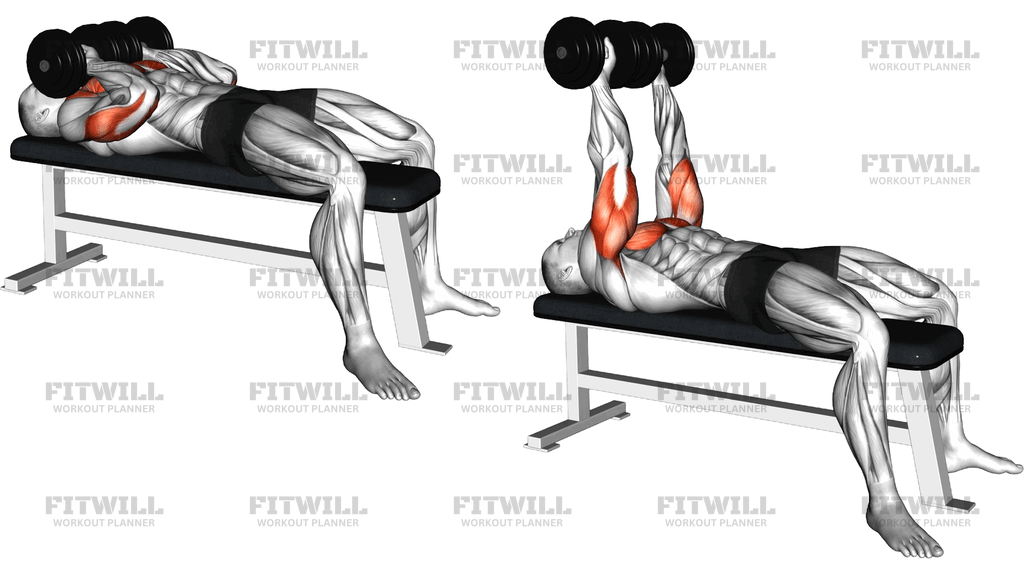
Instructions
- Sit on a flat bench with a dumbbell resting on each thigh, then lie back and kick the weights up so both dumbbells are held directly over your chest with your arms fully extended.
- Use a neutral grip with your palms facing each other, or rotate the palms slightly inward, and pull your shoulder blades down and back against the bench.
- Plant your feet flat on the floor, squeeze your glutes lightly, and brace your core so your torso stays stable on the bench.
- Position your elbows so they are tucked in close to your sides rather than flared out, keeping your forearms roughly vertical under the dumbbells.
- Inhale, then bend your elbows and lower the dumbbells in a controlled arc toward your upper chest, letting the elbows travel slightly down and forward past your torso.
- Stop when the dumbbells are just above your upper chest and your elbows are deeply bent, holding the weights steady for a brief moment without bouncing.
- Exhale and press the dumbbells back up along the same arc, driving them toward the ceiling until your arms reach full lockout and your triceps squeeze hard.
- Keep your wrists straight and stacked over your elbows throughout, and avoid letting the dumbbells drift out over your shoulders mid-rep.
- Complete all reps, then either lower the dumbbells to your chest and sit up, or safely drop them to the floor on each side once your arms are no longer under tension.
Tips & Tricks
- Choose a lighter weight than your close-grip dumbbell press, because the tucked-elbow arc places more of the load on the triceps and less on the chest to assist.
- If your elbows drift outward as you fatigue, cue yourself to press your upper arms gently toward your ribs; flared elbows turn the movement into a standard press and steal work from the triceps.
- Do not let the dumbbells sink toward your throat at the bottom; control the descent so the weights stop above the upper chest, not over your neck or face.
- A short pause at the bottom is more productive than bouncing, since rebounding off the stretched position reduces triceps tension and invites elbow discomfort.
- Keep your wrists neutral and stacked; bending the wrists backward under heavy dumbbells shifts stress to the forearms and weakens your press.
- If the bottoms of the dumbbells collide above your chest at lockout, bring them slightly wider apart instead of letting them clash mid-air.
- Use a spotter or set the dumbbells down to your chest when finishing a hard set rather than dropping heavy weights while your arms are near your head.
- A slight arch in your upper back is fine, but keep your lower back and hips in contact with the bench so the press stays stable and repeatable.
- Try a 2 to 3 second lowering phase on your last set or two; the JM press rewards controlled negatives with noticeably more triceps soreness and growth stimulus.
Frequently Asked Questions
What muscles does the Dumbbell Jm Bench Press work?
The triceps are the primary movers, working through the full range from the stretched bottom position to lockout. The chest and front shoulders assist during the middle of the press, but far less than in a standard dumbbell bench press.
How is the Dumbbell Jm Bench Press different from a close-grip dumbbell press?
In a close-grip press the dumbbells travel straight down over the chest with moderate elbow bend. In the Jm press the elbows stay tucked and travel further down and slightly forward, increasing elbow flexion and shifting more of the load onto the triceps.
How is the Dumbbell Jm Bench Press different from a skull crusher?
A skull crusher moves only at the elbows with the upper arms fixed over the shoulders. The Jm press combines that elbow-driven lowering with a pressing motion back to lockout, which lets you use heavier weights and brings in a small amount of chest help.
Is this exercise suitable for beginners?
Yes, as long as you start light and master the tucked-elbow path before adding load. Beginners should practice the movement with very light dumbbells until the bottom position feels controlled and comfortable.
How heavy should I go on the Dumbbell Jm Bench Press?
Most lifters get the best results with moderate weights in the 8 to 15 rep range, using roughly the weight they could close-grip press for many more reps. Because the triceps handle most of the work, going too heavy usually breaks down the elbow path before the triceps are challenged.
Where exactly should the dumbbells end up at the bottom of the rep?
The dumbbells should finish just above your upper chest near the lower neck area, with your elbows deeply bent and tucked close to your ribs. If the weights drift out over your shoulders or down toward your throat, the path is off.
Why do my elbows hurt when I do the Jm press?
Elbow discomfort usually comes from using too much weight, bouncing out of the bottom, or letting the wrists bend backward. Reduce the load, pause briefly at the bottom, keep your wrists stacked, and warm up your elbows with lighter pressing first.
Can I substitute the Dumbbell Jm Bench Press if I do not have a bench?
You can perform the same elbow-driven press lying on the floor, which also gives a built-in stopping point and is friendlier to the shoulders. The floor version shortens the range slightly, so you may want an extra rep or two per set.
Should I do the Dumbbell Jm Bench Press before or after my main press?
Do it after your primary pressing work. It is an accessory lift that fatigues the triceps quickly, and pre-exhausting them can compromise your heavier bench or overhead pressing.
Do I need a spotter for this exercise?
A spotter is helpful for heavy sets because the dumbbells finish close to your face and upper chest. If you train alone, keep the weights moderate and finish by lowering them to your chest and sitting up rather than dropping them with your arms near your head.