Seated Single Leg Hugging Knee Flexion
Seated Single Leg Hugging Knee Flexion is a bodyweight stretch performed on the floor, where you sit with one leg extended long in front of you and pull the opposite knee in toward your chest with both hands. The knee pull flexes the hip of the bent leg while the straight leg holds the opposite hip in extension, which places a targeted stretch through the front of the extended leg's thigh and hip, along with the glutes of the hugging side. The two-legged position is what makes it useful: each leg does a different job at the same time, so you get two effects from one hold.
This stretch fits well into warm-ups before lower body training, cool-downs after running or cycling, and desk-break routines for anyone who sits for long hours. Cyclists and runners often gravitate to it because the extended-leg position mimics the late push-off phase of a stride, where the hip extends and the rectus femoris crosses both the hip and knee. It is also a common choice in rehab-adjacent settings for regaining hip extension range after long periods of sitting, though it should never be used to push through pain.
Setup matters more than it looks. Sitting tall on your sit bones, rather than slumped behind them, determines whether the straight leg actually receives the stretch or whether your lower back simply rounds and absorbs the movement. Keeping the extended leg's kneecap pointing up and the thigh pressed toward the floor keeps the hip in true extension. If you sit with a rounded back or let the straight leg's knee lift, the stretch leaks into the spine and loses its focus on the hip and thigh.
To execute it well, clasp your hands around the bent knee or just below it and draw it toward your chest without forcing it past the point of comfortable tension. Your torso can lean back very slightly as the knee comes in, but avoid collapsing backward or hiking the hip off the floor. Breathe slowly and let the tension ease with each exhale rather than muscling the knee closer. Hold for twenty to forty seconds, then switch sides so both hips receive the same work.
Because it needs no equipment beyond floor space, this movement travels well — it works on a mat at home, in a hotel room, or on the grass after an outdoor session. Its main safety consideration is the extended knee: keep a soft, unlocked knee rather than jamming it straight back into the floor, and reduce the pull intensity if you feel any pinching at the front of the hip or strain in the lower back.
[ Workout Log & Planner ]
Put your next workout in Fitwill
Keep your plan and training log ready when you are.


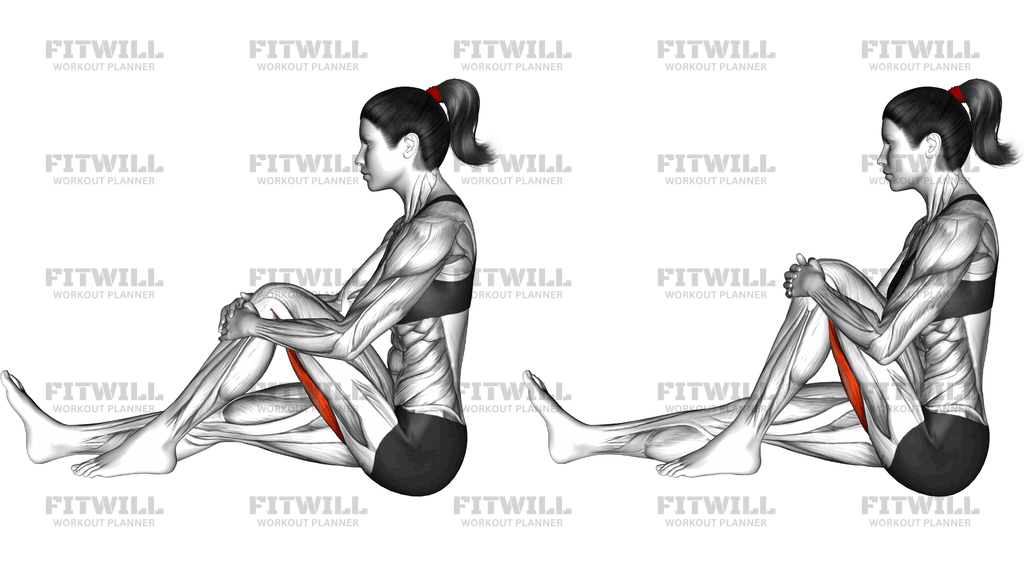
Instructions
- Sit on a mat or firm floor with both legs extended in front of you and your hands resting on the floor beside your hips.
- Bend your right knee and draw your right foot in toward your groin, then reach down and clasp both hands around the right knee or shin just below the kneecap.
- Sit up tall on your sit bones so your spine is long, and press the back of your left thigh toward the floor with the left kneecap pointing at the ceiling.
- Gently pull the right knee toward your chest until you feel a clear stretch along the front of the left thigh and hip, and through the right glute.
- Keep your shoulders relaxed and away from your ears as you hold the knee in; avoid shrugging or rounding your upper back over the leg.
- Hold the position for twenty to forty seconds, breathing slowly and letting the knee drift a little closer with each exhale.
- Release the clasp with control and lower the right leg back to the extended position without letting it drop.
- Reset your sitting posture, then repeat the same sequence on the left side.
- Complete one to two holds per side, and finish with both legs extended for a few breaths to even out.
Tips & Tricks
- If your lower back rounds the moment you pull the knee in, place a folded towel or low cushion under your sit bones — elevating the hips makes it far easier to keep the straight leg honest.
- The most common mistake is letting the extended leg's knee bend or the heel slide around; wedge the heel lightly against the floor and keep that kneecap facing up so the front-of-thigh stretch stays where it belongs.
- Pull the knee from below the joint rather than pressing down on the kneecap itself — hugging the shin or back of the thigh protects the knee.
- Do not yank the knee to your chest in one fast motion; the point of the hold is a sustained position, and a slow draw-in keeps the hip from guarding against the stretch.
- If you feel a pinch at the front of the bent hip, angle the knee slightly outward toward the same-side shoulder instead of pulling it straight up.
- Keep a small bend in the extended knee if the back of your thigh or the knee joint complains — the target of this stretch is the hip and front of the thigh, not the hamstring.
- Avoid hiking the bent-side hip off the floor; check that both sit bones stay in contact with the mat throughout the hold.
- Doing this stretch right after a long car ride or workday is where it earns its keep, since the extended-leg position directly counteracts hours of seated hip flexion.
- Exhale as you draw the knee in and breathe steadily during the hold — holding your breath tends to tighten the very muscles you are trying to lengthen.
Frequently Asked Questions
Which muscles does Seated Single Leg Hugging Knee Flexion stretch?
The straight leg receives the main stretch through the rectus femoris and hip flexors at the front of the thigh and hip, while the hugging side stretches the glutes. Some people also feel it lightly in the lower back, which is fine as long as it is not painful.
Why does one leg stay straight during Seated Single Leg Hugging Knee Flexion?
The straight leg holds that hip in extension, which is what lengthens the front-of-thigh and hip muscles. If both knees were pulled in, the front of the thigh would never be placed under stretch.
Is Seated Single Leg Hugging Knee Flexion suitable for beginners?
Yes, it requires no equipment and the intensity is fully self-controlled by how hard you pull the knee in. Beginners should start with a modest pull and a shorter hold of about fifteen to twenty seconds per side.
Should I sit on the floor directly or use a mat or cushion?
A mat makes the floor position comfortable, and sitting on a thin cushion helps if your hips are tight and your back rounds during the hold. Raising the sit bones slightly makes it easier to keep the spine tall and the straight leg flat.
How long should I hold Seated Single Leg Hugging Knee Flexion?
Twenty to forty seconds per side works well for most people, repeated once or twice. If you are using it after training, longer holds toward the forty-second end tend to feel more productive.
What is the most common mistake in this stretch?
Rounding the lower back and slumping behind the sit bones, which shifts the stretch away from the hips and into the spine. Sit tall first, then pull the knee in, and reset your posture if you notice yourself collapsing.
Can I do Seated Single Leg Hugging Knee Flexion if my knees are sensitive?
Yes, but clasp your hands around the shin or back of the thigh instead of pressing on the kneecap, and keep the pull gentle. If the bent knee itself complains, reduce the depth of the draw-in toward your chest.
What can I substitute if sitting on the floor is uncomfortable?
A standing version works similarly: hold onto something stable, stand tall, and pull one knee to your chest while keeping the standing leg's hip extended. The floor version gives a more secure base, but the standing alternative is a fair swap.
Should I feel the stretch in the leg I am hugging or the straight leg?
You will typically feel the front-of-thigh stretch in the straight leg and a glute stretch in the bent leg you are pulling in. If you feel nothing on the straight-leg side, press that thigh more actively toward the floor.
When is the best time to use this stretch in a workout?
It fits well as a cool-down after running, cycling, or lower body training, and also as a mobility break after long sitting. Before heavy training, keep the holds shorter and gentler so the muscles are not overly relaxed.