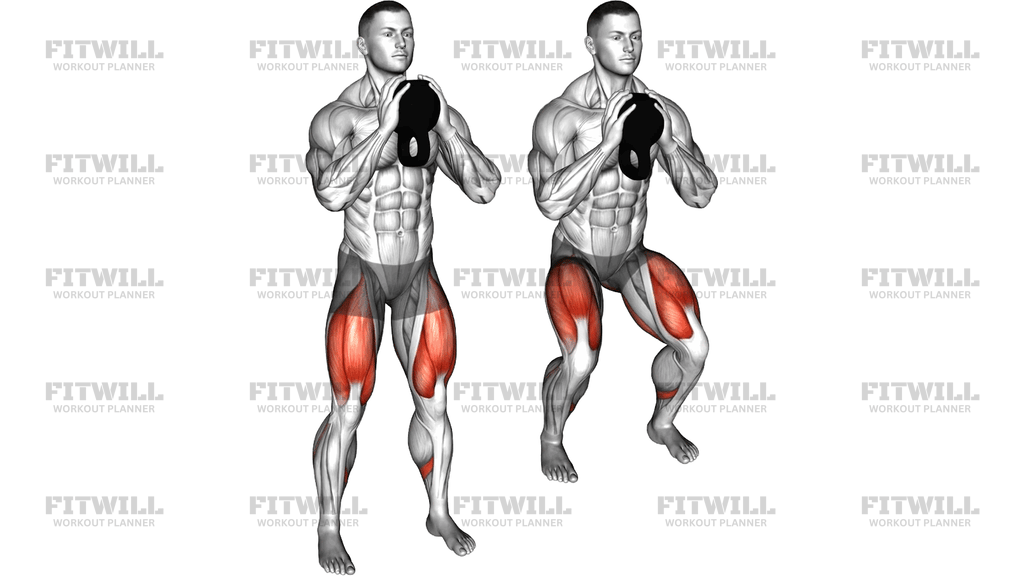
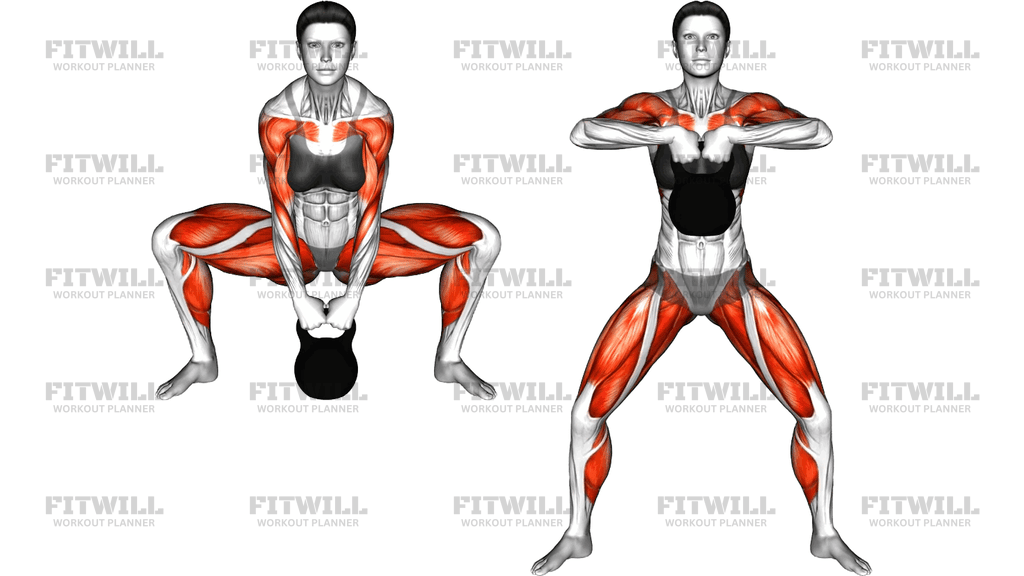
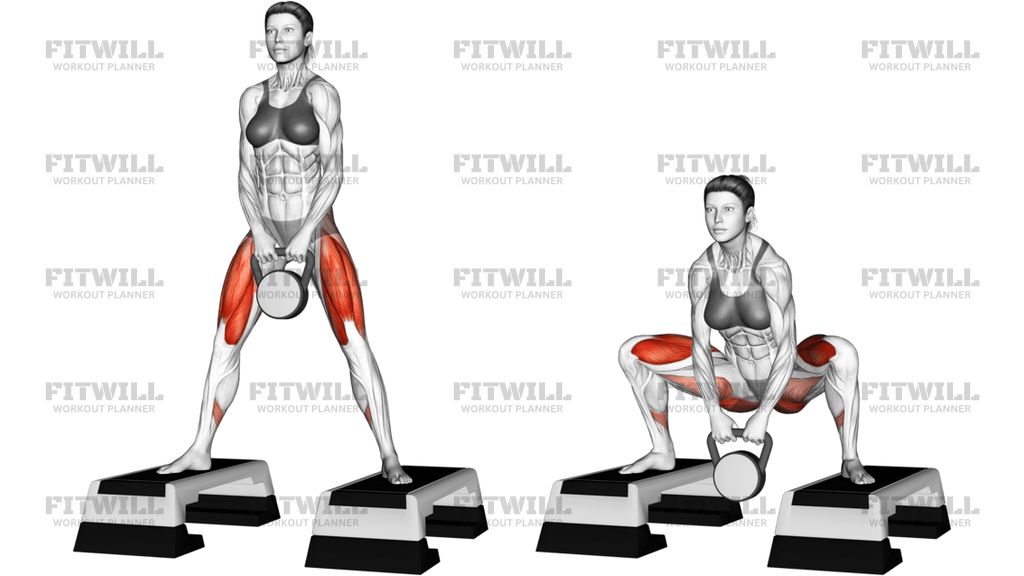
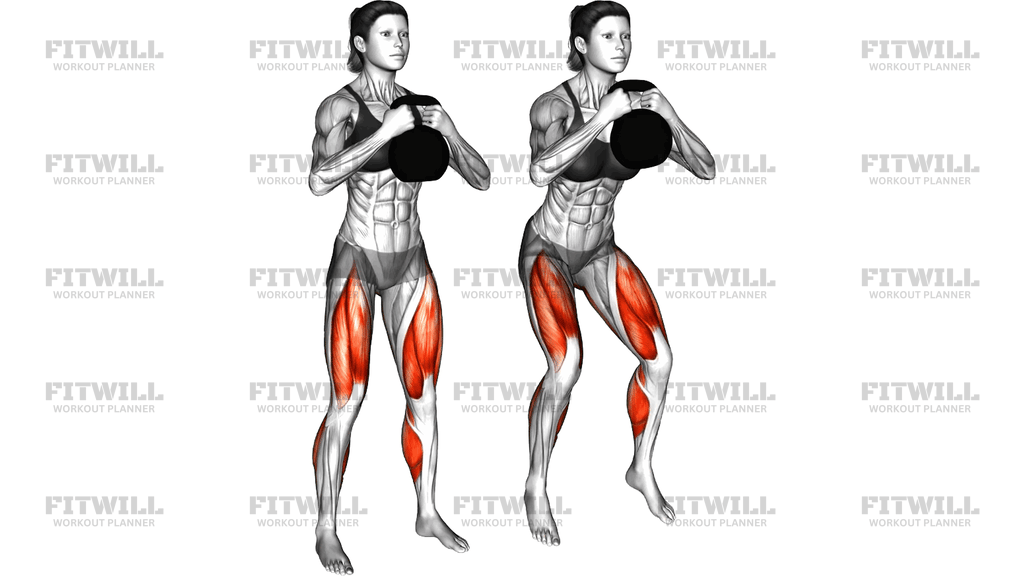
Kettlebell Step Up (Version 2)
The Kettlebell Step Up (Version 2) is a single-leg strength exercise performed by stepping onto a flat bench or sturdy platform while holding a kettlebell in each hand at your sides. Unlike bodyweight step-ups, loading each hand with a kettlebell lets you scale the challenge precisely without putting a bar on your spine, which makes it one of the most accessible ways to build serious unilateral leg strength. In the working position shown, the lifter stands fully upright on top of the bench with hips and knees locked out tall, then controls the descent back to the floor with the same leg.
This movement is highly useful for anyone who wants to fix side-to-side strength imbalances, since each leg has to do the full job of lifting and lowering your bodyweight plus the kettlebells. It transfers well to hiking, climbing stairs, running, and squatting or lunging patterns, and it is a staple in rehab-to-performance progressions because the step height can be adjusted to match your current hip and knee range.
The primary muscles worked are the quadriceps of the stepping leg, which extend the knee to raise you onto the bench. The glutes and hamstrings drive the hip extension at the top, while the calves and ankle stabilizers keep you balanced on an elevated, slightly narrow surface. Holding kettlebells also quietly trains your grip and forearms, and your core works the entire time to keep your torso from leaning or twisting as you step.
Setup matters more than people expect. Choose a bench height that lets you place your whole foot flat on the surface with your knee at roughly hip height or a little below — if you have to hop or drag your trailing leg up, the bench is too high. Stand facing the bench with a kettlebell in each hand, arms hanging straight down, shoulders back, and your weight stacked over the stepping leg before you ever leave the floor.
To execute well, shift your weight fully onto the working leg, drive through the whole foot — especially the mid-foot and heel — and stand up onto the bench until your hips and knees are fully extended. Avoid pushing off the trailing leg; it should just travel along for the ride. At the top, pause briefly and own the balance before lowering slowly and under control, letting the same working leg absorb the descent until your trailing foot touches the floor.
The Kettlebell Step Up (Version 2) fits neatly into lower-body strength days as a main unilateral lift, into conditioning circuits at lighter loads for higher reps, and into warm-ups as a groove-and-balance drill with light bells. Keep the reps honest: if your form breaks down — torso collapsing, foot slipping, or the trailing leg stealing the work — drop the weight or the bench height before adding reps.
[ Workout Log & Planner ]
Put your next workout in Fitwill
Keep your plan and training log ready when you are.


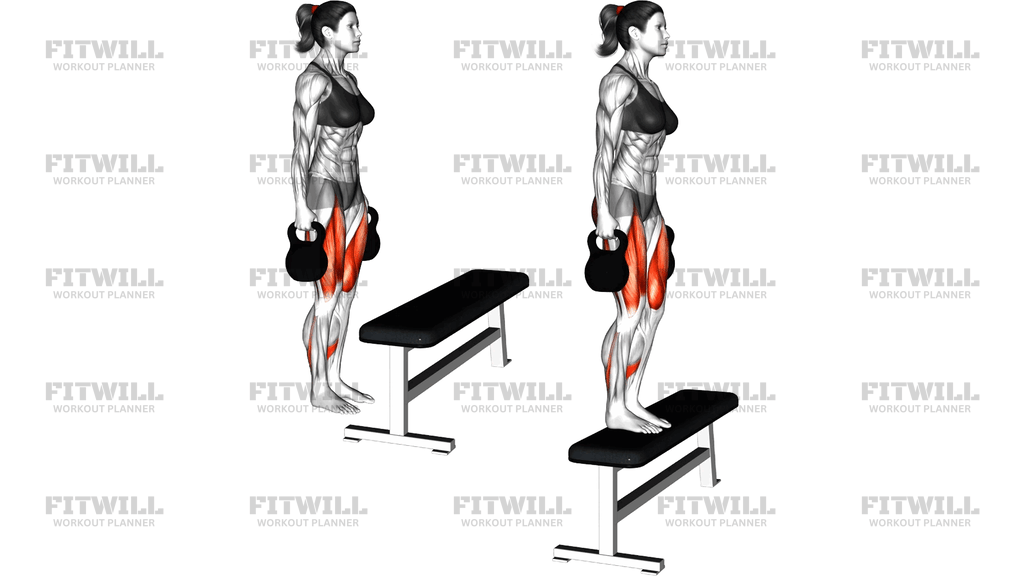
Instructions
- Place a flat bench in front of you and stand facing it, tall with your feet about hip-width apart.
- Grip a kettlebell by the handle in each hand and let your arms hang straight down at your sides, palms facing your thighs.
- Set your core by bracing your abs and pulling your shoulders back and down so the kettlebells stay close to your body.
- Place your entire right foot flat on top of the bench, with your knee tracking over or slightly outside your toes.
- Shift your weight fully onto the right leg and drive through your mid-foot and heel to straighten the knee and hip.
- Stand fully upright on the bench with your left foot lifted beside or slightly behind you, and pause for a beat at the top.
- Lower yourself slowly by bending the right knee and hip, controlling the descent until your left toes touch the floor.
- Exhale as you drive up, and inhale as you lower back down under control.
- Complete all reps on one leg, then switch so your left foot leads and your right leg trails.
- Set the kettlebells down before stepping off the bench — never hop down while holding weight.
Tips & Tricks
- If your trailing leg keeps pushing off the floor, the load is too heavy or the bench too high — the working leg should do all of the lifting.
- Keep the kettlebells hanging still at your sides; swinging them forward turns this into a balance fight instead of a leg exercise.
- Look at a fixed point on the wall ahead rather than down at the bench — dropping your head tends to round your upper back under load.
- Place your whole foot on the bench, not just the ball of your foot; toes-only contact is a sign the bench is too tall for you.
- The lowering phase should take about twice as long as the step up — if you plop back down, your quad control is not ready for that weight.
- Keep your knee stacked over your ankle on the bench; if the knee dives inward, consciously press it out over your little toe as you drive up.
- Your torso will lean forward slightly as you load the step, but if your chest collapses toward your thigh, lighten the kettlebells and re-brace.
- Stay tall at the top for a full second before descending — this trains the glute lockout and the ankle balance at the same time.
- Anchor the bench against a wall or rack if it slides on smooth flooring; a moving bench is the fastest way to lose a step mid-rep.
Frequently Asked Questions
What muscles does the Kettlebell Step Up (Version 2) work?
The quadriceps of the stepping leg do most of the work, with strong support from the glutes and hamstrings as you stand tall on the bench. Your calves, ankle stabilizers, grip, and core also work to keep you balanced while holding two kettlebells.
Is the Kettlebell Step Up (Version 2) good for beginners?
Yes, it is one of the friendliest weighted leg exercises to learn because you can start with a low bench and light kettlebells, or no weight at all. Master the bodyweight version first so the balance and knee position feel automatic before adding load.
How high should the bench be for the Kettlebell Step Up (Version 2)?
Pick a height where your whole foot sits flat on the bench and your knee bends to roughly hip height or slightly lower. If you have to rise onto your toes, lean far forward, or hop to get up, the bench is too high for your current mobility.
Should I step down or jump down from the bench?
Always step down slowly with control while holding the kettlebells. Jumping off an elevated surface with loaded hands hammers your knees and ankles and usually means the descent — where a lot of the strength benefit lives — is being skipped entirely.
Why does my trailing leg want to push off the floor during the Kettlebell Step Up (Version 2)?
That usually means the working leg cannot handle the full load yet. Reduce the kettlebell weight, lower the bench, or slow the tempo so the stepping leg does all the lifting and the trailing foot only balances and returns to the floor.
What can I use instead of a flat bench?
Any stable platform around the same height works — a sturdy box, a low plyo box, or solid stairs. Avoid anything wobbly or wheeled, because the Kettlebell Step Up (Version 2) puts all your weight on one foot on top of it.
How do I keep the kettlebells from pulling me off balance?
Keep your arms fully straight and the bells hanging right beside your thighs, and brace your core so your torso does not sway. If the bells swing or drift forward, you are likely rushing the rep or bending at the elbows.
How many reps and sets should I do of the Kettlebell Step Up (Version 2)?
For strength, work in the range of 6 to 10 controlled reps per leg for 3 to 4 sets with a challenging weight. For endurance or conditioning circuits, use lighter bells for 12 to 15 reps per leg, keeping the same strict step-and-lower technique.
Is the Kettlebell Step Up (Version 2) safe for my knees?
When the bench height matches your mobility and you keep your whole foot planted with the knee tracking over the foot, it is a knee-friendly way to build leg strength. If you feel sharp knee pain rather than muscle effort, lower the step height, reduce the load, and check your foot placement before continuing.