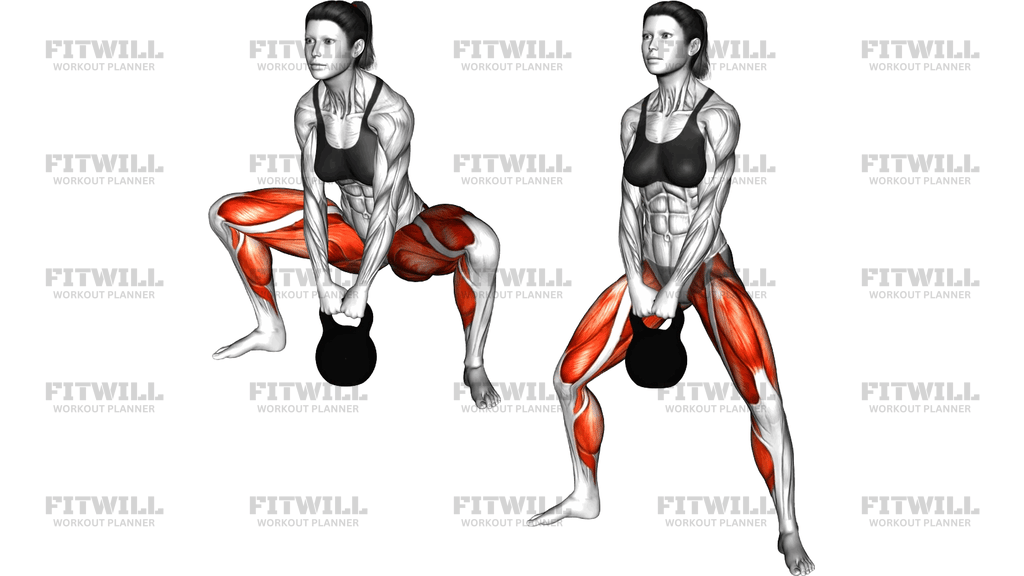
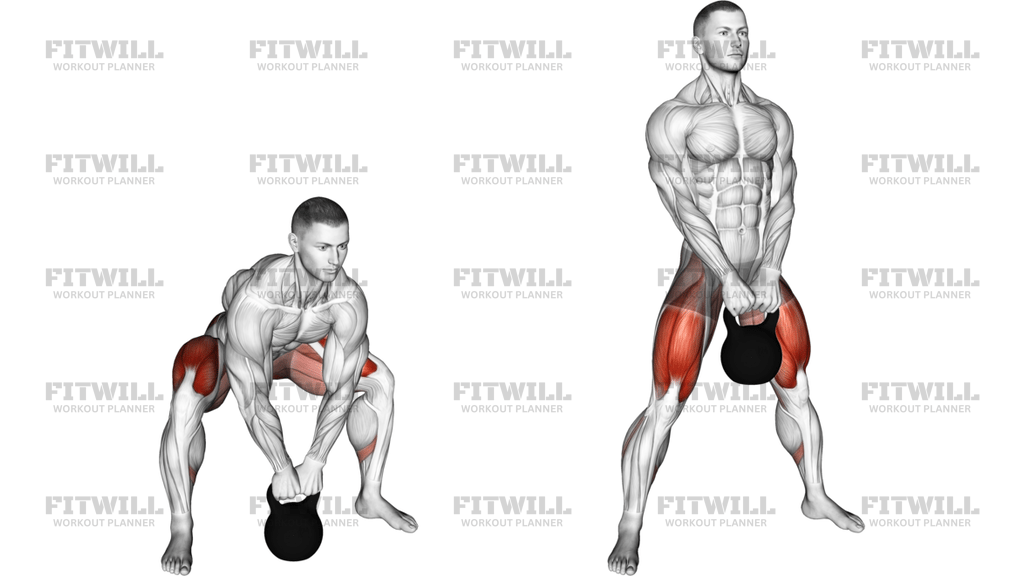
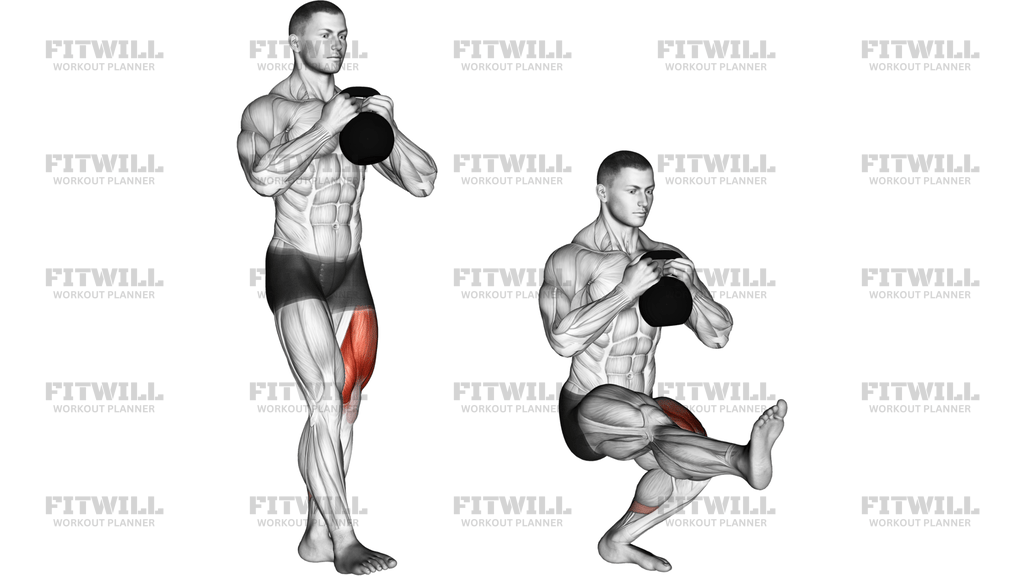
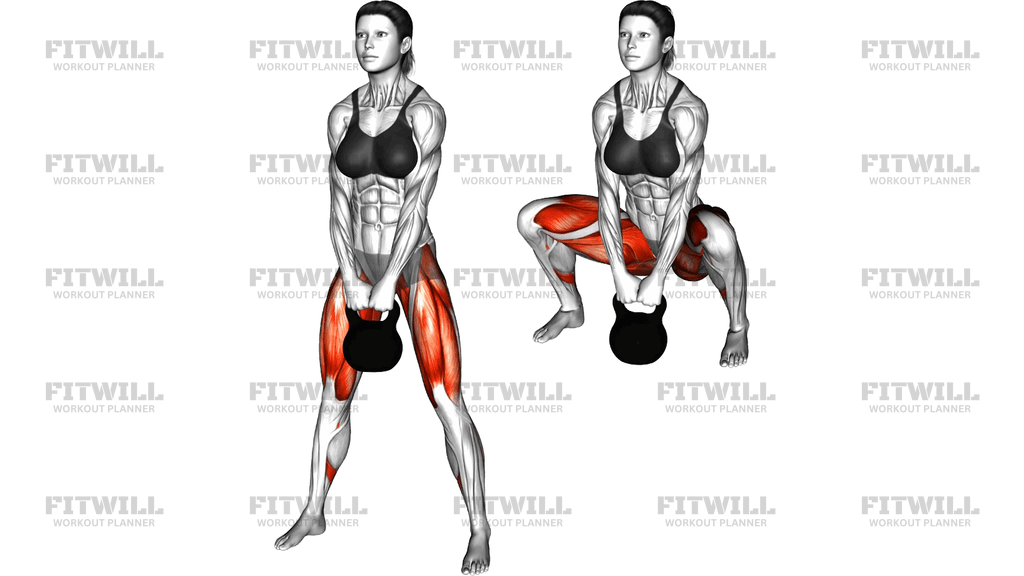
Kettlebell Wide Squat
The Kettlebell Wide Squat is a lower-body strength exercise performed with a wide stance and a single kettlebell held by both hands, letting it hang down between your legs. The broad foot position shifts more of the workload toward the inner thighs and quads while still heavily recruiting the glutes, which makes it a useful variation when you want to target the adductors along with the rest of the legs.
This movement suits lifters of most experience levels because the hanging kettlebell sits low and close to your center of mass, which keeps the squat stable and easy to balance. Beginners can use it to learn a deep, upright squat pattern without a bar on their back, while more experienced lifters can load it heavier or use it as a high-rep finisher for the legs.
Compared with a narrow-stance squat, the wide setup forces your knees to track outward over your toes and demands more from the hip external rotators and adductors. The weight hanging between your legs also pulls you into a slight forward lean, so your core and mid-back work isometrically to keep your chest up and spine neutral from top to bottom.
Setup matters more than people expect. Your stance should be noticeably wider than shoulder width, toes turned out comfortably, and the kettlebell should hang freely without touching the floor at the bottom. If your stance is too narrow, your knees will cave inward and the adductor emphasis disappears; too wide, and your hips may run out of range before your legs are fully worked.
To execute it well, sit straight down between your hips rather than pushing them far back, keep your chest tall, and drive your knees out in the same direction as your toes as you descend. At the bottom, your thighs should reach at least parallel if your mobility allows, then push the floor away and stand tall without letting your knees drift inward on the way up.
Common uses include warm-up loading for squat days, accessory work after barbell squats, or standalone leg training at home with a single kettlebell. Keep the weight honest: if you have to round your lower back or bounce out of the bottom to finish a rep, drop to a lighter bell and rebuild the pattern first.
[ Workout Log & Planner ]
Put your next workout in Fitwill
Keep your plan and training log ready when you are.


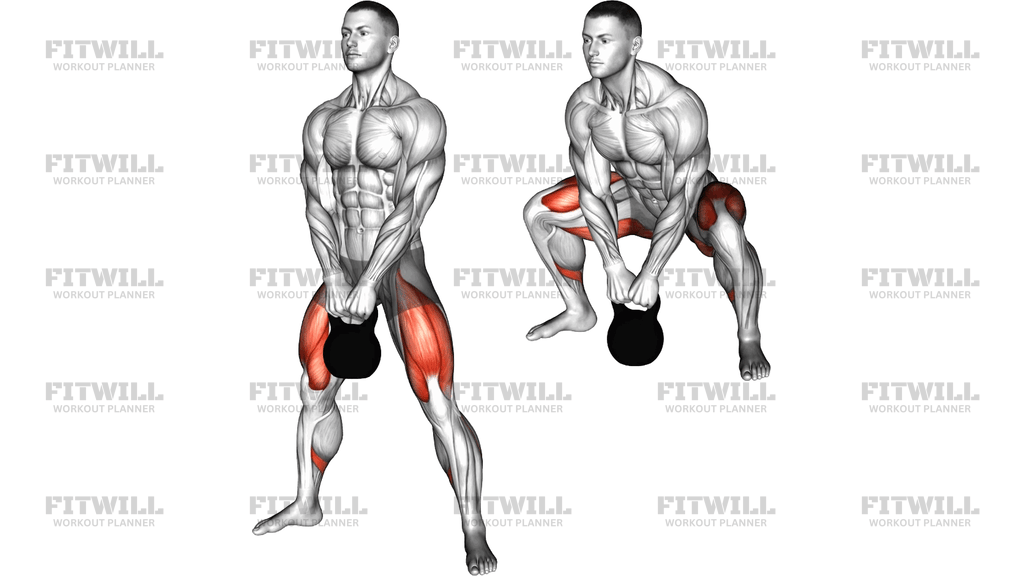
Instructions
- Place a kettlebell on the floor between your feet and set your stance roughly one and a half shoulder widths apart, with toes turned out about 30 to 45 degrees.
- Grip the kettlebell handle with both hands, one hand over the other or side by side, and let your arms hang straight down so the bell dangles between your legs.
- Lift your chest, pull your shoulders back gently, and brace your core as if preparing for a light punch to the stomach.
- Inhale, then bend your knees and sit straight down between your hips, letting the kettlebell travel down with your arms without swinging it.
- Push your knees outward so they track over your toes, and keep your weight spread evenly across your whole foot.
- Descend until your thighs reach at least parallel with the floor, or as deep as you can go while keeping your heels down and your spine neutral.
- Exhale and drive through the floor to stand up, squeezing your glutes at the top without locking your knees hard.
- Keep the kettlebell hanging quietly between your legs throughout the set; avoid swinging or rowing it upward with your arms.
- At the end of the set, lower the bell under control, set it on the floor between your feet, and release your grip before stepping away.
Tips & Tricks
- If your knees collapse inward as you fatigue, consciously drive them toward your pinky toes on every rep, or reduce the depth until you can control the knee path.
- Heels lifting off the floor usually means the stance is too narrow or ankle mobility is limited; widen your feet slightly or place a thin pair of flat shoes with no heel lift to feel the difference.
- Let the kettlebell hang with dead arms. If you find yourself curling or rowing the bell to help yourself up, the legs are unloading and the weight is likely too heavy.
- Keep your torso angle consistent from bottom to top. Excessively leaning forward and standing up chest-first turns the rep into a goodmorning and stresses the lower back.
- Sit down between your hips, not back behind your heels. This is a wide squat, not a wide hip hinge, and the kettlebell hanging low encourages a vertical drop.
- Breathe in on the way down and out on the drive up. Holding your breath for multiple reps in a row will make you dizzy on higher-rep sets.
- If the kettlebell taps the floor at the bottom, use a smaller bell, shorten the depth slightly, or check that you are not lowering it by bending your arms.
- Turn your toes out only as far as your hips allow comfortably. Forcing an extreme external rotation strains the knees and reduces how deep you can sit.
Frequently Asked Questions
Which muscles does the Kettlebell Wide Squat work the most?
The quads and glutes do the majority of the work, with the inner thighs (adductors) taking on extra load because of the wide stance. Your core, upper back, and grip work isometrically to hold the hanging kettlebell and keep your posture tall.
How is the Kettlebell Wide Squat different from a regular kettlebell squat?
The stance is much wider with the toes turned out, which shifts emphasis toward the adductors and hips and allows many lifters to sit deeper with an upright torso. The kettlebell also hangs between the legs rather than being held at the chest.
Is the Kettlebell Wide Squat good for beginners?
Yes, it is one of the friendliest loaded squat variations because the low, centered weight is easy to balance and teaches an upright, deep squat position. Start with a light bell and prioritize depth and knee tracking before adding load.
How heavy should the kettlebell be for this exercise?
Choose a weight you can lower smoothly to parallel and stand back up from without your heels lifting, knees caving, or lower back rounding. Because the legs are strong, most lifters quickly outgrow light bells and benefit from a moderately challenging load in the 8 to 15 rep range.
Why does my lower back round at the bottom of the Kettlebell Wide Squat?
This usually happens when the depth exceeds your current hip or ankle mobility, or when the weight is being lowered by bending forward instead of sitting down. Cut the depth to where your spine stays neutral and work on hip mobility separately.
Can I do the Kettlebell Wide Squat if I have knee discomfort?
The wide stance is often more comfortable than narrow-stance squatting because it gives the hips room to descend, but you should still keep the depth pain-free and never force the knees inward. If discomfort persists, consult a qualified professional before continuing.
Should my arms do anything during the movement?
No, keep your arms straight and relaxed so the kettlebell simply hangs between your legs. Actively swinging or pulling the bell turns it into a different exercise and steals work from the legs.
What can I use instead of a kettlebell for the Kettlebell Wide Squat?
A single dumbbell held vertically by one end works almost identically when hung between the legs. A weight plate hugged to the chest in a wide stance is another reasonable substitute, though the load sits higher and changes the balance slightly.
How deep should I squat in the Kettlebell Wide Squat?
Aim for thighs at or just below parallel as long as your heels stay planted and your back stays neutral. Depth that forces your pelvis to tuck under reduces the leg benefit and shifts stress to the lower back.
How many sets and reps should I do?
For strength, work in 4 to 6 reps with a heavier bell; for muscle and conditioning, 3 to 4 sets of 10 to 15 reps works well. It also makes an effective finisher when performed as one long, controlled set with a light weight.