Dumbbell Single Arm Shrug
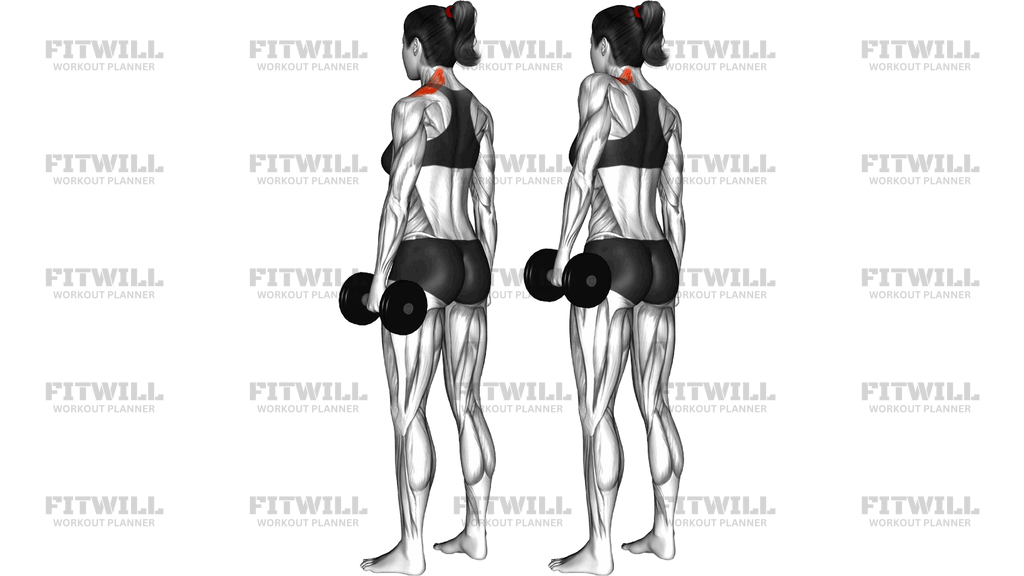
The Dumbbell Single Arm Shrug is a standing upper-back exercise performed by shrugging one shoulder straight up toward the ear while holding a single dumbbell at your side. Because only one side works at a time, the load travels through just half of your body, which makes the upper trapezius on the working side do the lifting while your core and lower back quietly handle the asymmetry. The highlighted area at the base of the neck and along the top of the shoulder is exactly where you should feel this move.
This unilateral setup is the main reason to choose it over a two-dumbbell shrug. If one trap is noticeably weaker or less developed than the other, the strong side can no longer take over, so the weaker side gets honest work. It is also useful for people who feel awkward or cramped shrugging with both arms at once, and for lifters whose grip gives out early on barbell or double-dumbbell shrugs, since a single dumbbell is easier to hang onto for a full set.
The movement itself is simple, but the details matter. Your torso should stay tall and level throughout — the most common breakdown is a sideways lean away from the working arm as the shoulder rises. The dumbbell hangs at arm's length beside your thigh, and the shoulder travels vertically toward the ear. No rolling, no swinging, no bending the elbow to turn it into a partial upright row. A brief pause at the top, where the shoulder nearly touches the ear, is what separates a productive rep from a quick bounce.
Beyond building the upper traps, the exercise trains grip strength and shoulder-girdle control. Carrying a heavy dumbbell for the length of a set forces the forearm flexors to hold on, and keeping the torso square against a one-sided load engages the obliques and quadratus lumborum as stabilizers. For anyone who carries bags, backpacks, or children on one side, or who sits at a desk with rounded shoulders, directly strengthening the muscles that elevate and control the shoulder blades has clear everyday carryover.
Keep the weight honest. A shrug is a short-range movement, so it is tempting to load up and yank the dumbbell up with momentum, but that shifts work away from the trap and toward the spine and elbow. Choose a dumbbell you can lift cleanly for your target reps, move the shoulder straight up and lower it under control, and let the muscle — not momentum — do the work. If you feel it more in your neck than the top of your shoulder, the weight is likely too heavy or your head is drifting toward the working side.
[ Workout Log & Planner ]
Put your next workout in Fitwill
Keep your plan and training log ready when you are.


Instructions
- Stand with your feet about hip-width apart, holding one dumbbell in your right hand with a neutral grip, palm facing your body.
- Let the dumbbell hang at full arm's length beside your thigh and set your feet so your weight is even across the whole foot.
- Pull your shoulder blade down and back slightly to establish a tall posture, then brace your core to keep your torso from tilting.
- Keep your left arm relaxed at your side or lightly holding something sturdy for balance if needed.
- Exhale and shrug your right shoulder straight up toward your right ear, keeping the arm straight and the elbow unlocked.
- Pause for a beat at the top with the shoulder lifted as high as it will go without rolling backward or forward.
- Inhale and lower the dumbbell under control until your shoulder returns to its relaxed starting height.
- Complete all reps on the right side, then switch the dumbbell to your left hand and match the reps.
- Set the dumbbell down between sides if your grip is fading rather than letting your form slide on the second side.
- Keep your head facing forward and level throughout — do not tilt it toward the rising shoulder.
Tips & Tricks
- If your torso tips sideways away from the dumbbell as you shrug, lighten the load; the lean means the weight is pulling you out of position instead of the trap lifting it.
- Resist the urge to roll your shoulders in circles — the trap works through a straight vertical path, and rolling just adds neck strain with no extra muscle work.
- Think 'ear to shoulder' rather than 'dumbbell up' — focusing on the shoulder rising toward the ear keeps the effort in the trapezius instead of the biceps.
- Keep a small bend in the elbow, but do not curl the dumbbell; if the elbow bends noticeably during the rep, the arm is doing work that belongs to the shoulder.
- Use a brief pause at the top of each rep instead of bouncing; shrugs have a short range, and the pause is what keeps the trap under tension.
- If your grip fails before your trap does, use a dumbbell with a thicker comfortable handle you can hold loosely, or use lifting straps — just note that this removes some forearm and grip work.
- Breathe out on the shrug and in on the lowering phase; holding your breath while loaded on one side makes it harder to keep the torso square.
- Match reps and weight between sides by starting with your weaker arm and letting it set the standard for the stronger side.
- Stand away from any lean or support so the obliques have to stabilize you; the anti-tilt work is part of the value of doing this one arm at a time.
Frequently Asked Questions
What muscles does the Dumbbell Single Arm Shrug work?
The primary muscle is the upper trapezius on the working side, with support from the levator scapulae and mid-trapezius. Your forearm flexors handle the grip, and the obliques stabilize your torso against the one-sided load.
Why do a shrug one arm at a time instead of with two dumbbells?
The single-arm version stops your stronger side from compensating, which makes it ideal for fixing a left-to-right strength imbalance. It also lets you spot and correct any sideways torso lean that would go unnoticed with both arms loaded.
Should my arm stay straight during the Dumbbell Single Arm Shrug?
Yes — the dumbbell hangs at arm's length with only a small natural bend in the elbow. If your elbow bends significantly, you are turning the rep into a partial curl and stealing work from the trap.
Is shoulder rolling a better way to do shrugs?
No. The trapezius elevates the shoulder blade in a straight vertical line, so a controlled up-and-down path with a pause at the top trains it better than circular rolling, which mostly adds neck strain.
I feel this in my neck instead of my shoulder — what should I change?
The weight is probably too heavy, causing you to hike the whole shoulder girdle and tense the neck. Reduce the load, keep your head level and facing forward, and lift the shoulder without letting it drift toward your ear-side jaw.
Can beginners do the Dumbbell Single Arm Shrug?
Yes, it is one of the friendliest upper-body exercises to learn because the range of motion is short and the setup is simple. Beginners should start with a light dumbbell and focus on a level torso and a clean vertical path before adding weight.
How heavy should the dumbbell be?
Pick a weight you can shrug cleanly for your target reps with a visible pause at the top and no sideways lean. Because the range is short, grip and torso control usually give out before the trap does — treat grip failure as your cue to reset rather than grind.
What can I use instead of a dumbbell for this movement?
A single kettlebell works almost identically, and a low cable with a single handle adds constant tension through the top of the rep. A barbell held in one hand is awkward and not recommended.
How many sets and reps should I do?
Two to four sets of 10 to 15 reps per side covers both strength and muscle-building goals. Because shrugs are low-skill, they also respond well to slightly higher reps with a controlled tempo and a top-of-rep hold.
Is it safe to shrug with weight if I sit at a desk all day?
For most people, controlled shrugging with a light-to-moderate dumbbell is fine and can complement desk work by strengthening the upper traps through their full range. Keep your head neutral, avoid rolling the shoulders, and stop if you feel sharp discomfort in the neck.