Cable Standing Leg Curl
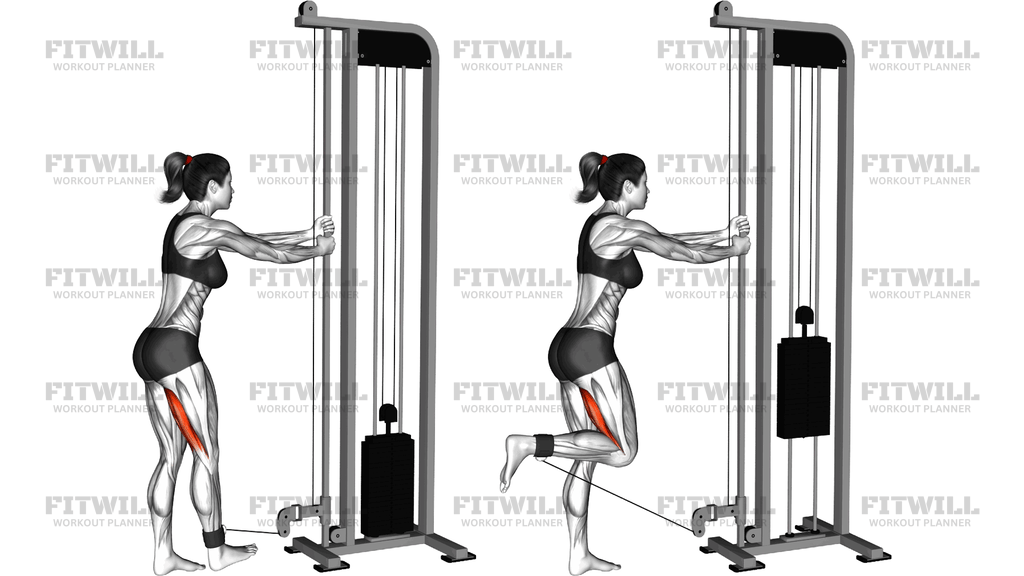
The Cable Standing Leg Curl is a single-leg hamstring isolation exercise performed at a cable station with an ankle strap attached to the low pulley. You stand facing the machine, brace your hands against the frame, and curl one heel up toward your glutes against the pull of the cable. The standing position means the working hamstring handles the load from a hip-extended position, which closely matches how the hamstring functions during walking, running, and sprinting.
This exercise targets the hamstrings through knee flexion, with the calf muscles and glutes of the working leg assisting and the standing leg working hard for balance. Because each leg is trained on its own, it quickly exposes and helps correct left-to-right strength differences that machine leg curls often hide. The cable also keeps steady tension on the hamstring from the bottom of the rep all the way to the top, unlike some machine variations where tension drops off.
Setup matters more here than it looks. The pulley needs to be at its lowest position, the strap should sit snugly around the ankle rather than the calf, and you need to stand far enough from the machine that the cable pulls slightly backward on your ankle even at the start. If you stand too close, the resistance vanishes early in the rep; too far, and the cable drags you forward off balance.
Execution is simple but easy to rush. Keep your torso tall with a slight forward lean, hold the frame for support, and pull your heel up toward your glute without letting your hip drift forward or your knee slide ahead of your body. Squeeze briefly at the top, then lower the heel back under control so the cable never yanks your leg down. The tempo on the way down is where most of the hamstring's growth stimulus comes from, so treat it as part of the rep rather than a rest.
The Cable Standing Leg Curl fits well as an accessory after squats, deadlifts, or lunges, or as a primary hamstring movement on days when the lying leg curl machine is busy. It is also a solid choice for people who find lying or seated leg curl machines uncomfortable, since the standing position avoids pressure on the hips, knees, or stomach and requires minimal setup time.
[ Workout Log & Planner ]
Put your next workout in Fitwill
Keep your plan and training log ready when you are.


Instructions
- Attach an ankle strap to one ankle and clip it to the low pulley of a cable machine, with the pulley set to its lowest position.
- Stand facing the machine about one to two feet back, and hold the frame or handles with both hands at chest height for support.
- Shift your weight onto the non-working leg so it sits directly under your shoulders, and let the strapped leg hang straight with light tension already on the cable.
- Brace your core, keep a slight forward lean from the hips, and set your shoulders down and back before the first rep.
- Exhale and curl your heel up toward your glutes, keeping your thigh in line with your torso and letting the knee stay roughly under your hip.
- Squeeze the hamstring for a beat at the top, where the heel is as close to the glute as it can comfortably go.
- Inhale and lower your heel slowly back to the starting position, resisting the cable the entire way down instead of letting it drop.
- Complete all reps on one leg, then unclip or restrap and repeat the same number of reps on the other leg.
- Reset your stance between sets so the cable tension starts on the muscle rather than with slack in the line.
Tips & Tricks
- If the resistance fades before your leg is half curled in, you are standing too close to the machine; step back until the cable pulls on your ankle from the very start of the rep.
- Watch for the hip of the working leg drifting forward as the heel rises, which turns the move into a hip-dominant swing; press that hip back slightly and think of the knee as the only hinge.
- Keep the knee angle of the supporting leg soft, not locked, so you are not resting on the joint while balancing.
- Avoid letting the cable snap your leg down on the return, a common sign the weight is too heavy or you are rushing; the lowering phase should take about two to three seconds.
- Do not pull with your arms against the frame, which rocks your torso and steals work from the hamstring; your hands are there for balance only.
- If your standing foot wobbles near the end of a set, widen your base slightly and find a fixed spot on the machine to look at rather than adjusting the weight down immediately.
- Stop the curl before your heel pushes so far back that your lower back arches and ribs flare; the top position should come from the knee, not the spine.
- Test both legs with the same weight and rep count, and start each set with your weaker side so the strong leg does not set the pace.
Frequently Asked Questions
What muscles does the Cable Standing Leg Curl work?
The hamstrings are the primary movers, bending the knee against the cable's resistance. The calves assist in knee flexion, the glutes of the working leg help keep the hip positioned, and the standing leg plus core handle balance.
Is the Cable Standing Leg Curl good for beginners?
Yes, as long as the weight is kept light at first. The main learning points are the standing balance and controlling the descent, so a beginner might start with one or two sets per leg before treating it as a main hamstring exercise.
How does the Cable Standing Leg Curl differ from a lying or seated leg curl machine?
It trains one leg at a time from a standing position, so the hamstring works while the hip is extended, similar to running. It also keeps constant cable tension through the whole range and lets each side progress independently.
Where should the ankle strap sit?
The strap should wrap snugly around the ankle, just above the ankle bone, not around the calf. A strap placed too high on the lower leg reduces the lever arm and makes the movement feel awkward and less stable.
How far from the machine should I stand?
Stand close enough that the cable runs nearly vertical but far enough that tension stays on the hamstring even at the bottom with the leg straight. If the first part of the rep feels free, take a small step back.
Why does my lower back arch when I curl my heel up?
That usually means the hip is drifting forward or the heel is traveling past a comfortable range, so the spine compensates. Keep a slight forward lean, brace the core, and end the curl when the knee has done its job rather than forcing extra heel height.
Can I substitute the Cable Standing Leg Curl if my gym has no ankle strap?
A resistance band anchored low with a loop around the ankle works similarly, though the resistance is harder to fine-tune. Lying or seated leg curls are reasonable replacements, but they do not train the legs one at a time from a standing position.
How heavy should I go on the Cable Standing Leg Curl?
Choose a weight you can lower under control for two to three seconds on every rep. Because you are balancing on one leg, loading up heavily usually shows up as torso swinging and cable snapping rather than extra hamstring work.
Is it safe for the knees?
The knee only flexes against a controlled resistance, which is generally well tolerated, and the standing position avoids pressure that some people feel on lying curl machines. Anyone with a recent knee injury should keep the range pain-free and consult a professional before loading it.