Cable Lateral Step Up
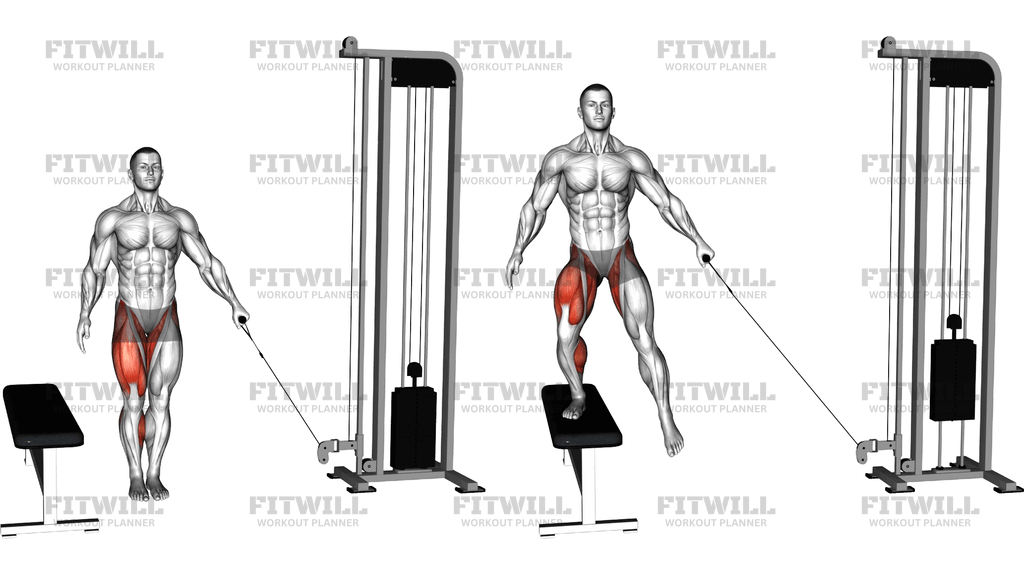
The Cable Lateral Step Up is a single-leg strength exercise performed by standing sideways to a flat bench with a low-pulley cable handle in the hand on your far side, so the cable crosses behind your body. From there, you place your inside foot on top of the bench, drive through that leg to stand fully upright on the bench, and then lower yourself back down under control. The cable adds a constant sideways-and-backward pull, which turns a familiar step up into a much more demanding balance and stability challenge.
The highlighted workload in this movement sits in the quadriceps of the stepping leg, with strong support from the glutes as you extend the hip at the top. The gluteus medius and other hip stabilizers on the working leg work hard to keep your knee tracking straight and your pelvis level while the cable drags you toward the machine. Your standing foot, ankle, and core also stay engaged the entire time, which is exactly why this variation is more humbling than a plain bodyweight step up.
This exercise suits lifters who already feel steady on regular step ups and want to load the pattern without holding dumbbells. Because the resistance comes from a cable rather than weights in your hands, your arms and grip stay relaxed and the loading angle is slightly diagonal, which many people find lets them focus on the leg doing the work. It is a solid choice for building unilateral leg strength, evening out side-to-side differences, and training the hip stability that carries over to squats, lunges, and running.
Setup details matter here. Choose a bench height that lets your stepping leg reach the top with roughly a 90-degree knee bend, since a bench that is too high forces you to push off the floor with the trailing leg and steals the work from the target muscles. Stand close enough to the bench that the step is genuinely lateral, not a diagonal hop, and hold the handle with the hand on the side away from the machine so the cable passes behind your legs without snagging.
Execution should be slow and deliberate. Push the floor-side foot away from the ground rather than lunging forward, drive through the whole foot on the bench, and finish with your hip fully extended at the top before lowering one smooth inch at a time. If you wobble badly at first, that is normal; reduce the weight and own the balance before chasing load.
Practically, the Cable Lateral Step Up fits best as an accessory movement after your main lower-body lifts, usually for two to four sets of six to twelve controlled reps per side. Start with your weaker leg, match the work on the stronger side, and treat any forward collapsing of the knee or heavy pushing from the trailing foot as a signal to drop the weight and tighten up your form.
[ Workout Log & Planner ]
Put your next workout in Fitwill
Keep your plan and training log ready when you are.


Instructions
- Set a flat bench so it runs parallel to the cable machine, roughly an arm's length away, with the bench about knee height or slightly lower.
- Attach a single handle to the low pulley, then stand sideways to the machine with the bench on your outside, holding the handle in the hand that is farther from the machine so the cable passes behind your body.
- Let your inside arm hang relaxed at your side, square your hips toward the bench, and position your inside foot flat on the bench with your whole foot on the surface, knee bent to about 90 degrees.
- Brace your core, keep your chest tall, and lean the weight slightly over the stepping leg so your shoulder stacks over the working knee.
- Exhale and drive through the foot on the bench, pushing the floor-side foot clear of the ground and standing all the way up until your working leg is straight and your hip is fully extended at the top.
- Keep the trailing leg relaxed and hanging close to the bench rather than swinging it up for momentum.
- Inhale as you lower yourself by bending the working knee, letting the trailing foot touch the floor softly instead of collapsing down.
- Keep a light but firm grip on the handle and resist the cable's pull sideways; your torso should not lean toward the machine at any point.
- Complete all reps on one leg, then switch sides by turning around so the other leg faces the bench and the cable again crosses behind you.
- Between sets, recheck your distance from the machine and reset your stance so every rep starts from the same position.
Tips & Tricks
- If the cable drags across your legs or the bench, you are standing too close to the machine; take one small step back so the line clears your body during the step up.
- A common mistake is turning this into a diagonal lunge off the bench. Your stepping foot should stay facing the bench the whole time, and your movement should stay lateral.
- Watch your working knee in a mirror: if it caves inward toward the machine as you press up, the cable is winning. Drop the weight and consciously push the knee slightly outward.
- Use a bench height that puts your thigh parallel to the floor at the bottom. A taller bench tempts you to spring off the trailing leg, which removes most of the single-leg challenge.
- Drive through your heel and mid-foot on the bench, not your toes. Rising onto the ball of the foot is a sign the load is too heavy or the bench is too high.
- Keep the handle arm long and relaxed. Bending the elbow and rowing the handle during the step turns the set into a mixed arm exercise and shortens the cable's stability demand unpredictably.
- Pause for one full second at the top with your hip locked out. This kills the bounce and forces the glutes of the working leg to finish the rep.
- Do the weaker leg first and stop the stronger leg at the same rep count so the imbalance narrows over time instead of growing.
- If balance is the limiting factor, place your free hand lightly on a rack or wall instead of reducing the bench height, and work toward letting go.
Frequently Asked Questions
Which muscles does the Cable Lateral Step Up work the most?
The quadriceps of the stepping leg do the bulk of the pressing work, with the glutes extending the hip at the top. The hip stabilizers, calves, and core work isometrically to keep you upright against the cable's pull.
Why does the cable cross behind my body instead of being held in the near hand?
Holding the handle in the far-side hand keeps the cable clear of your legs and the bench, and it centers the resistance closer to your midline. In the near hand, the cable would pull you sideways into the machine and disrupt your balance much more.
How high should the bench be for the Cable Lateral Step Up?
Pick a height where your knee sits at about 90 degrees with your foot flat on top, usually around knee height. If the bench is much higher, you will start compensating by pushing off the trailing leg or rounding forward.
Can beginners do the Cable Lateral Step Up?
Beginners are better served by mastering bodyweight lateral step ups first. Once you can perform smooth, wobble-free reps without the cable, add a very light cable load and rebuild from there.
Why do I keep losing my balance toward the machine?
The cable pulls you laterally and slightly backward, so any lean or soft torso gives that pull the win. Brace your core, keep a tall posture, lighten the weight, and make sure you are not holding the handle with a bent, pulling arm.
Should the trailing leg help during the step up?
No. The trailing foot should only help you regain the floor on the way down. If you feel a strong push from it at the start of each rep, lower the bench or reduce the load so the stepping leg can do the work alone.
What can I substitute if my gym has no low pulley near a bench?
A resistance band anchored low can replace the cable with the same cross-behind setup, or you can hold a dumbbell in the far-side hand to mimic the offset load. A plain bodyweight lateral step up remains a valid fallback.
How many sets and reps should I use for the Cable Lateral Step Up?
Two to four sets of six to twelve reps per leg works well as an accessory lift after your main squat or hinge work. Because balance is a limiter, prioritize controlled reps over heavy loads.
Is it safe for my knees?
Done with a sensible bench height and a controlled descent, the movement is generally knee-friendly because you set the depth yourself. If you feel sharp knee pain, lower the bench, reduce the weight, and check that your knee is tracking over your foot rather than caving inward.