Dumbbell Standing Around World
The Dumbbell Standing Around World is a shoulder movement where you hold a dumbbell in each hand at your sides and sweep both arms through a wide circular path, raising them out to your sides, arcing them up overhead, and then lowering them down in front of your body before reversing the circle. The name comes from the way the weights literally travel around your upper body, tracing a ring that passes through every angle of shoulder movement in a single repetition.
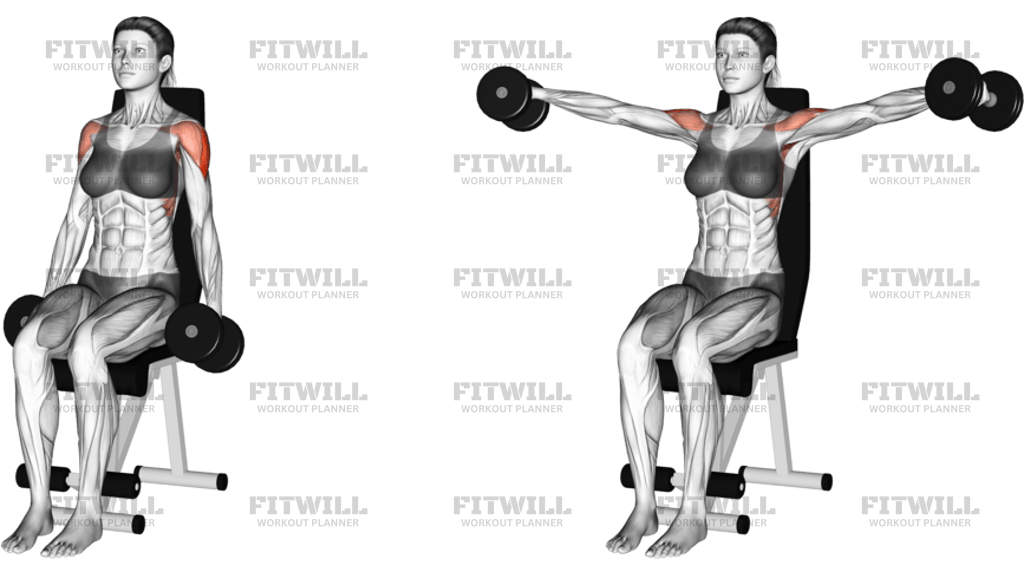
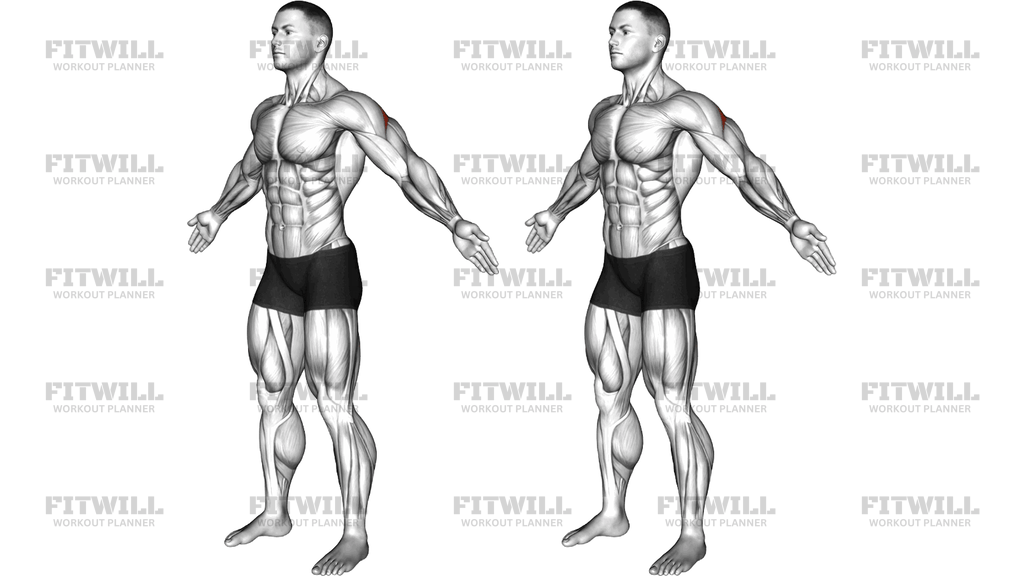
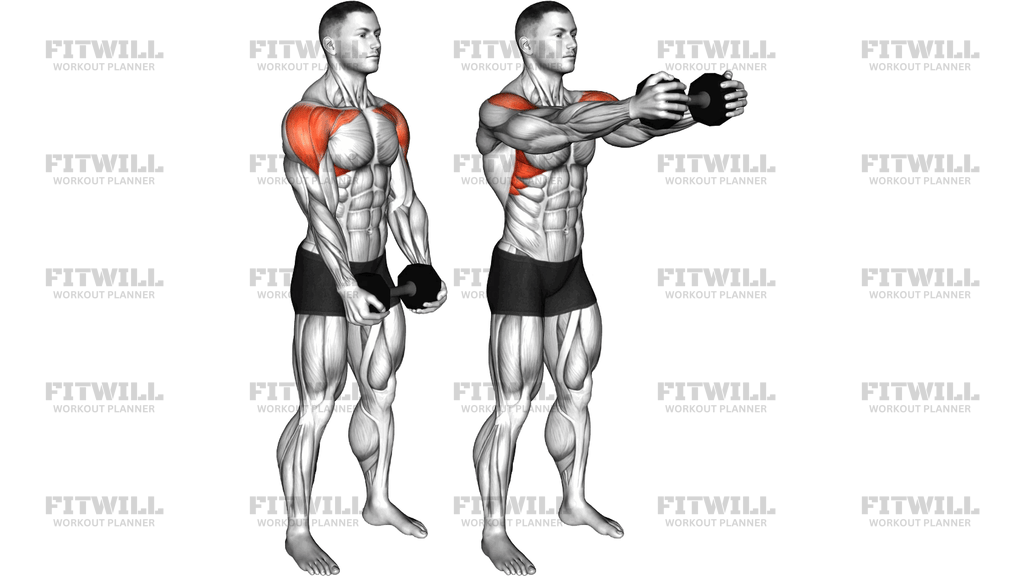
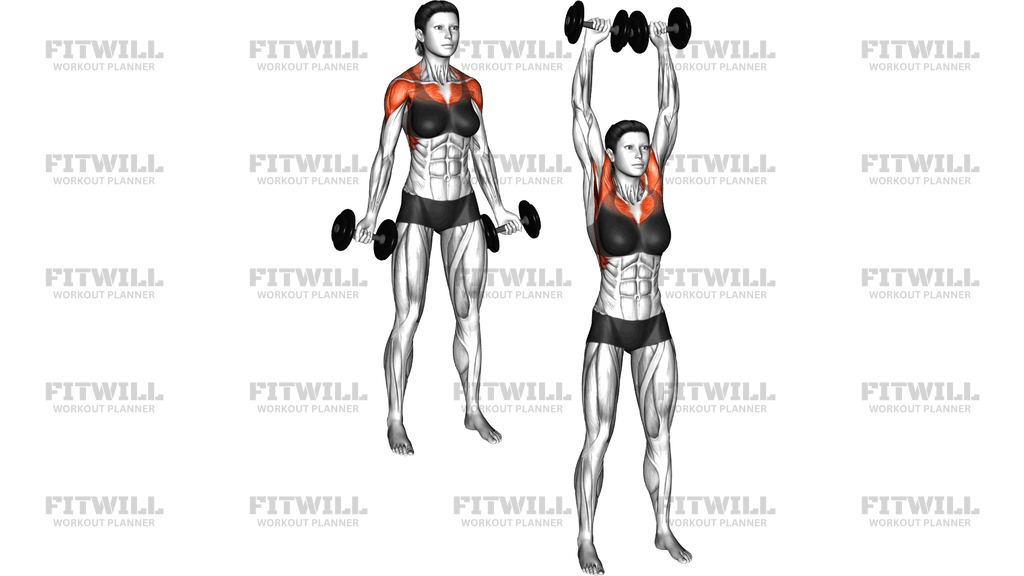
Because the circle passes through lateral raise, front raise, and overhead press positions all in one continuous arc, this exercise loads the shoulders through their full range rather than in one fixed plane. The middle and front delts do most of the visible work, while the upper traps assist as the arms reach overhead and the rotator cuff stabilizes the joint throughout the rotation. The image's muscle highlighting across the shoulder caps and upper chest reflects exactly where you should feel this movement.
This is a particularly useful exercise for lifters whose shoulder training is stuck in straight-line patterns like raises and presses. Moving through a smooth, continuous arc demands control at angles you never visit in those exercises, which builds coordination and stability alongside strength. It works well as a warm-up primer before pressing days, as a finishing movement with light weights to fatigue the delts through every angle, or as a low-load mobility drill for anyone whose shoulders feel stiff from sitting at a desk.
Setup matters more than it might seem. Standing upright with a braced core and a stable base keeps your torso from swaying as the dumbbells swing around you, and because the arms pass overhead, keeping your ribcage down protects your lower back from arching under the load. Choosing light dumbbells is not a concession here; the long lever arm of a straight arm holding a weight creates substantial demand at the shoulder even with very light plates.
To execute it well, think of your hands as drawing two parallel rings around your body, one on each side. Keep a soft, almost-straight elbow, move deliberately rather than swinging, and pause briefly when the dumbbells touch overhead before tracing the same path back down. The tempo should feel smooth and even in both directions — if any part of the circle feels jerky, the weight is likely too heavy or your torso is compensating.
A practical safety note: the overhead portion is the point where the shoulder is most vulnerable, so never force the arc if your shoulders pinch or grind at the top. Slightly bend the elbow as the arms pass ear height, and shrink the circle rather than pushing through discomfort. Start with weights light enough that you could complete twenty slow reps, and earn heavier loads gradually.
[ Workout Log & Planner ]
Put your next workout in Fitwill
Keep your plan and training log ready when you are.


Instructions
- Stand with your feet about hip-width apart, holding a dumbbell in each hand with a neutral grip, arms hanging straight down at your sides and palms facing your thighs.
- Pull your shoulders back and down, brace your abdominal wall, and keep your ribcage stacked over your pelvis so your torso stays upright throughout the set.
- Begin the circle by raising both dumbbells out to your sides in a smooth arc, keeping your elbows nearly straight with just a soft bend.
- Continue the sweep upward as if tracing a ring around your body, letting the weights travel out wide and then up past shoulder height.
- Bring the dumbbells together overhead until your arms are fully extended and the plates touch or nearly touch above your head.
- Reverse the path without pausing: sweep the dumbbells back down the same wide arc, lowering them in front of your body until your arms return to your sides.
- Inhale as the weights travel upward through the arc and exhale steadily as they lower back down to the start.
- Complete the full circle in one controlled motion, taking roughly two to three seconds per half of the rep instead of swinging through it.
- At the bottom of each rep, reset your posture — re-brace the core, drop the shoulders away from the ears — before starting the next circle.
- Keep your neck relaxed and eyes forward so the dumbbells passing overhead do not pull your head out of position.
Tips & Tricks
- Choose much lighter dumbbells than you would use for lateral raises — with straight arms and a long arc, even 2-5 kg per hand is plenty for most lifters.
- If your torso leans back as the dumbbells pass overhead, your ribcage is flaring to compensate; cue yourself to pull the ribs down and squeeze the glutes to lock the pelvis in place.
- A common mistake is bending the elbows heavily and turning the movement into a partial press — this shortens the arc and robs the delts of the extended lever position that makes the exercise valuable.
- The dumbbells should travel in two parallel vertical rings, not drift forward or behind you; imagine slots on either side of your body that your hands must stay within.
- If you feel pinching at the top of the circle, allow a small elbow bend as the arms pass ear height rather than forcing a fully straight-arm overhead position.
- Avoid letting the weights crash into each other overhead — a soft touch with control keeps tension on the shoulders instead of dumping it into the joint.
- This drill works exceptionally well as the first movement of a shoulder workout with very light weight, priming the delts and rotator cuff before presses and raises.
- Do not rush the bottom turnaround; a controlled reset at your sides each rep keeps the circle round and prevents the arc from becoming a swing.
- If you have limited shoulder overhead mobility, shrink the circle slightly so the arc stays comfortable rather than arching your lower back to fake extra range.
Frequently Asked Questions
Which muscles does the Dumbbell Standing Around World work?
The front and side delts do most of the work as the arms sweep through the arc, with the upper traps assisting overhead and the rotator cuff stabilizing the shoulder throughout. The upper chest contributes briefly as the arms travel through the lower front portion of the circle.
Is the Dumbbell Standing Around World good for beginners?
Yes, as long as the weight is light and the tempo is slow. Because it combines several shoulder patterns into one arc, it is actually a great way for beginners to learn how their shoulders move before isolating individual raises.
How heavy should the dumbbells be for this exercise?
Start with a pair you could press overhead easily twenty or more times — often half or less of your lateral raise weight. The straight-arm arc creates a long lever, so the demand at the shoulder is much higher than the load suggests.
Why do my lower back and torso feel involved during the Around World?
As the dumbbells pass overhead, any arching or rib flare shifts load away from the shoulders and onto the spine. Brace your abs, squeeze your glutes lightly, and reduce the weight if you need to sway to finish the circle.
Should my elbows stay straight during the Dumbbell Standing Around World?
Keep them nearly straight with only a soft bend to protect the joint. A fully locked elbow under load can stress the joint, while a big bend turns the movement into a press and shortens the arc.
Can I use the Dumbbell Standing Around World as a warm-up?
Absolutely — with very light dumbbells it is an excellent primer before overhead pressing or lateral raise work, taking the shoulders through a full circle of motion and waking up the stabilizers.
How many reps and sets should I do?
For a warm-up or mobility focus, do 1-2 sets of 8-12 slow circles. As a finishing movement, 2-3 sets of 10-15 controlled reps with light weight works well.
What can I substitute if I do not have dumbbells?
Small weight plates or light kettlebells held by the horns work with the same arc, and resistance bands can approximate the circle with less joint compression. Even unweighted, the movement retains value as a shoulder mobility drill.
Is it safe if my shoulders click or pinch during the arc?
Mild, painless clicking is common, but pinching or sharp discomfort is a signal to adjust. Slightly bend the elbows overhead, shrink the diameter of the circle, and lighten the load; if discomfort persists, skip the overhead portion and work a smaller arc.
How is the Around World different from just doing front raises and lateral raises?
Raises train one fixed plane at a time, while the Around World blends them into one continuous path so the shoulder never stalls at a transition point. That constant change of angle challenges coordination and stabilization in a way straight-line raises do not.