Kettlebell Kneeling One Arm Bottoms Up Press
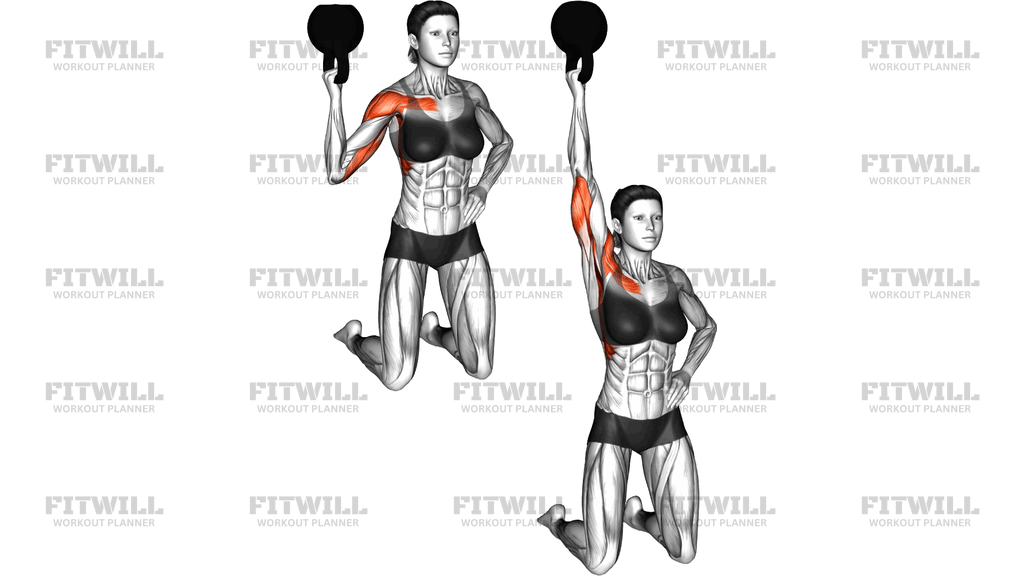
The Kettlebell Kneeling One Arm Bottoms Up Press is an overhead press performed from a tall kneeling position while holding the kettlebell upside down, with the bell sitting above your hand and the handle gripped near the bottom. That inverted hold is the defining feature: because the weight sits above your grip, the kettlebell wants to tip in every direction, so your forearm, shoulder, and trunk have to work continuously just to keep it vertical. This turns a basic pressing movement into a demanding stability exercise.
The tall kneeling stance is the second key element. With both knees on the floor and no bench behind your back, you cannot lean on a backrest or cheat with leg drive. Your hips, glutes, and core must hold your torso upright while the pressing arm works overhead. This removes most of the body english people use to grind through heavy presses and forces honest, controlled shoulder mechanics.
The main work falls on the front and side deltoids of the working arm, with the triceps extending the lockout. Just as much of the challenge is in the supporting structures: the rotator cuff and forearm stabilizers fight the tipping bell, the grip stays active on the handle, and the core resists the pull of a load held slightly off-center. Because the shoulders and trunk are working together under genuine instability, this movement is popular with lifters who want to build overhead control rather than chase maximum press weight.
To perform it well, kneel tall with your ribs stacked over your pelvis, clean the kettlebell to your shoulder in the bottoms-up position, and press it straight up without letting the bell drift forward or wobble. The kneeling setup matters because it exposes restrictions in hip and trunk control; if you cannot stay upright here, that usually shows up as lower back arching or side bending during standing overhead work.
This exercise suits intermediate trainees who already own a solid standing or half-kneeling press. It is commonly used as a shoulder health and stability drill, a warm-up progression before heavier pressing, or a main movement in lighter control-focused sessions. Start with a kettlebell much lighter than your normal press weight, keep reps slow and deliberate, and stop the set as soon as the bell becomes hard to keep vertical, since fatigue on this exercise shows up as wobbling rather than as a grinding lockout.
[ Workout Log & Planner ]
Put your next workout in Fitwill
Keep your plan and training log ready when you are.


Instructions
- Kneel on the floor with both knees down and your shins roughly parallel, sitting tall so your hips are stacked directly under your shoulders.
- Clean a light kettlebell to your shoulder in the bottoms-up position, gripping the handle firmly so the bell sits above your hand and points at the ceiling.
- Place your free hand on your hip and squeeze your glutes to lock your pelvis in a neutral position.
- Brace your trunk as if preparing for a light punch, keeping your ribs down over your hips with no lower back arch.
- Press the kettlebell straight up, keeping the bell vertical and your forearm stacked under it throughout the lift.
- Reach full lockout with your arm in line with your ear, bicep near your head, and the bell balanced on top for a brief pause.
- Lower the kettlebell under control back to your shoulder, resisting the bell's tendency to tip as it descends.
- Exhale as you press and inhale at the top or as you lower, keeping the breath steady and the trunk tight.
- Complete all repetitions on one side, then re-clean or set the kettlebell down before switching arms.
- Keep every rep slow enough that the bell stays vertical; if it starts wobbling uncontrollably, end the set.
Tips & Tricks
- Choose a kettlebell well below your normal one-arm press weight; the bottoms-up hold makes even a light bell feel far heavier.
- If the bell tips forward, your wrist is breaking back too far. Keep your knuckles facing the ceiling and your wrist neutral instead of letting the hand extend.
- Squeeze the handle hard. Grip tension travels up the forearm and noticeably steadies the shaking bell.
- Watch for side bending toward the pressing arm as fatigue builds. Keep your free hand on your hip and your shoulders level to catch this early.
- Do not arch your lower back to finish the press. If you cannot reach lockout without arching, the weight is too heavy or your thoracic extension is the limiting factor.
- Keep the pressing path vertical and close to your body. Letting the bell drift forward turns the stability drill into a sloppy front raise.
- Point your back foot toes down or tuck them under, and spread your knees slightly if the kneeling position is uncomfortable on your knees or ankles.
- Pause for one to two seconds at lockout with the bell balanced. The top position is where most of the stabilization benefit lives.
- End the set when the bell starts oscillating, not when the press becomes hard. Wobbling reps teach poor control rather than build it.
Frequently Asked Questions
What muscles does the Kettlebell Kneeling One Arm Bottoms Up Press work?
The front and side deltoids do the pressing, with the triceps extending the lockout. The rotator cuff, forearm stabilizers, grip, and core all work hard to keep the inverted bell vertical and your torso upright.
Why hold the kettlebell bottoms up instead of in the normal position?
With the bell above your hand, the load constantly tries to tip in multiple directions, so your forearm, rotator cuff, and shoulder stabilizers must stay engaged the entire time. This makes the press a control exercise rather than a pure strength lift.
Is the Kettlebell Kneeling One Arm Bottoms Up Press suitable for beginners?
It is better suited to lifters who already have a comfortable standard one-arm kettlebell press. Beginners can build toward it by mastering the tall kneeling press first, then adding the bottoms-up hold with a very light bell.
How heavy should the kettlebell be for this exercise?
Use roughly half of your normal one-arm press weight or less when starting. If the bell cannot stay vertical for a controlled set of five to eight reps, drop to a lighter kettlebell.
Why kneel instead of standing for the Bottoms Up Press?
Kneeling removes leg drive and any lean against a bench, so your hips, glutes, and core must hold your torso upright without help. It also limits how much weight you can force up, keeping the emphasis on shoulder stability.
My kettlebell keeps wobbling and shaking during the press. What should I change?
Some shaking is normal and part of the training effect, but excessive tipping usually means the weight is too heavy, your grip is too relaxed, or your wrist is extending backward. Grip the handle hard, keep your knuckles to the ceiling, and reduce the load.
What can I substitute if I do not have a kettlebell?
A dumbbell cannot recreate the bottoms-up hold, but a single-arm kneeling press with a dumbbell or a kettlebell held normally trains similar pressing muscles with less stability demand. A bottoms-up half-kneeling press is a close cousin if tall kneeling is difficult.
How should I breathe during the Kettlebell Kneeling One Arm Bottoms Up Press?
Exhale as you press the bell overhead and inhale during the controlled lowering phase. Keep your trunk braced throughout rather than releasing air completely at the top.
Is this exercise safe for the shoulders?
It is generally shoulder-friendly when done with a light bell because the load stays modest and the movement builds overhead control. Stop if you feel pinching at the top of the press, and keep the path vertical with the wrist neutral rather than letting the bell drift behind your head.