Smith Rear Lunge
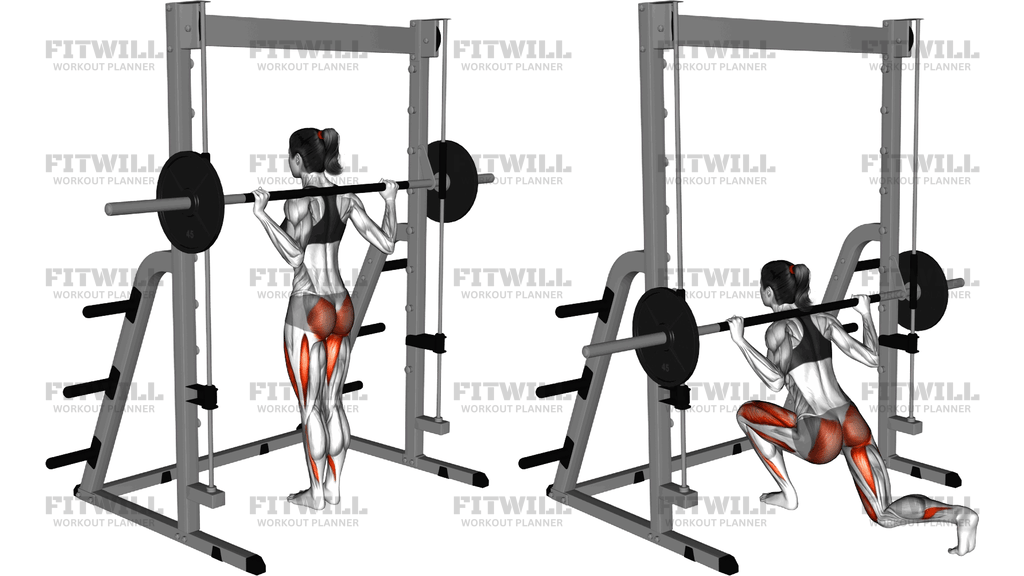
The Smith Rear Lunge is a reverse lunge performed with the bar of a Smith machine resting across your upper back. Because the bar travels on a fixed vertical path, the machine handles the balance work for you, which lets you concentrate on the lunge pattern itself: stepping one leg behind you, lowering until both knees are bent, and driving back up through the front leg. In this version the working leg stays planted while the rear leg reaches back, placing a strong emphasis on the glutes and front-leg quads.
This setup is especially useful for people who find free-barbell lunges unstable, or anyone rehabilitating confidence after time away from single-leg work. Lifters who want extra glute emphasis also like the rear lunge because stepping backward tends to keep the shin more vertical and load the hips harder than a forward lunge does. The Smith machine makes it easier to control depth and keep your torso upright without the bar drifting.
The main muscles worked are the glute of the front leg and the quadriceps, with the hamstrings assisting on the way up and the calf of the rear leg stabilizing the back-foot position. Your core works to keep the torso tall under the bar throughout the set, and the front ankle gets plenty of stabilization demand even with the machine's guidance.
Setup matters here more than people expect. Position yourself so the bar path lines up over the middle of your front foot, not over your heels or toes. Set the bar at about upper-chest height so you can unrack it by straightening your legs rather than rising onto your toes, and make sure the safety stops are set below your lowest working depth.
To perform it well, keep your ribcage stacked over your hips and your gaze forward. Take a controlled step straight back, plant the ball of the rear foot, and lower until the front thigh is roughly parallel to the floor and the back knee hovers just above the ground. Drive through the whole front foot to stand, then either repeat on the same leg or alternate legs depending on your goal.
You will see this movement in lower-body strength sessions, glute-focused hypertrophy blocks, and as a stepping stone toward heavier barbell lunges. Start with a light load to learn your foot position, since the fixed bar path means the machine will not forgive a setup that places your stance too far forward or back.
[ Workout Log & Planner ]
Put your next workout in Fitwill
Keep your plan and training log ready when you are.


Instructions
- Set the Smith machine bar at around upper-chest height and load an even amount of weight on both sides.
- Stand under the bar and place it across your upper traps, similar to a back squat position, with hands gripping the bar just outside your shoulders.
- Unrack the bar by straightening your legs, then take one step back and set your feet hip-width apart.
- Brace your core, lift your chest, and shift the bar slightly forward so it sits over the middle of your working foot.
- Inhale, then step one leg straight back, landing on the ball of that foot with your heel lifted.
- Lower your hips straight down until your front thigh is about parallel to the floor and your back knee is just above the ground, keeping your torso upright.
- Exhale and press through the entire front foot to push yourself back up until both legs are straight again.
- Complete all repetitions on one leg, then step the rear foot back in, re-rack the bar by rotating the hooks, and switch sides.
Tips & Tricks
- If your front knee travels far past your toes, your stance is probably too short; take a longer step back so the shin stays closer to vertical.
- A common mistake is letting the bar pull you forward onto your toes because the fixed path sits behind your center of mass; nudge your whole body a step forward under the bar before starting the set.
- Keep the rear knee tracking straight down rather than letting it flare outward, which usually means the back hip is rotating open.
- Push the floor away with the whole front foot, not just the heel or toes, to keep the glutes and quads sharing the work.
- Control the lowering phase for two to three seconds; the machine's fixed path tempts people to drop quickly and bounce out of the bottom.
- Do not let your torso lean way forward over the front thigh — a slight forward hinge is fine, but collapsing the chest shifts stress away from the glutes.
- If your standing foot keeps sliding on the platform, check that your weight stays mid-foot through the whole rep rather than shifting as you step back.
- Set the safety stops a few inches below your deepest rep so a missed rep can be safely escaped.
- Start with the same leg every set while learning, then move to alternating legs once your foot placement is consistent.
Frequently Asked Questions
Which muscles does the Smith Rear Lunge target most?
The primary work is done by the glutes and quadriceps of the front leg. The hamstrings assist on the way up, and the calf of the rear leg stabilizes the trailing foot position.
Why step backward instead of forward for this lunge?
Stepping back keeps the front shin more vertical and shifts more of the load to the glutes and hips. It is also easier on the front knee for many lifters.
Is the Smith Rear Lunge good for beginners?
Yes. The fixed bar path removes most of the balance demand, so beginners can learn the lunge pattern and build leg strength before progressing to dumbbell or free-barbell versions.
How far back should I step during the Smith Rear Lunge?
Far enough that both knees can bend to about 90 degrees at the bottom with your front shin close to vertical. If your front knee jams forward or your rear foot cannot reach the floor comfortably, adjust the step length.
Should I work one leg at a time or alternate legs?
Doing all repetitions on one leg before switching makes it easier to feel and correct imbalances. Alternating is fine for general conditioning once your form is consistent.
What is the most common mistake with this exercise?
Setting up too close to the bar, which forces the torso forward and pushes weight onto the front toes. Take a small step forward under the bar so the bar sits over the middle of your working foot.
Can I use the Smith Rear Lunge instead of regular barbell lunges?
It is a solid substitute when you want less stability demand or are training without a spotter. The trade-off is less carryover to free-weight balance, so treat it as a stepping stone or a controlled hypertrophy option.
How heavy should I go on the Smith Rear Lunge?
Start lighter than you would for a back squat, since single-leg loading doubles the demand on the working limb. Choose a weight you can lower under control for all reps without your torso collapsing.
Is it safe for the knees?
With a proper step length and controlled lowering, the rear knee tracks toward the floor rather than being driven forward over the toes, which keeps the movement knee-friendly for most people. Stop and shorten your range if you feel pinching or discomfort at the front of the knee.