Smith Bent Over Row (Version 2)
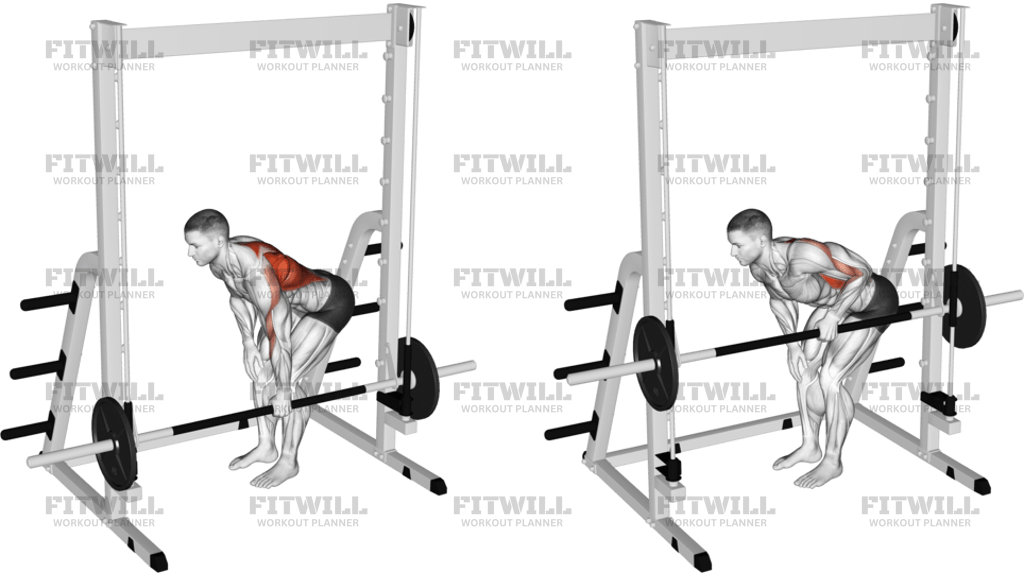
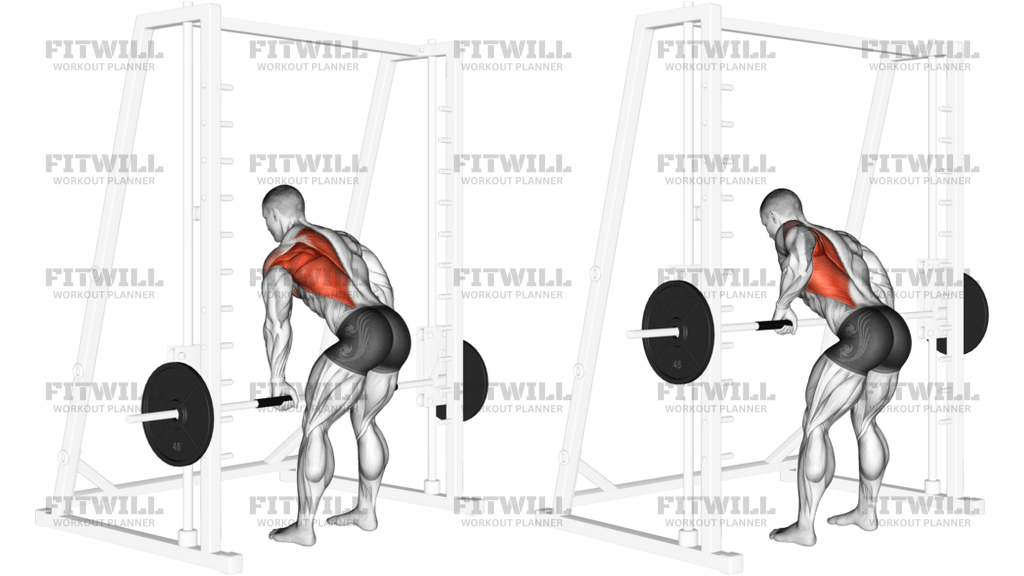
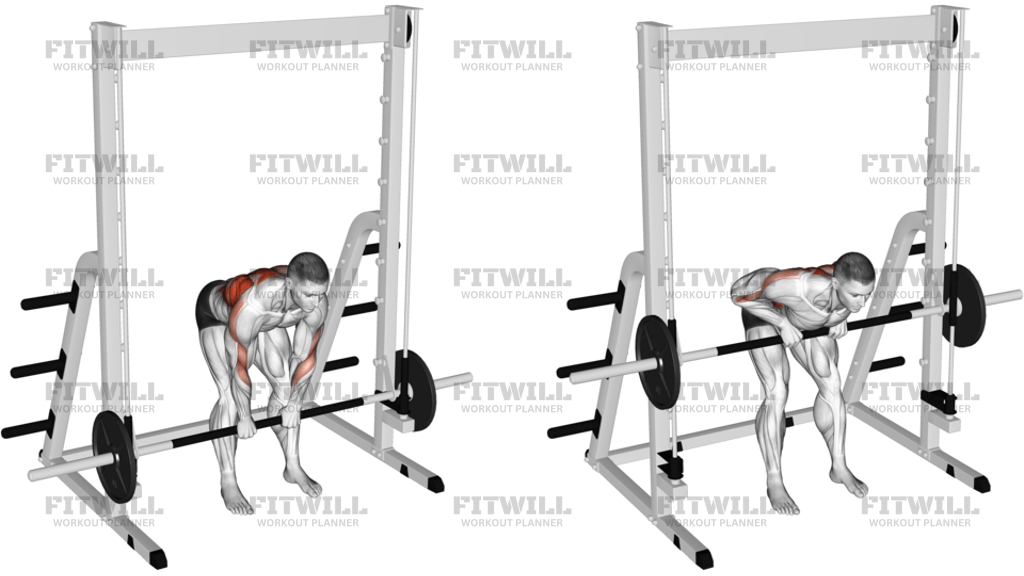
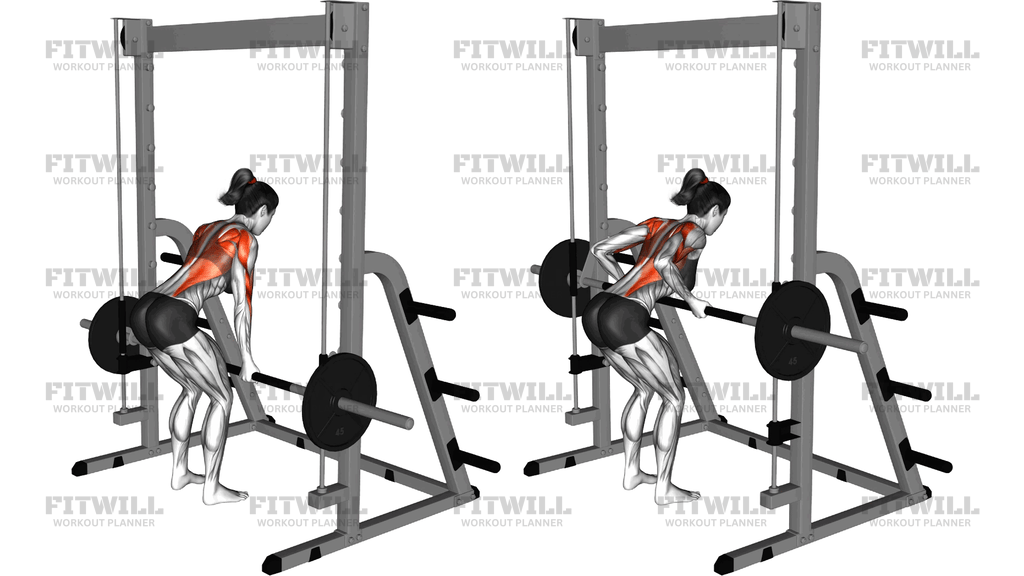
The Smith Bent Over Row is a horizontal rowing variation performed inside the Smith machine, where the bar travels along fixed vertical rails instead of moving freely. You stand facing the machine, hinge forward at the hips so your torso leans well past 45 degrees, and row the bar up toward your lower ribcage before lowering it back to arm's length. The fixed bar path is the defining feature: once the bar is unracked, it can only move up and down in a straight line, which removes the balance demands of a free-weight barbell row.
The main work is done by the lats, which drive the bar toward your torso, with strong support from the rhomboids and mid-traps as the shoulder blades pull together at the top. The rear shoulders assist the pull, the biceps bend the elbows, and the spinal erectors plus glutes and hamstrings hold your hinged torso in place isometrically. Because the machine stabilizes the bar, you can concentrate fully on squeezing the target muscles rather than stabilizing the load.
This setup suits several groups of lifters. Beginners appreciate the predictable bar path while they learn to feel their back muscles working. Intermediate and advanced lifters often use it as a heavy, low-fatigue rowing day movement, or as a controlled finishing exercise after free-weight rows when grip and core stability are already tired. It is also a practical option for anyone with balance limitations or for home and commercial gym setups where a Smith machine is available but a free barbell row is not comfortable.
Setup matters more than it might appear. The height of the bar stop determines how deep your hinge is, so set it at roughly knee or mid-shin level before you load the bar. Your hinge angle dictates which part of the back works hardest: a more horizontal torso biases the lats, while a slightly more upright torso shifts emphasis toward the upper back and traps. Feet placed slightly in front of the bar keep your shins clear of the plates and let the bar travel close to your legs.
To execute it well, brace your core before every rep, pull your elbows back and slightly up rather than just bending your arms, and aim the bar at your lower ribs or upper abdomen. Pause briefly with the shoulder blades drawn together, then lower the bar under control to a full hang. Keep the pull smooth along the fixed rails; jerking the bar or bouncing it off the stops shifts tension away from the back and into the joints.
A few practical safety points go a long way. Never round your lower back in the hinge, and if you feel your torso rising with each rep, the weight is too heavy. Because the Smith machine bar can be rotated to lock at any point, it also serves as a built-in safety feature if you lose your grip mid-set.
[ Workout Log & Planner ]
Put your next workout in Fitwill
Keep your plan and training log ready when you are.


Instructions
- Set the Smith machine bar stops at about knee to mid-shin height and load the bar evenly on both sides.
- Stand facing the machine with your feet roughly hip-width apart and slightly in front of the bar so the plates clear your shins.
- Hinge forward at the hips, pushing your glutes back and keeping your knees softly bent, until your torso is angled between 45 degrees and near-parallel to the floor.
- Grip the bar with an overhand grip slightly wider than shoulder width and unlatch it from the rotation catch so it can slide on the rails.
- Brace your core, lift your chest, and pull your shoulder blades down before starting the first rep.
- Row the bar straight up along the rails until it reaches your lower ribcage or upper abdomen, driving your elbows up and back.
- Squeeze your shoulder blades together at the top for a brief pause, keeping your wrists neutral and your elbows close to a 45-degree angle from your torso.
- Lower the bar in a controlled motion until your arms are fully extended and the weight settles into a dead hang without touching the stops between reps.
- Exhale as you pull the bar up and inhale as you lower it back down.
- When your set is finished, rotate the bar to engage the safety catch, then rack it on the stops before releasing your grip.
Tips & Tricks
- If your torso stands up taller with every rep, the weight is too heavy or your hinge is too shallow—drop the load and re-establish a solid hip hinge before continuing.
- A rounded lower back is the most common fault here; reset your brace and lift your chest between reps rather than letting your spine drift as fatigue builds.
- Because the bar path is fixed, the bar cannot come toward you—step your feet slightly forward if you feel the plates dragging against your shins on the descent.
- Pull with your elbows, not your hands. If your forearms burn before your back does, lighten the load and think about driving your elbows toward the ceiling behind you.
- Aim for a dead hang at the bottom of each rep. Bouncing the bar off the lower stop creates a free impulse that robs the lats of work.
- Do not grip the bar with an extremely wide hold; it shortens the rowing range and shifts stress toward the rear shoulders and traps away from the lats.
- Avoid pulling the bar toward your chest, which turns the movement into a different rowing angle—target the lower ribs for the lat-dominant version shown here.
- Tuck your chin and keep your neck in line with your spine so you are looking at the floor a step or two ahead of you, not up at the mirror.
- Use the Smith machine's rotation latch deliberately: always lock the bar back in place before letting go, especially on your final rep when your grip is tired.
Frequently Asked Questions
Which muscles does the Smith Bent Over Row work the most?
The lats do the main pulling, with the rhomboids, mid-traps, and rear shoulders working hard at the top of each rep. The biceps assist, while the lower back, glutes, and hamstrings hold your hinged torso steady throughout.
Is the Smith Bent Over Row good for beginners?
Yes, it is one of the friendlier rowing variations to learn. The fixed bar path removes the balance component of a free barbell row, so a beginner can focus on bracing, hinging, and feeling the back muscles pull.
How is the Smith Bent Over Row different from a regular barbell bent over row?
The Smith machine bar only moves vertically on its rails, so you cannot drift forward, backward, or side to side. That makes it more stable and easier on the lower back, though it also means your stabilizing muscles work less than with a free barbell.
Where should I aim the bar at the top of the rep?
Row it up to your lower ribcage or upper abdomen. Pulling toward the chest changes the shoulder angle and shifts emphasis toward the upper traps and rear shoulders instead of the lats.
Why do my lower back muscles fatigue before my back finishes the set?
Your spinal erectors are working isometrically to hold the hinge, so they may tire first if your torso angle is too low or your brace is weak. Raise your torso slightly toward 45 degrees and reset your core tension before each set.
Can I use an underhand grip on this exercise?
Yes, an underhand grip rotates the elbows closer to the torso and generally favors the lats and biceps slightly more. Keep the same hinge and bar path, and use a grip width no wider than shoulder width.
What should I do if the plates touch my shins during the rep?
Step your feet a little further forward of the bar so the vertical bar path runs just in front of your shins. Do not lean further back to solve it, as that rounds your lower back.
How heavy should I go on the Smith Bent Over Row?
Choose a load you can pull to your ribs with a brief pause at the top and a smooth, controlled descent for all planned reps. If your torso rises, your lower back rounds, or the bar bounces off the stop, the weight is beyond what your position can hold.
What can I substitute if my gym has no Smith machine?
A barbell bent over row is the closest free-weight substitute, while a chest-supported row or single-arm dumbbell row removes even more lower back demand if your hinge fatigues quickly.
How do I finish the set safely on the Smith machine?
After your last rep, rotate the bar toward the rack hooks so it locks on the rails, then release your grip. This is especially important on final reps when your grip and back are already fatigued.