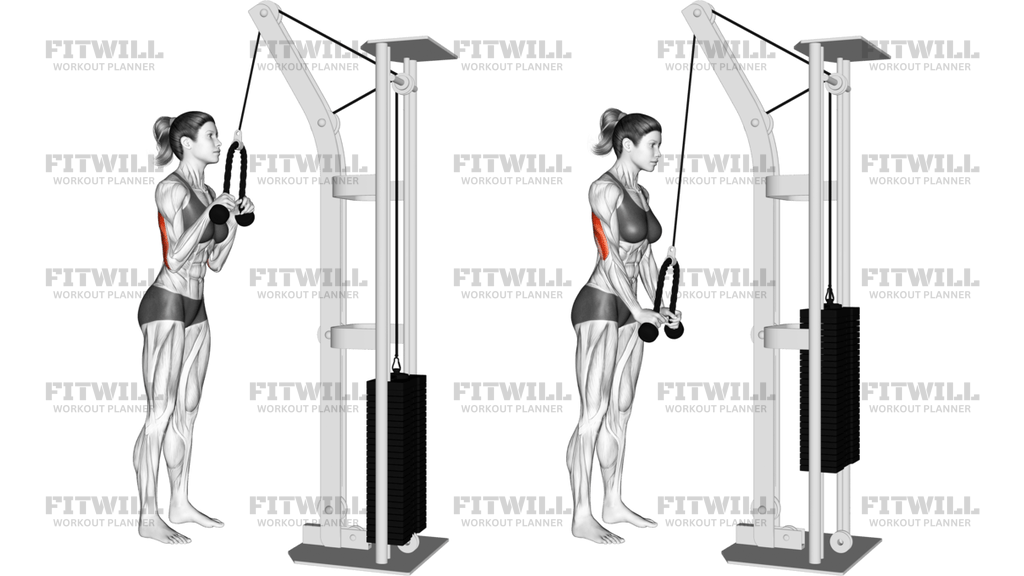
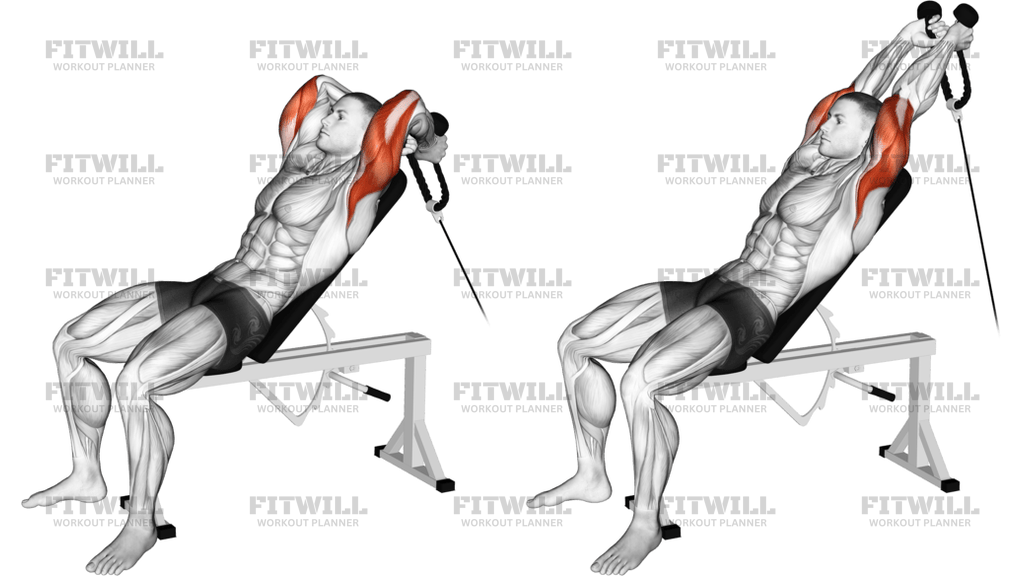
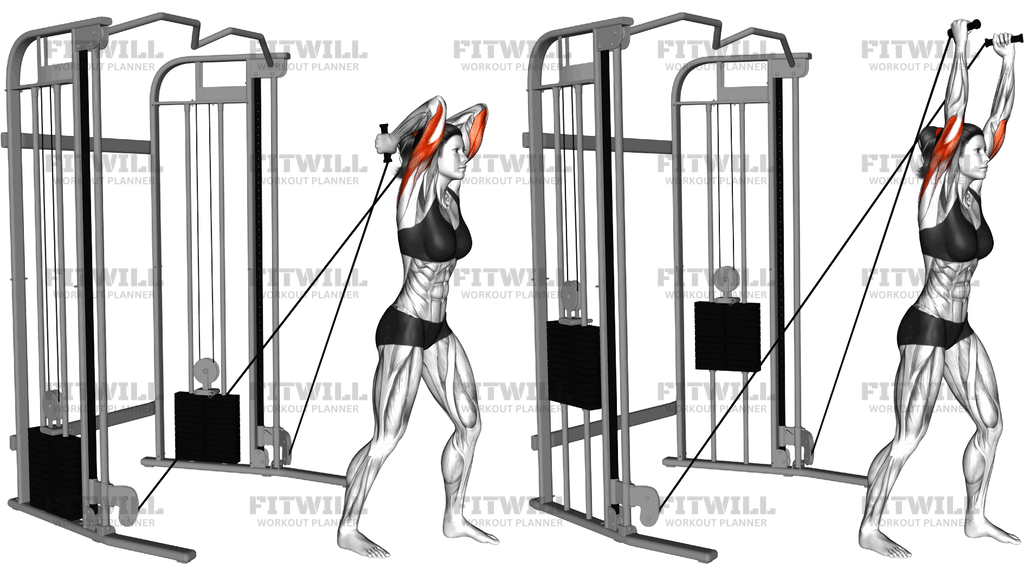
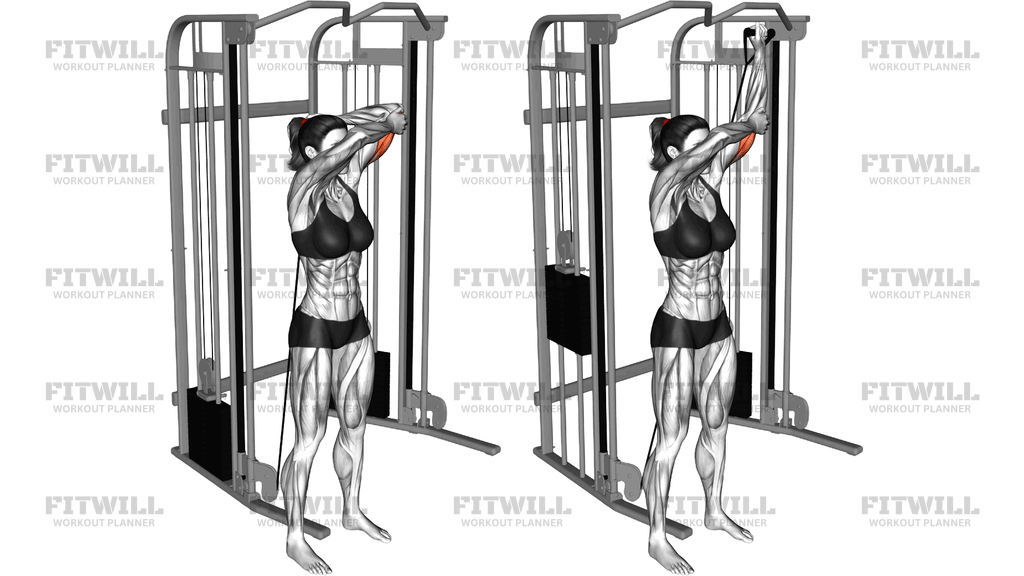
Cable Standing Neutral Grip Overhead Triceps Exte
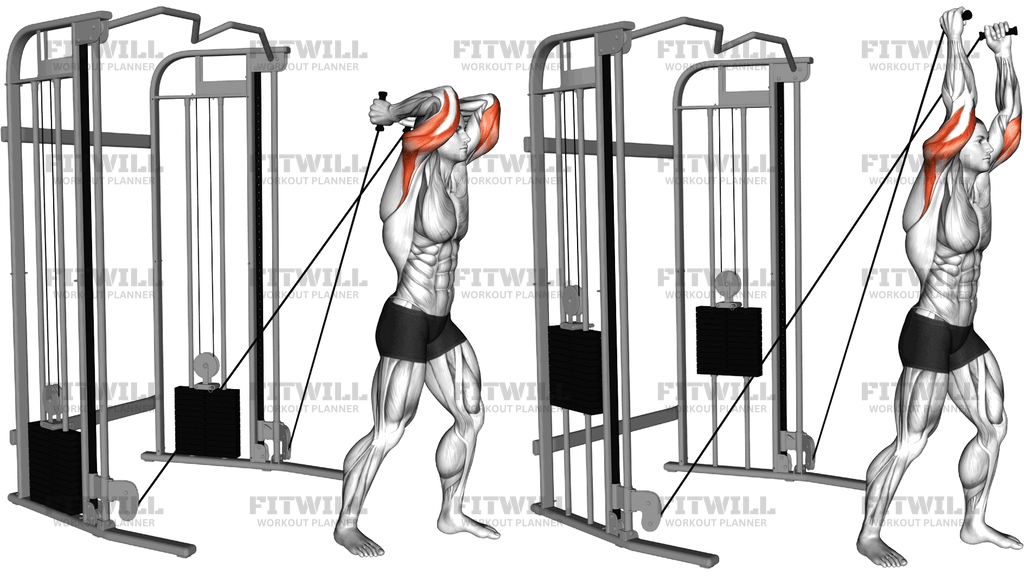
The Cable Standing Neutral Grip Overhead Triceps Extension is a cable-based isolation exercise for the back of the upper arms, performed with a rope attachment running from a low pulley behind your body. You hold the rope handles with your palms facing each other, reach overhead so the cable runs along your back, and extend your arms fully toward the ceiling before lowering the weight back down behind your head. Because the cable pulls from below and behind, the resistance stays on the triceps through the entire arc, including the stretched position that most press-down variations never load.
What makes this setup especially valuable is the overhead arm position. With your elbows raised above your shoulders, the long head of the triceps sits in a lengthened position, and that is the head most press-downs and close-grip bench variations under-train. The neutral grip also allows your wrists to sit in a comfortable, natural alignment, which is easier on the joints than a fixed straight bar and lets you focus on the extension rather than wrist discomfort.
This movement suits a wide range of lifters. Beginners can learn to isolate the triceps with a stable, guided resistance path, while more experienced trainees use it as a hypertrophy finisher or as the main triceps movement on arm-focused days. It is also a practical choice for people whose shoulders tolerate overhead work better than heavy lying barbell extensions, since the cable provides smooth tension and each arm can be monitored independently.
Setup matters more than most lifters expect. Stand facing away from the machine with a staggered stance, one foot slightly forward to give you a stable base, and lean your torso slightly ahead of vertical so the rope does not pull you backward. Your elbows should stay narrow and point forward throughout, framing your head rather than flaring outward. If you stand too far from the pulley the cable drags you back; too close and the tension is weak at the bottom of the stretch.
To execute it well, flex your elbows to lower the rope handles behind your head until your forearms approach your biceps or you feel a solid stretch across the back of the arms, then press the handles up and slightly forward until your elbows are fully extended overhead. Squeeze the triceps hard at the top, pause briefly, and lower under control rather than letting the stack drop. The elbows are the hinge; if they drift up and down with the weight, the shoulders start doing the job the triceps should own.
A few practical points keep this exercise safe and effective. Start with a lighter load than you think you need, because the overhead stretch position is where the cable feels heaviest and where form tends to break first. Keep your ribs down and your core braced so you do not arch your lower back into an exaggerated lean as the weight gets heavy, and stop the set if you feel any pinching at the shoulders or elbows.
[ Workout Log & Planner ]
Put your next workout in Fitwill
Keep your plan and training log ready when you are.


Instructions
- Attach a rope to the low pulley of a cable machine and set the weight stack to a moderate load.
- Grip the rope handles with a neutral grip, palms facing each other, and turn to face away from the machine.
- Bring the rope up over one shoulder, then stand with a staggered stance, one foot slightly forward, and lean your torso a few degrees forward.
- Start with your elbows up beside your head, bent to about ninety degrees, and the rope handles hanging behind your head.
- Brace your core and keep your ribs down so your lower back stays in a neutral position before each rep.
- Extend your elbows to press the handles up overhead until your arms are straight and your elbows are fully locked out near ear height.
- Squeeze your triceps at the top for a brief pause, keeping the elbows narrow and pointing forward.
- Lower the handles behind your head by bending the elbows only, stopping when you feel a firm stretch in the back of the arms.
- Exhale as you press up, inhale as you lower the weight back down.
- Complete all reps, then step forward and lower the handles back to the pulley with control before releasing your grip.
Tips & Tricks
- Keep the elbows from flaring outward; when they widen, the movement turns into a partial press and the stretch across the triceps long head is lost.
- Do not let the elbows travel up and down with the weight. If your shoulders are moving the rope, drop the load until only the forearms are moving.
- If the cable pulls you backward off balance, shift to a slightly longer staggered stance and lean the torso forward a touch more.
- Arching the lower back is one of the most common faults once the weight gets heavy; imagine tucking your tailbone slightly and keeping the abs tight.
- A very short distance between you and the pulley makes the rope slack at the stretch position, so step out just far enough to keep tension even at full extension.
- Slightly turn your wrists outward at full lockout, rotating away from each other, to get a stronger peak contraction at the top of each rep.
- Control the eccentric for two to three seconds; the stretched position behind the head is where this variation outperforms standard press-downs.
- If your wrists ache with the rope handles, check that your palms stay facing each other rather than bending back under load.
- Use a lighter weight and higher reps than you would for press-downs, since the overhead position makes the triceps work hardest exactly where leverage is worst.
Frequently Asked Questions
Which muscles does the Cable Standing Neutral Grip Overhead Triceps Extension work?
It targets all three heads of the triceps, with particular emphasis on the long head because the elbows overhead place it in a lengthened position. The shoulders and core contribute only as stabilizers.
Why use a neutral grip instead of a straight bar for overhead cable extensions?
With palms facing each other, your wrists are not forced into a fixed position, which reduces joint stress and often feels smoother at the elbows. Many lifters can also extend slightly harder in this alignment.
Is the Cable Standing Neutral Grip Overhead Triceps Extension suitable for beginners?
Yes, as long as the weight starts light. The cable gives a predictable resistance path, and the main skills to learn are keeping the elbows still and avoiding lower back arch.
Why does the cable pull me backward during this exercise?
The rope runs from a low pulley behind you, so it creates backward force on your torso. Use a staggered stance and lean your torso slightly forward so your body position counteracts that pull.
How far should I lower the rope handles behind my head?
Lower until your forearms approach your biceps or you feel a clear stretch across the back of your arms. Going deeper than that without elbow control invites strain rather than extra growth.
Can I do this exercise seated instead of standing?
Yes, a seated overhead version on a bench with back support removes the balance demand and makes lower back arching harder. The standing version simply adds a small stability component.
What can I substitute if my gym has no low pulley available?
A single dumbbell held in both hands overhead, or a resistance band anchored low behind you, replicates the same overhead extension pattern. Cable versions provide more even tension, but the pattern carries over.
Is overhead triceps work safe for the shoulders?
For most people it is comfortable because the cable load is adjustable and smooth. If you have a history of shoulder impingement, use a smaller range behind the head and stop before any pinching sensation.
Where should this exercise sit in my training week?
It works well as a primary triceps movement on arm days or as a finisher after pressing work, typically in sets of eight to fifteen reps. Because it loads the stretched position, treat it as a hypertrophy tool rather than a max-strength lift.
Why do my elbows drift forward at the top of each rep?
That usually means the weight is too heavy and you are turning the extension into a pressing motion. Reduce the load and think of the elbows as fixed hinges that only the forearms rotate around.