Bench Hip Extension
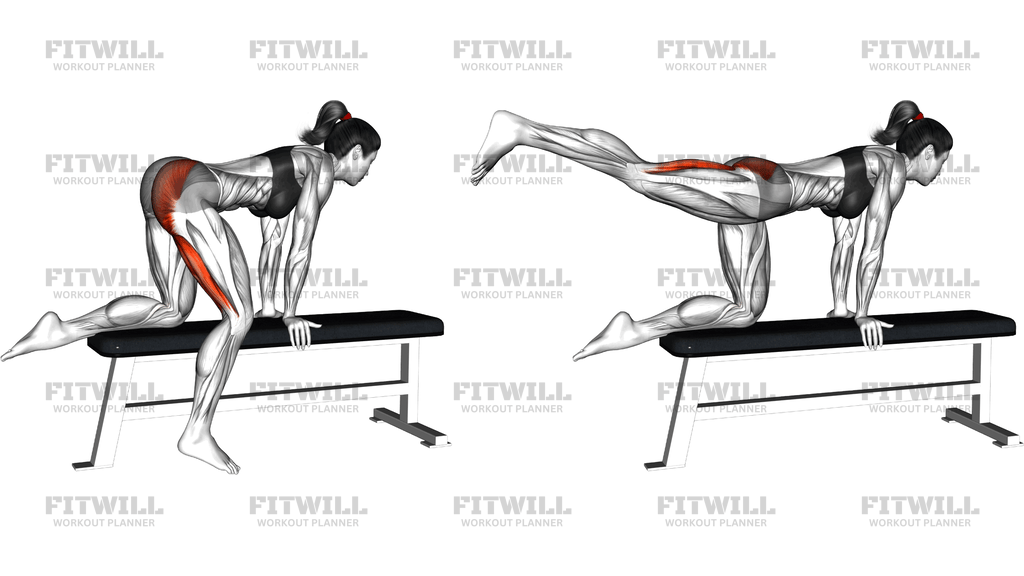
Bench Hip Extension is a kneeling bodyweight movement performed on a flat bench that isolates hip extension through a long, free range of motion. You kneel on the bench with both hands planted on the pad for support, keep one knee resting on the bench, and sweep the other leg up and back behind you until it approaches hip height or slightly above. The working leg stays straight as it rises, so the glutes and hamstrings do the lifting rather than the quads.
This exercise is especially useful for people whose glutes struggle to fire properly during bigger lifts. Because the torso is supported and the spine is close to horizontal, the lumbar muscles have a much easier job than they do in standing hip extension variations, letting you concentrate on squeezing the glute instead of fighting to stay upright. It is a popular warm-up activation drill before squats, deadlifts, and hip thrusts, and it also works well as a high-rep burnout finisher on glute day.
The main muscles worked are the gluteus maximus and the hamstrings of the moving leg. The kneeling leg's glute works isometrically to hold your pelvis steady, and the deep core engages to keep your trunk from twisting as one leg lifts. The lower back contributes as a stabilizer, but in this supported position the demand on it is modest compared with bent-over or standing variations.
Setup matters more than it looks. Your hands should be directly under your shoulders, the kneeling knee positioned so your torso is angled slightly downward rather than propped up high, and the working leg starts hanging below or just behind the edge of the bench. If you start with the leg already elevated or your hips sit too far back, the glute never gets a proper stretch at the bottom and the movement turns into a short, choppy swing.
Execution should feel like a pendulum driven from the hip, not a kick. Lift the leg by driving the thigh up and back while keeping the hips square to the bench, pause briefly at the top where the glute is fully shortened, then lower the leg slowly under control until the hip reaches a mild stretch. Swinging for momentum, arching the lower back to gain height, and rotating the pelvis open are the three habits that quietly steal the work away from the glutes.
Because it requires no equipment beyond a stable bench and no external load, Bench Hip Extension is easy to program anywhere. Beginners can learn it with a small range and higher reps, while more advanced lifters can add ankle weights, a resistance band, or tempo pauses once strict bodyweight reps feel easy.
[ Workout Log & Planner ]
Put your next workout in Fitwill
Keep your plan and training log ready when you are.


Instructions
- Place a flat bench on a non-slip surface and set one knee in the middle of the pad, with your other foot on the floor behind the bench to steady yourself before you begin.
- Place both palms flat on the bench directly under your shoulders with your arms straight, then lift your back foot off the floor so you are supported only by your hands and one kneeling knee; let the working leg hang down behind the edge of the bench.
- Angle your torso slightly downward toward the bench and lightly brace your abdominal muscles so your pelvis stays level with the floor.
- Begin each rep with the working hip in a mild stretch, thigh hanging down and slightly behind your body, knee extended but not locked.
- Squeeze the glute of the working leg and raise the straight leg up and back until it reaches about hip height or slightly higher, keeping the hips square to the bench.
- Pause for one to two seconds at the top and actively contract the glute rather than relying on momentum.
- Lower the leg slowly over two to three seconds until the hip returns to the stretched starting position.
- Exhale as the leg rises, inhale as it lowers, and keep the breath steady rather than holding it.
- Complete all reps on one side, then switch legs so the opposite knee rests on the bench, and reset your hand position and brace before starting the second set.
Tips & Tricks
- If your lower back arches to lift the leg higher, stop at the height where your torso position is unchanged; extra range gained by arching comes from the spine, not the glutes.
- Check that your hips have not rotated open at the top of each rep — both hip points should face straight down toward the bench throughout.
- Keep the supporting knee from sliding toward the edge of the bench; if you drift forward mid-set, reposition and reset your grip before continuing.
- A common mistake is kicking the leg up fast and letting it drop; if you cannot lower it over a slow two-count, the set is being driven by momentum.
- Feel the working glute cramp or the front of the hip pinch? Squeeze the glute consciously before lifting and shorten the range slightly rather than pushing through discomfort.
- Point the toes of the working leg down or keep the foot neutral — do not turn the sole of the foot toward the ceiling, which encourages the pelvis to rotate.
- Place a folded towel under the kneeling knee if the bench pad feels thin, and keep the ankle of the supporting leg relaxed so tension stays in the hip, not the knee.
- Once fifteen strict reps per side feel easy, add an ankle weight or loop a light band around the working ankle and the base of the bench before adding speed or height.
Frequently Asked Questions
Which muscles does the Bench Hip Extension work?
The gluteus maximus of the lifting leg is the primary mover, with the hamstrings assisting. The glute of the kneeling leg and the deep core work statically to keep the pelvis and trunk steady.
Is the Bench Hip Extension good for beginners?
Yes, because the bench supports your torso and there is no external load to manage. Beginners should use a shorter range and focus on feeling the glute contract before adding reps, tempo, or weight.
How high should I lift my leg during the Bench Hip Extension?
Roughly to hip height or slightly above is enough for most people. If the leg goes higher only by arching your lower back or opening the hip, you have passed the range your glutes are actually controlling.
Why do I feel the Bench Hip Extension in my lower back instead of my glutes?
That usually means your spine is extending to lift the leg rather than the hip doing the work. Reduce the height of each rep, tighten your abs before lifting, and imagine the thigh driving straight back, not up.
How does kneeling on the bench change the exercise compared with standing hip extensions?
The supported, near-horizontal torso removes most of the balance and lower back demands of the standing version. This makes it easier to isolate the glute and control the pelvis rep by rep.
Can I add weight to the Bench Hip Extension?
Yes. Ankle weights or a light resistance band looped around the working ankle work well once strict bodyweight reps are comfortable. Add load gradually, since the glute shortens fully at the top and that position is where added load is felt most.
What can I substitute if I do not have a bench?
A quadruped hip extension on the floor, sometimes called a donkey kick, trains the same pattern with less range, and a stability ball can also replace the bench if it is firm and will not roll.
How many reps and sets should I do?
For activation before lower body training, two sets of ten to fifteen controlled reps per side work well. As a glute finisher, three to four sets of fifteen to twenty reps per side with a two-second top pause is a solid target.
Is the Bench Hip Extension safe for my knees?
For most people, yes — the moving leg stays relatively straight and the load is light. If kneeling on the bench bothers the supporting knee, pad the surface and place the knee near the middle of the pad rather than at the edge.