Resistance Band Assisted Muscle Up
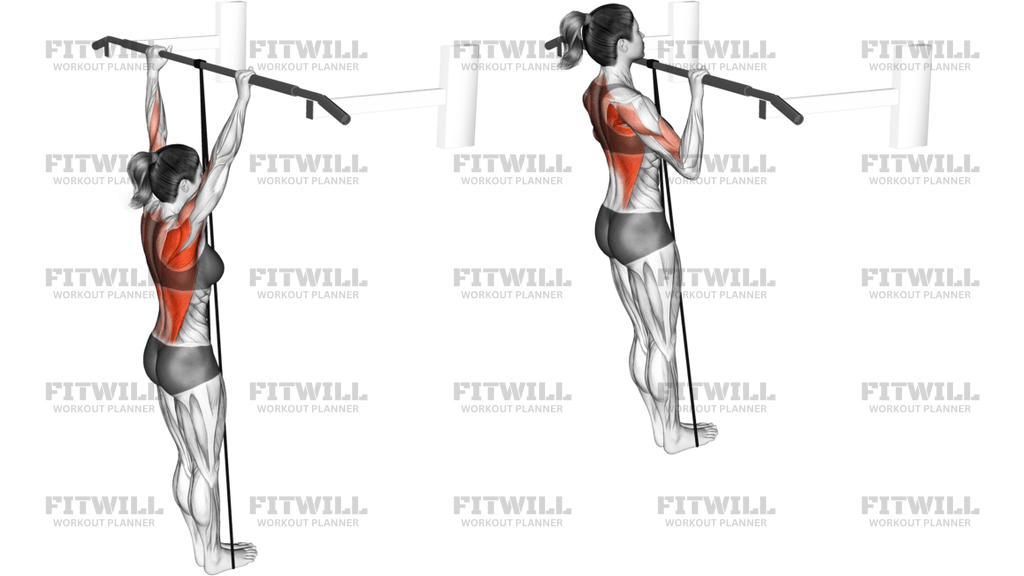
The Resistance Band Assisted Muscle Up is a progression exercise for learning the muscle up on a pull-up bar or power tower. A looped resistance band is anchored over the bar and placed under one or both feet, which offsets part of your body weight through the hardest portions of the lift. From a dead hang, you pull explosively, transition over the bar, and press up until your arms are locked out in a support position above the bar.
This movement is aimed at anyone who can already perform several strict pull-ups and dips but cannot yet link them into a smooth muscle up. The muscle up fails for most people at the transition point, where a pull-up ends and a dip has not yet begun. The band removes just enough load to let you practice that transition repeatedly without grinding or swinging your way through it, which is how bad technique habits usually start.
The exercise trains the lats and upper back through the pulling phase, the biceps and forearms during the hang and early pull, and the chest, shoulders, and triceps during the press out to support. Your core works hard the entire time to keep your body from swinging, especially as your hips pass the level of the bar and your weight shifts forward over your hands.
Setup matters more here than in most assisted exercises. The band tension changes throughout the rep, providing the most help at the bottom and less as you approach the top, so a band that is too strong will let you skip the transition entirely. Loop it over the bar so it hangs securely, place your foot well inside the loop, and check that it cannot slip off your foot mid-rep before you commit to pulling.
A good rep looks like one continuous path: an aggressive pull toward the bar, a controlled lean back and over the top as the elbows sweep down, then a press to straight arms with your shoulders stacked over your hands. Resist the urge to kick or kip into the movement. The goal is a clean groove your body can later reproduce with less or no assistance.
Use this drill as the main muscle up progression in a session when you are fresh, typically 3 to 5 sets of 2 to 5 reps. As the reps become crisp, move to a lighter band rather than adding volume, so the strength you build transfers directly to an unassisted muscle up.
[ Workout Log & Planner ]
Put your next workout in Fitwill
Keep your plan and training log ready when you are.


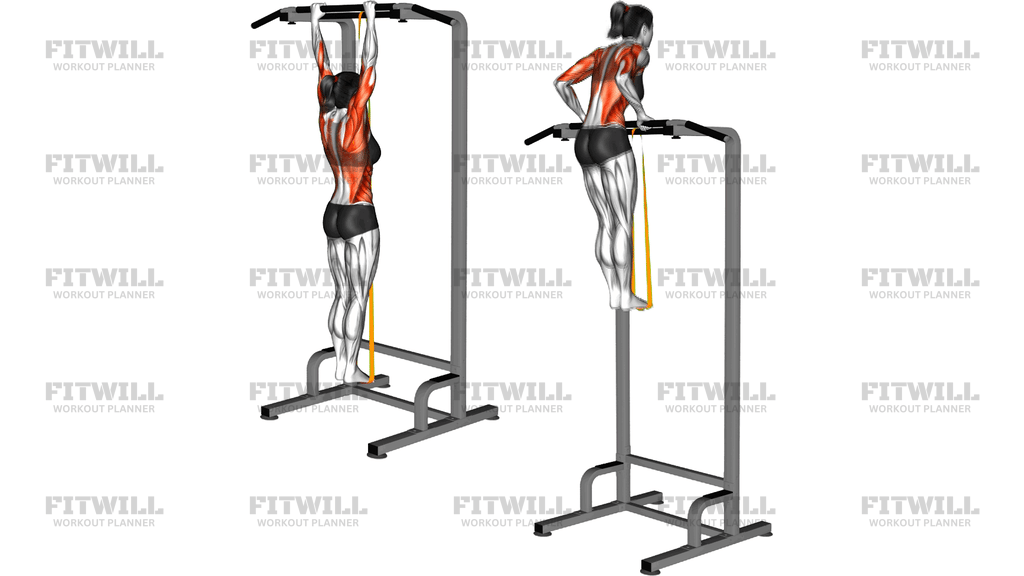
Instructions
- Loop a resistance band over the pull-up bar of a power tower and pull it down through itself so it hangs securely from the bar.
- Place one foot fully inside the bottom of the band loop, point that foot slightly downward to keep the band from slipping, and let your other leg hang below or lightly cross behind it.
- Grip the bar with an overhand grip slightly wider than shoulder width, arms fully extended, and let the band take up tension under your foot.
- Brace your core and squeeze your glutes lightly so your body forms a straight, controlled line from head to heel with minimal swing.
- Pull hard and fast with your elbows driving down toward your hips, keeping the bar close to your chest rather than pulling straight up in front of it.
- As your chest reaches the bar, lean back slightly, then shift your weight forward over your hands while your elbows sweep down and back.
- Press forcefully through your palms until your arms are straight and your shoulders are stacked directly over your hands in a support position above the bar.
- Breathe in before the pull, exhale forcefully through the transition and press, and avoid holding your breath through the entire rep.
- Lower yourself in control: bend your elbows, let your body drop back toward the bar, then extend your arms fully to return to the dead hang with the band still under your foot.
- Reset for a few seconds at the bottom, recheck the band on your foot, then start the next rep from a still hang rather than a swing.
Tips & Tricks
- If your body pitches forward at the top and you cannot press out, the transition is your weak link, not your pulling power. Add slow transition drills at a lower band tension instead of doing more full reps.
- A common mistake is pulling the bar too far in front of the body, which makes the transition nearly impossible. Cue yourself to pull the bar toward your lower chest, not to pull your chest straight up.
- Keep the banded foot flexed and the toes angled down. If the band rolls toward your toes and slips, you lose assistance mid-rep at the exact moment you need it most.
- Do not chase extra height with a hard knee drive or hip kick. A small, controlled knee lift is fine to initiate the pull, but violent kipping turns this into a momentum drill and undermines the strength you are trying to build.
- Progress by reducing band thickness, not by adding reps. Once you can complete 5 clean reps with a given band, move to the next lighter band and rebuild from 2 to 3 reps.
- If one side rises faster than the other because only one foot is banded, alternate which foot goes in the band between sets to keep the load balanced.
- Warm up with strict pull-ups and straight-bar dips first. Going into the transition cold is the most common cause of a stalled, ugly rep where the elbows never come over the bar.
- Inspect the band before every session for small tears or thin spots. A snapped band while you are above the bar is a real fall risk on a power tower.
- Keep your wrists rolled over the bar as your hands move from pull to press. Letting your wrists bend back sharply during the transition strains the forearms and makes the press weaker.
Frequently Asked Questions
What muscles does the Resistance Band Assisted Muscle Up work?
The lats and upper back do most of the pulling work, the biceps and forearms assist through the hang and early pull, and the chest, shoulders, and triceps handle the press to support. Your core stabilizes your body through the entire transition.
Can beginners use the Resistance Band Assisted Muscle Up?
It is not a beginner exercise. You should be able to do several strict pull-ups and supported dips first, because the band only reduces load, it does not change the coordination the movement demands.
How strong should the resistance band be for this exercise?
Choose a band that lets you complete the full transition to a support position with control but still feels hard at the top. If the band launches you above the bar easily, it is too strong and you are practicing less than you think.
Why do I get stuck at the transition point of the Resistance Band Assisted Muscle Up?
The transition is the hardest part because pulling strength runs out before pressing strength takes over. Slow down slightly before the bar, pull it toward your lower chest, and practice the lean-over movement with a stronger band until the path feels natural.
Should one foot or both feet be in the band?
One foot in the band is the standard setup shown here, which leaves your other leg free to balance and makes it easy to step out safely. Both feet in the band gives more assistance but makes dismounting and switching bands clumsier.
What is a good substitute if I do not have a power tower with dip handles?
You can perform Resistance Band Assisted Pull-Ups and band-assisted dips as separate exercises, or use an Assisted Pull-Up Machine to train the pulling and pressing phases. The linked transition is best practiced on a bar you can actually get over, so a power tower or low pull-up bar is ideal.
How many reps and sets should I do of the Resistance Band Assisted Muscle Up?
Because it is a skill-heavy strength movement, keep the volume low and the quality high: 3 to 5 sets of 2 to 5 reps while fresh, resting fully between sets. Stop the set as soon as your form breaks down into swinging.
Is it safe to jump down from the support position at the top?
It is better to lower back over the bar under control and finish in the dead hang, then step off. Dropping from full support repeatedly hammers the elbows and shoulders and defeats the purpose of practicing the controlled descent.
How long does it take to move from the Resistance Band Assisted Muscle Up to an unassisted muscle up?
It depends on your starting strength, but most people who already have solid pull-ups and dips progress through progressively lighter bands over several weeks to a few months. Move to a lighter band once 5 clean reps feel smooth rather than adding endless volume.