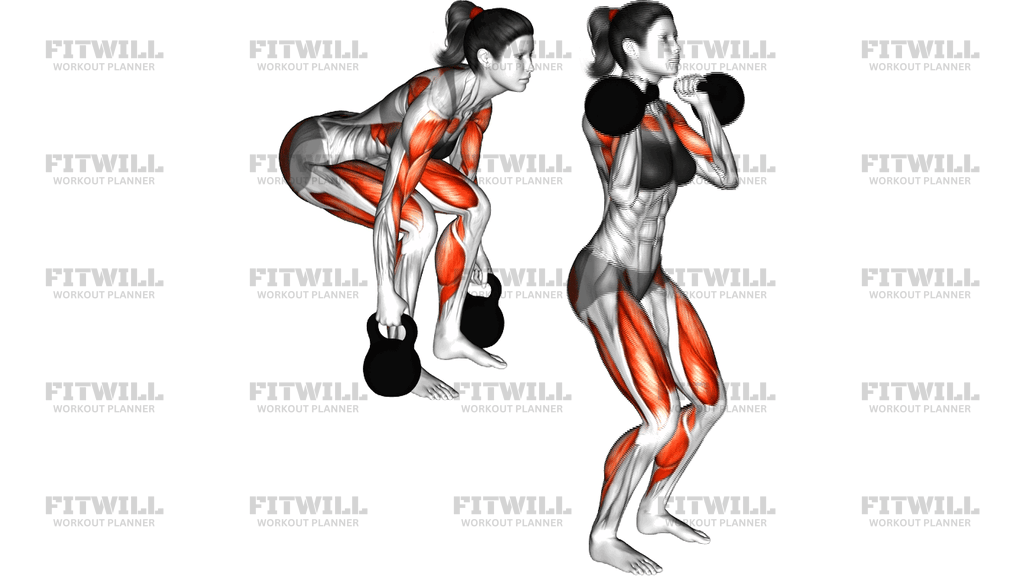
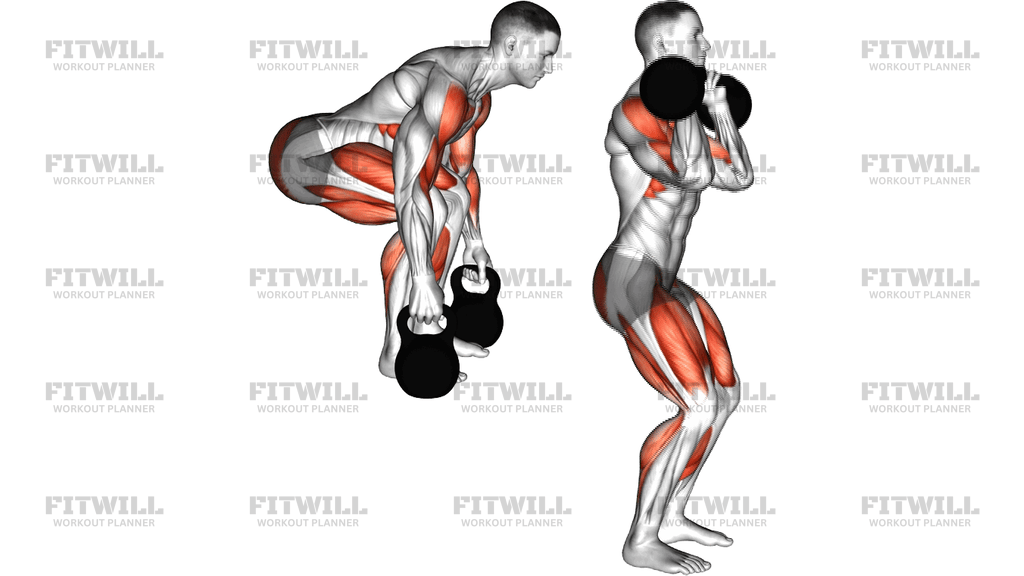
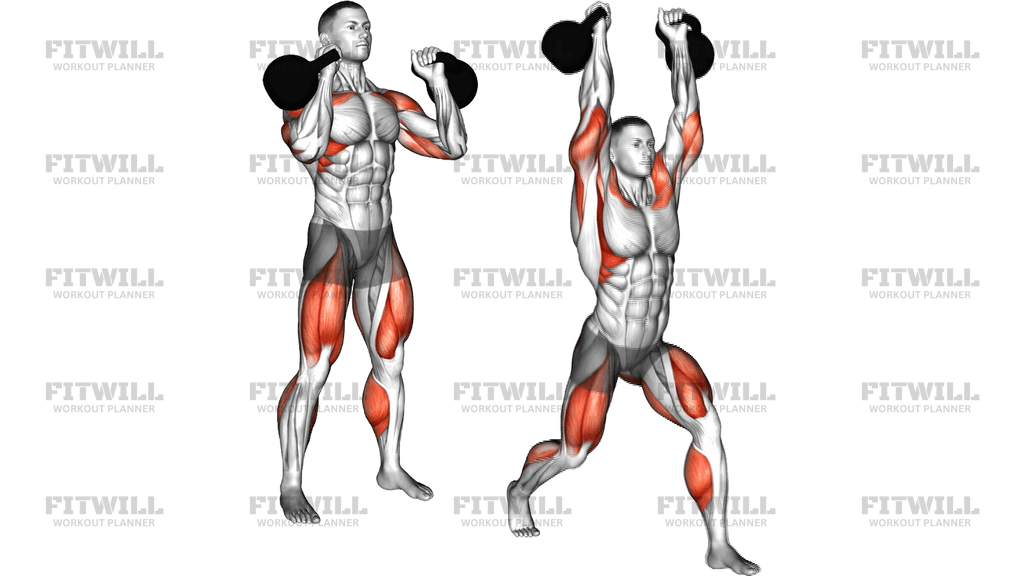
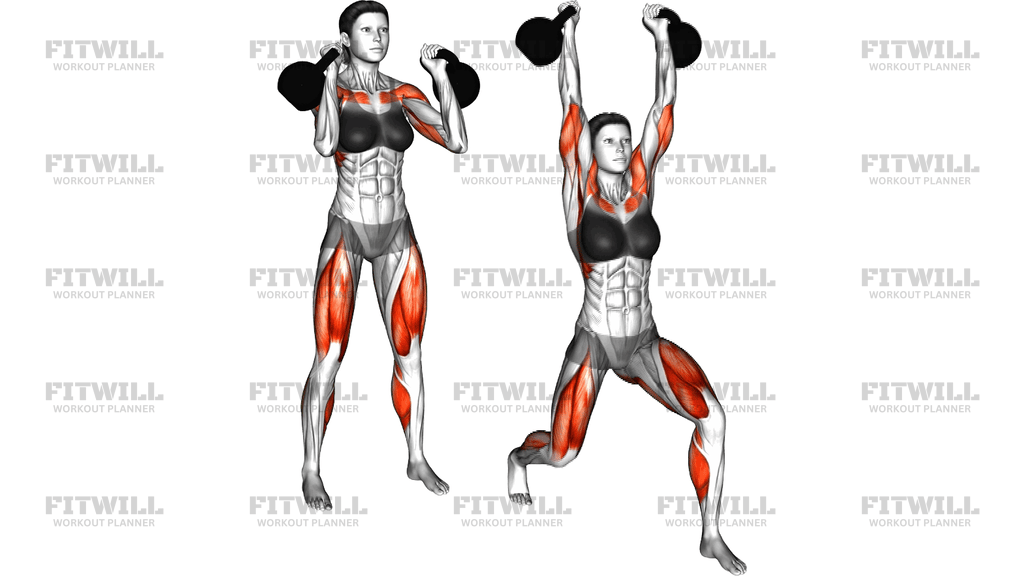
Kettlebell Turkish Get Up (Squat Style)
The Kettlebell Turkish Get Up (Squat Style) is a full-body ground-to-standing movement where you hold a kettlebell locked out overhead the entire time. Unlike the classic lunge-style version, you rise from the floor through a seated position and then pull yourself into a deep squat before standing all the way up. You then reverse the exact same sequence to return to the floor, keeping your eyes on the bell throughout.
This exercise is one of the best all-in-one builders of shoulder stability, core strength, and coordinated movement. The overhead arm has to stay vertical and stacked while everything beneath it changes position, which challenges the rotator cuff, traps, and upper back in a way presses cannot. Meanwhile, the transitions off the floor demand serious work from the abs, obliques, glutes, and legs.
The squat style variation is especially useful for lifters who want to reinforce a strong, upright bottom position in their squat, and for anyone who wants to train getting up and down off the floor with load — a skill with clear carryover to daily life. It suits intermediate trainees who already own a clean overhead lockout, and it rewards patience far more than speed.
Setup matters more here than in almost any other kettlebell lift. Because you start lying on your back with the bell overhead, a missed rep puts the weight directly above you, so choose a kettlebell you can press and control confidently, work on a non-slip surface or mat, and never let the bell drift behind your head line. The arm should finish stacked over the shoulder, elbow locked, wrist straight.
Good execution looks slow and deliberate: roll up to your elbow, then your hand, sweep the leg through to a seated position, drive through both feet into a squat, and stand tall. On the way down, retrace every step exactly — squat down, sweep the leg back, lower to the hand, then the elbow, then roll to the floor. Rushing or skipping steps is where the bell ends up in the wrong place, so treat each rep as a sequence of positions rather than one fluid race.
[ Workout Log & Planner ]
Put your next workout in Fitwill
Keep your plan and training log ready when you are.


Instructions
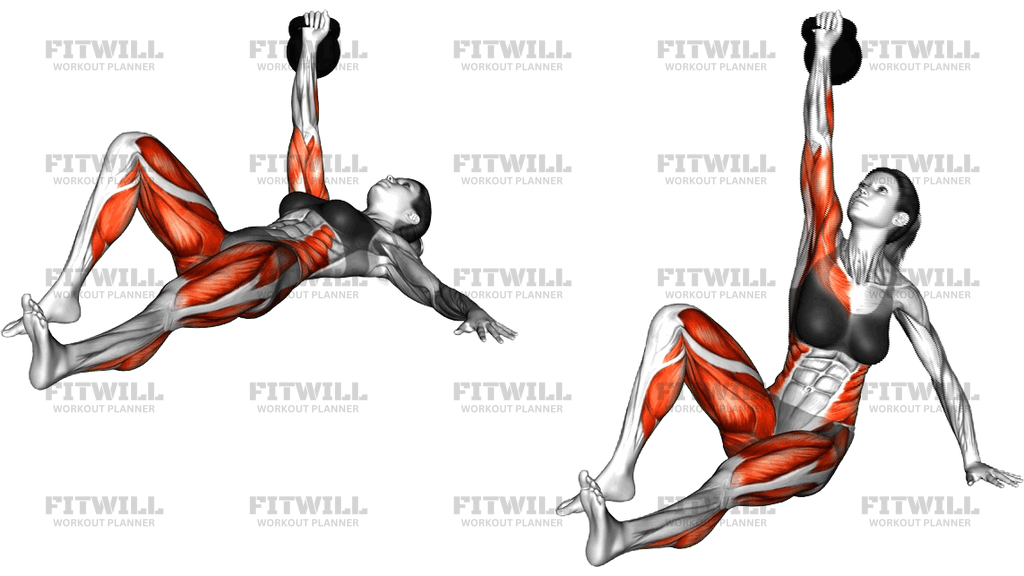
- Lie on your back on a mat with a kettlebell beside your right shoulder. Roll the bell into your right hand and press it up until your arm is straight and stacked directly over your shoulder, then bend your right knee and plant that foot flat, keeping the left leg extended and the left arm out at about 45 degrees.
- Keep your eyes on the kettlebell and brace your torso as if bracing for a light punch before every transition.
- Drive through the planted right foot and roll up onto your left elbow, keeping the kettlebell pointed at the ceiling and your shoulder blade pulled down your back.
- Press up from your elbow onto your left hand so the supporting arm is straight, and sit up tall with your chest lifted.
- Sweep your extended left leg back under your hips and kneel so your left knee and right foot form a stable base, still holding the bell locked out overhead.
- Push through both feet and rise into a deep squat in one piece, chest up and eyes on the bell, then stand all the way up until your legs are straight and the kettlebell is overhead.
- Pause at the top, then reverse the pattern exactly: squat down, sweep the left leg forward to kneel, sit back onto your left hand, lower to your elbow, then roll your upper back down to the floor.
- Once your shoulders are on the ground, bring the kettlebell back over your chest and lower it with your left hand assisting, keeping it under control rather than dropping it.
- Exhale on the hardest parts of each transition — the roll up, the squat drive, and the descent — and breathe steadily while holding positions.
- Complete all repetitions on one side, then switch the bell to the other hand and repeat, always returning the bell to the floor with both hands.
Tips & Tricks
- Keep the loaded arm vertical the whole time, not just pointed upward. If the bell drifts toward or behind your head, that is a sign the shoulder is fatiguing — set the rep down and rest rather than muscling it back.
- Most people try to sit straight up during the roll to the elbow. Instead, think of rolling diagonally across your back toward the supporting elbow, like you are sliding a newspaper out from under your body.
- In the squat-style ascent, keep your chest as upright as possible from the kneel to the stand. Leaning forward dumps load onto your lower back and makes the bell drift forward off your shoulder line.
- If the bell feels unstable overhead, the problem is often a bent wrist. Keep the knuckles facing the ceiling and the forearm vertical; a floppy wrist compounds every small error as you move through the transitions.
- Start with a weight you could comfortably press five to eight times, not your one-rep max. The get up taxes the shoulder isometrically for far longer than a press does.
- Practice the no-hands version — balancing a flat shoe or an empty hand overhead — until every transition is familiar before adding meaningful load.
- Do not rush the descent. The way down is where most bell drops happen because people relax once they think the rep is finished.
- Keep the supporting hand actively pressing into the floor during the elbow and hand phases; a lazy support arm makes the sit-up feel twice as heavy.
- Work on a mat with clear space around you, and never turn your head away from the kettlebell while it is overhead.
Frequently Asked Questions
What muscles does the Kettlebell Turkish Get Up (Squat Style) work?
The shoulders — especially the deltoids and rotator cuff — work isometrically to hold the bell overhead, while the abs, obliques, glutes, and legs drive the transitions. The grip and upper back get steady work stabilizing the kettlebell throughout.
What makes the squat style different from the standard Turkish Get Up?
In the squat style you sweep the leg through to a seated or kneeling position and then rise into a deep squat to stand, instead of stepping up into a lunge. This places more demand on the legs, hips, and upright torso control, and it closely mimics getting up off the floor naturally.
Is the Kettlebell Turkish Get Up (Squat Style) suitable for beginners?
Beginners should start with the movement unloaded or with a very light weight until every transition feels automatic, since the squat pattern demands good hip and ankle mobility. Learning the half get up first — stopping at the seated position — is a smart progression.
How heavy should my kettlebell be for this exercise?
Choose a bell you can press overhead and hold steadily for 30 to 60 seconds. The get up holds the shoulder under load for much longer than a press, so control matters more than the number on the bell.
Why do I have to keep my eyes on the kettlebell the entire time?
Watching the bell keeps your head and neck in a stable position and lets you catch drift before it becomes a problem. Taking your eyes off the weight overhead is one of the fastest ways to lose the lockout position.
How many reps should I do?
One to three slow, controlled reps per side is plenty for most people, since each rep takes 30 to 60 seconds of continuous tension. Quality of positions matters far more than rep count.
What should I do if my wrist starts bending under the weight?
Stop the rep and lower the bell safely rather than pushing through it. A bending wrist usually means the weight is too heavy or your grip is too loose — the handle should rest across the heel of your palm with the wrist locked straight.
Can I substitute anything if I do not have a kettlebell?
A single dumbbell works, though its center of gravity makes the lockout less stable, and a barbell or heavy book held flat can be used for no-load practice. The kettlebell's offset handle is simply the most comfortable option for this movement.
Is it safe to start lying on the floor with a weight overhead?
It is safe when you press the bell up with your free hand assisting, keep it over your shoulder — never behind your head — and use a weight you control confidently. Always set the bell down with both hands rather than dropping or collapsing it at the end of a set.
How does the squat style help my barbell squat?
Rising from the kneel into a deep squat with an overhead load reinforces an upright torso, braced core, and controlled bottom position. It is a common corrective drill for lifters who collapse forward out of the hole.