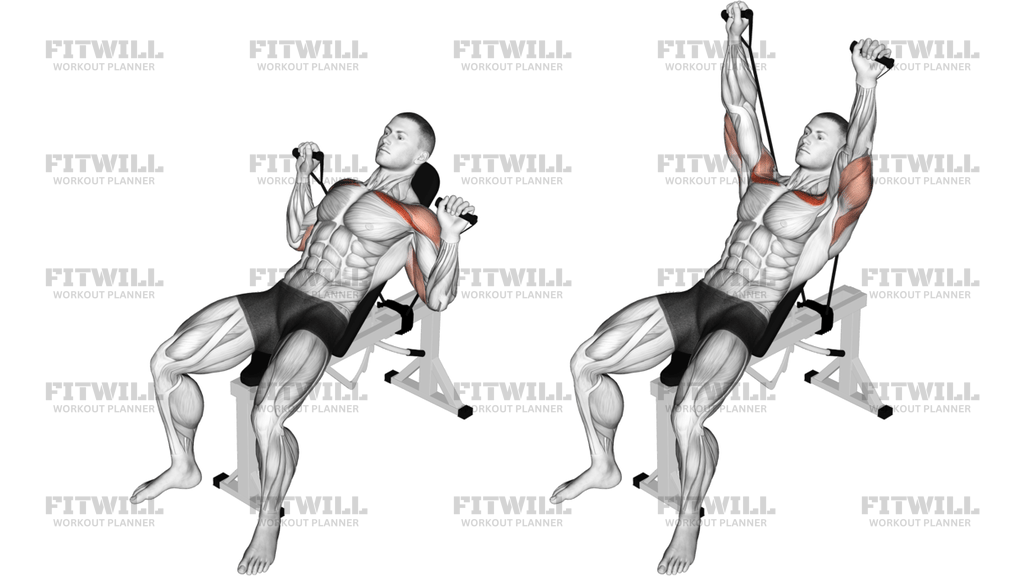
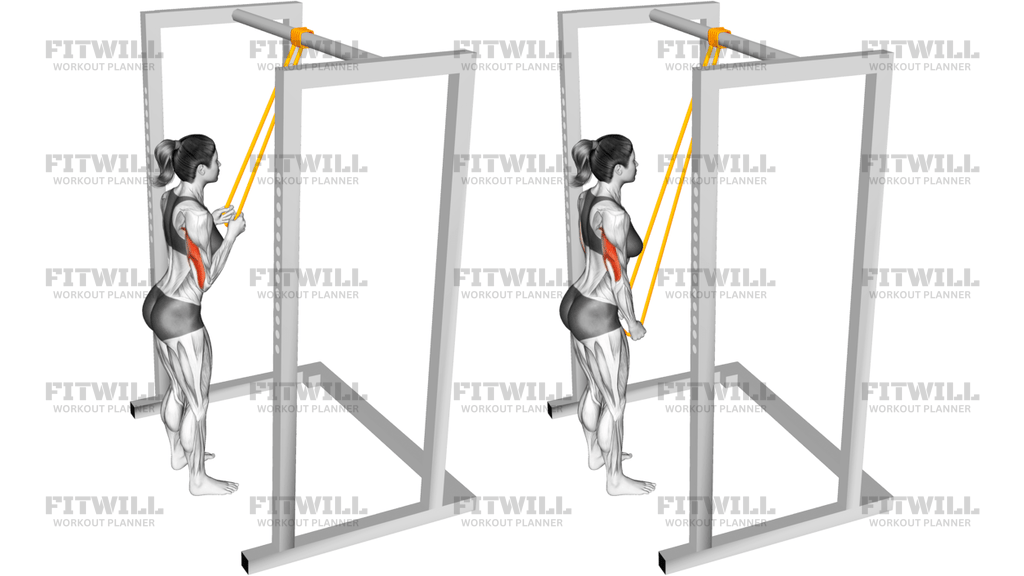
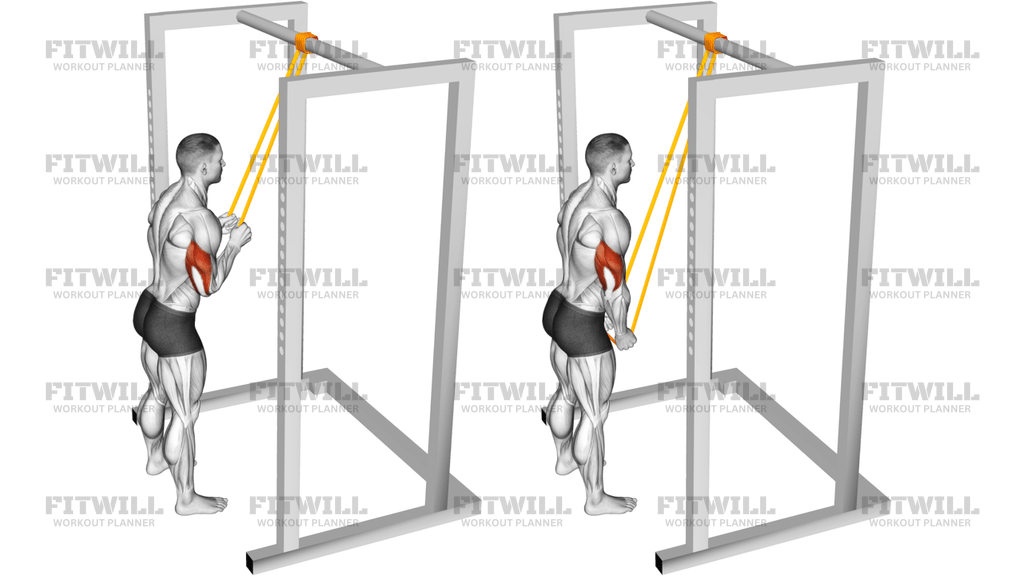
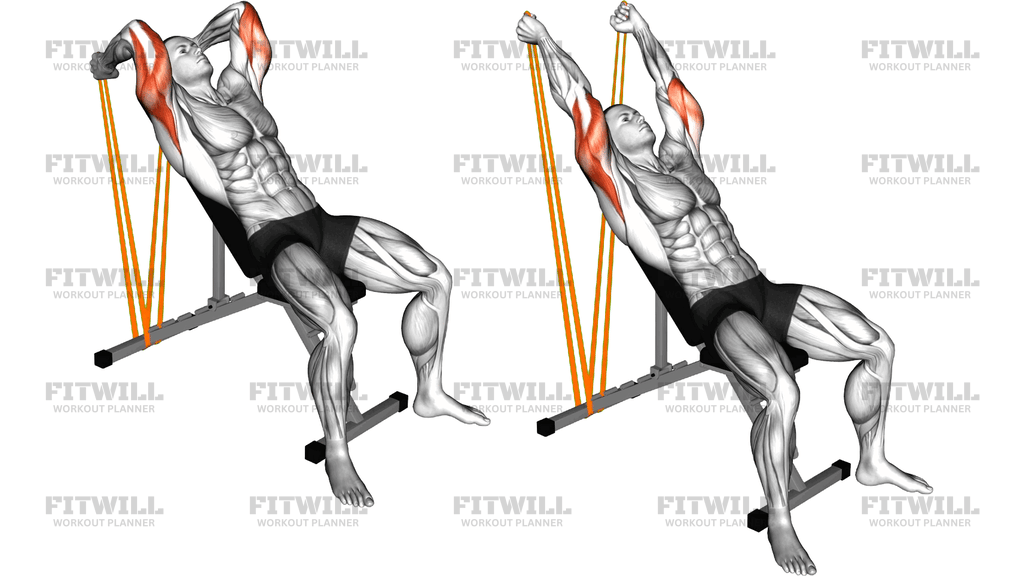
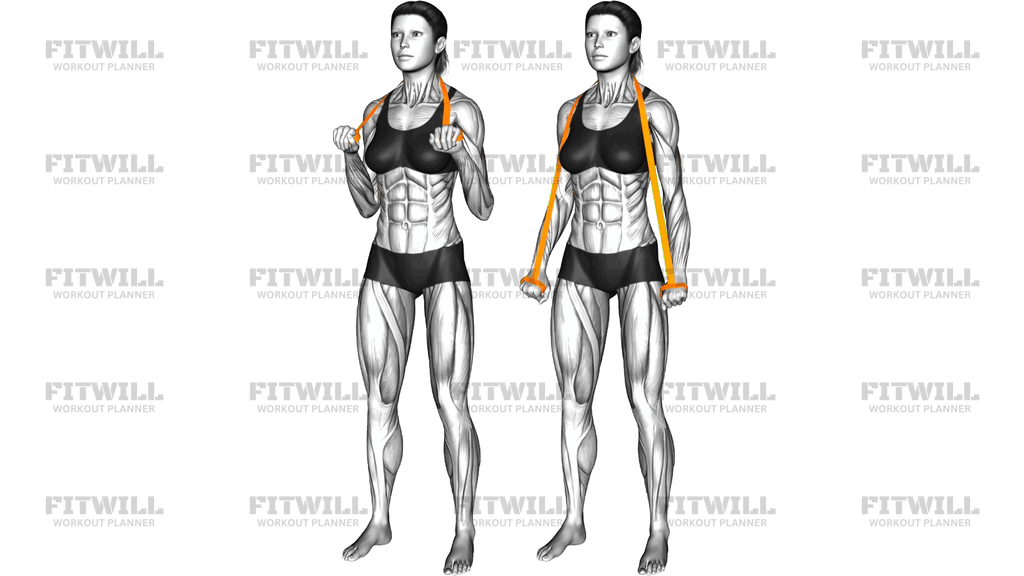
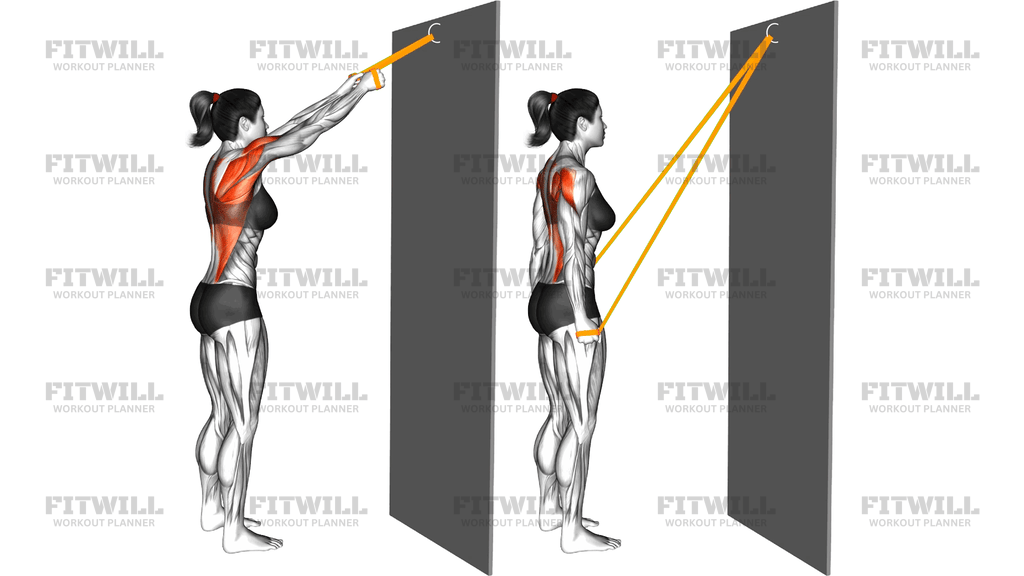
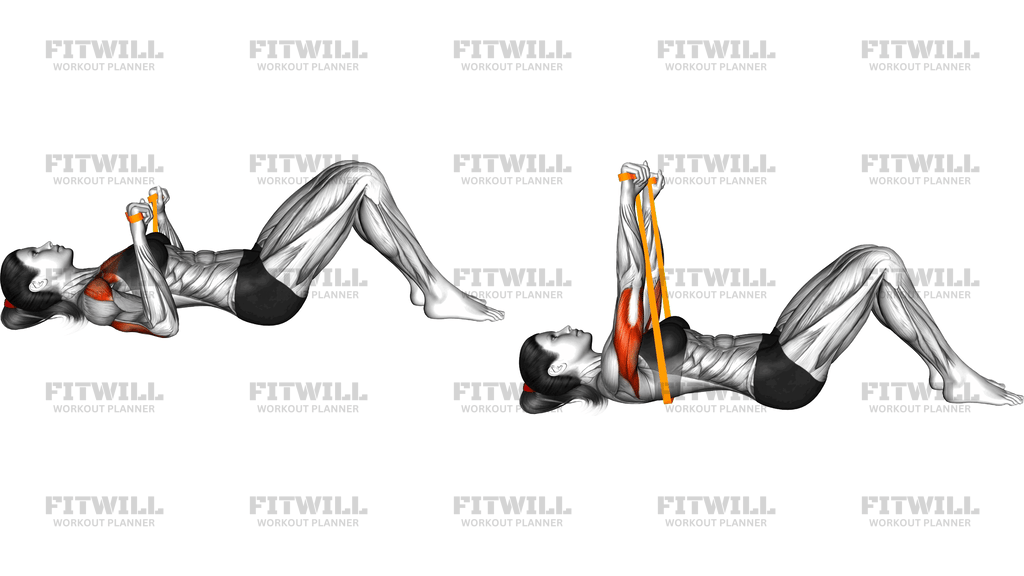
Band High Pulley Overhead Triceps Extension
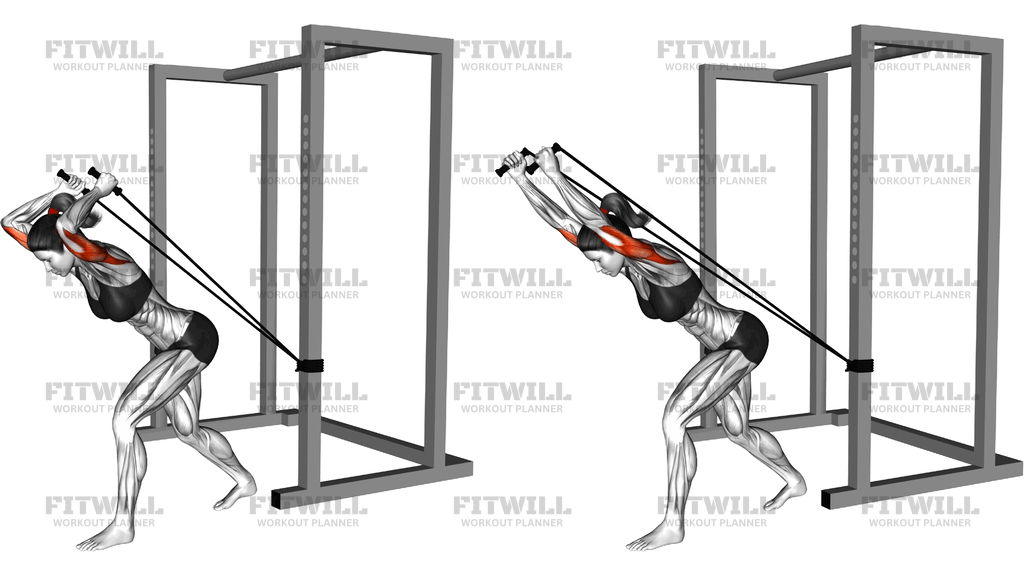
The Band High Pulley Overhead Triceps Extension is a bent-over overhead extension where a resistance band, anchored low behind you, provides the load as you straighten your arms from behind your head. You stand in a split stance with your torso hinged forward, hands gripping the band handles, and press the band up and forward until your arms are fully extended overhead. Because the band pulls from a low anchor point behind your body, the tension keeps working your triceps through the entire overhead arc.
This movement primarily trains the triceps, with particular emphasis on the long head, which is most active when the shoulder is flexed overhead. Your front shoulders assist to hold the arms up, and your core and upper back work isometrically to keep your hinged torso stable while the band pulls you backward. It is essentially a band-based version of the high-pulley overhead cable extension, making it useful when you do not have access to a cable machine.
The forward-leaning stance is what separates this from a standard standing overhead extension. Hinging the torso forward and anchoring the band low changes the resistance angle so the band challenges your triceps in a stretched overhead position rather than pulling straight down your back. Your rear leg acts as a brace, so set your split stance deliberately before you start pressing.
To execute it well, keep your elbows narrow and pointing forward throughout, and let only the forearm move during the extension. The elbows should stay roughly at the same height as your ears or slightly above, bending to lower the handles behind your head and extending to press the band up. Avoid flaring the elbows outward or turning the movement into a shoulder press, since that shifts effort away from the triceps.
This exercise fits well as a finishing movement on an arm day, as a home-friendly substitute for overhead cable work, or as a way to train the long head of the triceps with minimal equipment. Because band tension increases as you extend, the hardest part of the rep is at lockout, which many lifters find gentler on the elbow joint than fixed-weight overhead loading.
For safety, check that the band anchor is secure before each set and that the band has no visible wear. Start with a light band until you can control the backward pull without your torso collapsing forward, and keep your neck neutral by looking down at the floor a short distance ahead of you rather than craning upward.
[ Workout Log & Planner ]
Put your next workout in Fitwill
Keep your plan and training log ready when you are.


Instructions
- Anchor a resistance band low on a rack or sturdy object behind you, then grab one handle in each hand and walk forward until the band is taut with your arms extended overhead.
- Take a split stance with your left foot forward and right leg back, then hinge your torso forward to roughly 45 degrees so the band runs past your shoulder toward the low anchor behind you.
- Brace your core, soften your knees, and look down at the floor slightly ahead of you to keep your neck in line with your spine.
- Begin with your elbows bent and pointed forward, hands behind or beside your head, and feel the band pulling your arms back toward the anchor.
- Extend your elbows to press the handles up and forward until your arms are straight overhead and in line with your torso angle.
- Squeeze the triceps briefly at full extension without locking the elbows hard or shrugging your shoulders toward your ears.
- Bend your elbows slowly to let the band draw your hands back behind your head, resisting the pull until your forearms return to the start position.
- Exhale as you press up, inhale as you lower back down, keeping the breathing steady and controlled.
- Complete all repetitions, then switch your stance so the opposite leg is forward and repeat for balanced work.
Tips & Tricks
- If the band drags you backward as you press, step farther away from the anchor or use a lighter band; you should be able to hold the hinged position without being pulled onto your back foot.
- Keep your elbows from drifting wider than shoulder width. Flared elbows turn the movement into a partial shoulder press and reduce the stretch on the triceps long head.
- The bend should come only from the elbows. If your shoulders are rising and lowering with each rep, the load is too heavy or the band angle is pulling you out of position.
- Match your torso angle on both sides of each set. A common habit is to stand more upright as fatigue sets in, which changes the resistance curve and shortens the overhead range.
- Alternate which leg is forward each set. Since the rear leg carries the brace against the band's pull, always training the same split can create an uneven setup.
- Stop the extension just short of a hard elbow lockout if your elbows are sensitive; the band's peak tension at that point makes full lockout unnecessary for stimulus.
- Choose a band length that leaves tension even at the bottom position. If the band goes slack when your elbows are bent, the triceps lose the stretch portion of the rep.
- Check the anchor point and band surface before every session. A band slipping off a low attachment mid-press is the main safety risk in this setup.
- Keep your wrists straight and stacked over your forearms. Bending the wrists backward under the band's pull strains the forearms and blurs the feeling in the triceps.
Frequently Asked Questions
Which muscles does the Band High Pulley Overhead Triceps Extension work?
The triceps are the prime movers, especially the long head because the shoulder is flexed overhead. The front shoulders help hold the arms up, and your core and upper back stabilize the forward-leaning torso.
Why is the torso bent forward in this exercise instead of standing upright?
Hinging forward changes the angle between your arms and the low-anchored band so the resistance loads the triceps in the overhead position, similar to a high-pulley cable setup. Standing upright with the same low anchor would pull the band down behind you and alter the resistance curve.
Can beginners do the Band High Pulley Overhead Triceps Extension?
Yes, provided they start with a light band and master the hinged split stance first. The band pulling backward is the trickiest part, so beginners should prioritize a stable torso over adding resistance.
What is the most common mistake with this movement?
Letting the elbows flare out or drop as the band pulls back, which turns the extension into a shoulder-dominant press. Cue yourself to keep the elbows narrow and fixed, moving only the forearms.
What can I use if I do not have handles on my band?
You can grip the band ends directly or loop the band around your palms, though handles give a more secure grip when the band is taut overhead. A single band with two anchorable ends works best for this setup.
How does this compare to an overhead cable triceps extension?
It mimics the same overhead path and long-head emphasis, but band tension rises toward lockout while a cable stays more constant. Many people find the band version easier on the elbows at full extension.
How far should I stand from the band anchor?
Far enough that the band is already under light tension when your elbows are bent behind your head, but not so far that it drags your torso backward during the press. Adjust your distance before starting the set rather than mid-rep.
Should my elbows be at head height or above?
Aim to keep your elbows roughly at ear height or slightly above and pointing forward. Letting them sink below shoulder level as the band pulls reduces the overhead stretch and shifts tension toward the shoulders.
Is it safe for the shoulders and elbows?
For most people, yes, when the load is controlled and the elbows stay narrow. If overhead positions cause shoulder discomfort, reduce the range of motion, use a lighter band, or consult a qualified professional before continuing.
How many reps and sets work well for this exercise?
Two to four sets of 10 to 15 reps is a solid range, since bands allow smooth, joint-friendly volume. Use it near the end of an upper-body or arm session when the triceps are already warm.