Resistance Band Incline Triceps Extension
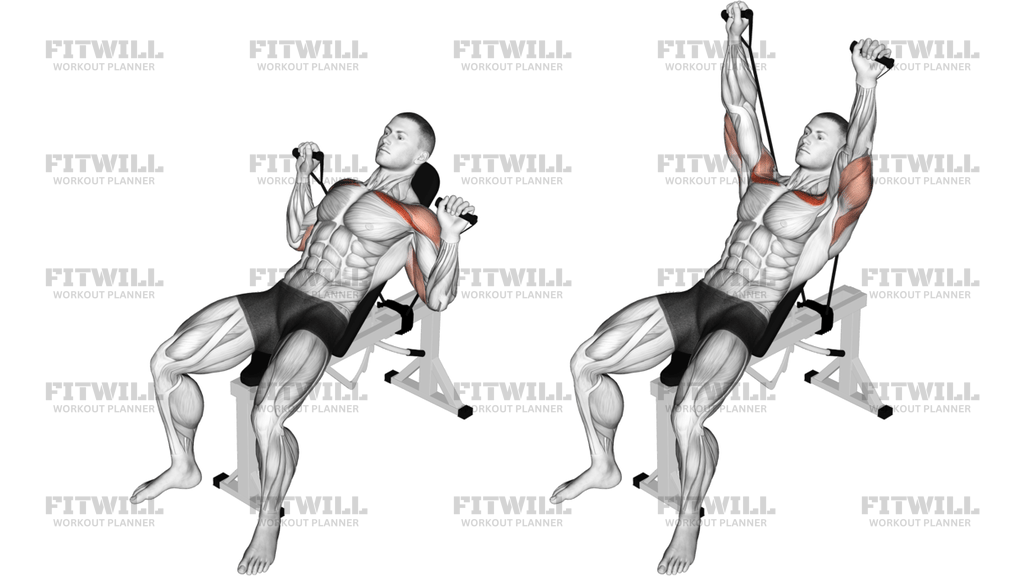
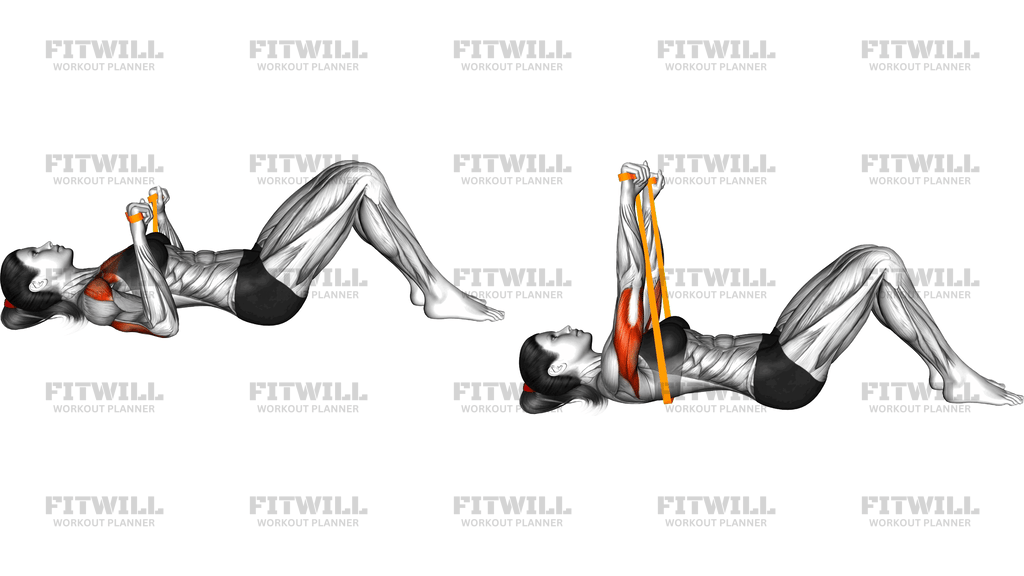
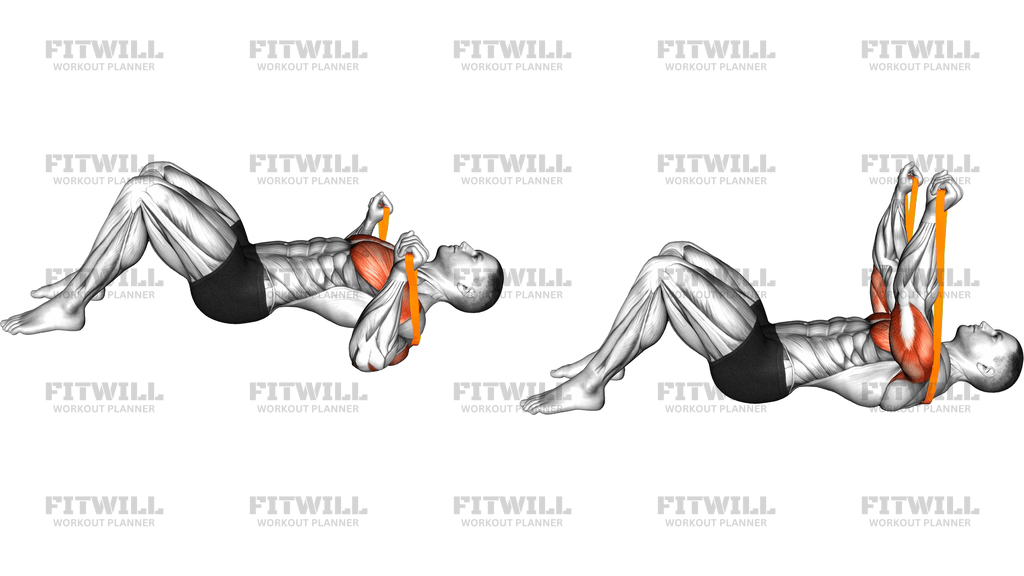
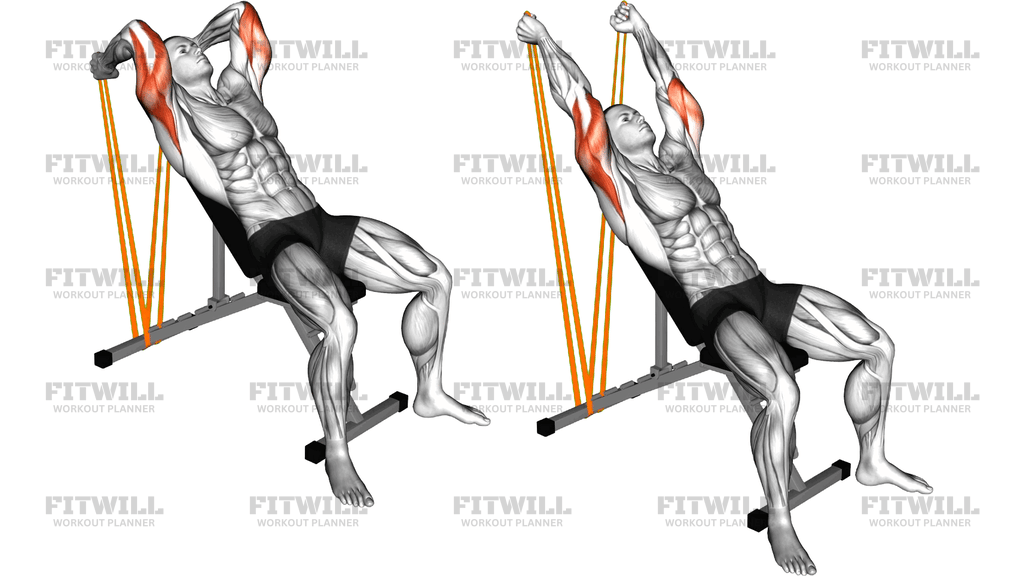
The Resistance Band Incline Triceps Extension is an overhead extension performed while leaning back on an incline bench, with a resistance band anchored low behind the bench and held in both hands. You start with your elbows bent so your hands hang back behind your head, then press the band up and forward until your arms are fully extended above and slightly in front of your face. The inclined torso position changes the angle of pull compared with a seated or standing overhead extension, which keeps tension on the triceps through a longer portion of the range.
This movement primarily targets the triceps, with particular emphasis on the long head. Because the shoulder is extended and the elbows are overhead, the long head is stretched at the bottom of each rep, which is exactly the position where it tends to get the most useful work. The front of the shoulders and the upper back work isometrically to hold your arms in position, and your core stabilizes your torso against the backrest.
The setup matters more here than in most triceps exercises. The band must be anchored securely at the base of the bench or a low point behind you, and the distance between you and the anchor determines how much tension you get at the start. Too little pre-tension and the bottom of the rep feels empty; too much and you will struggle to keep your elbows from drifting forward as you press.
This is a solid choice for lifters who want triceps volume without heavy loading on the elbows, for home gym training where a band and adjustable bench are available, or as a finisher after presses or dips. It also suits people rehabbing around cranky elbow joints, since band resistance is smooth and easy to regulate.
To execute it well, keep your upper arms close to your ears and your elbows pointing up throughout the set. Move only at the elbow joint: the forearms swing from behind your head to a locked-out position overhead, while the upper arms stay fixed. Control the return slowly rather than letting the band snap your forearms back, and keep your head and back in contact with the bench instead of craning forward to help the press.
As with any band exercise, inspect the band for wear before each session and confirm the anchor cannot slip. If you cannot complete a rep with your elbows stable and in place, the band is too heavy — step down a resistance level rather than turning it into a partial press.
[ Workout Log & Planner ]
Put your next workout in Fitwill
Keep your plan and training log ready when you are.


Instructions
- Set an adjustable bench to a 30-45 degree incline and anchor a resistance band securely around the base of the bench frame or a low fixed point behind you.
- Sit back on the bench with your feet flat on the floor and grip one end of the band in each hand, bringing both hands up overhead so the band runs behind your back to the anchor.
- Position your elbows bent at roughly 90 degrees with your hands hanging behind your head, upper arms vertical and close to your ears.
- Brace your core and press your head and upper back firmly into the bench pad.
- Extend your elbows to press your hands up and slightly forward until your arms are straight overhead, keeping your upper arms from drifting forward.
- Pause briefly at full extension and squeeze the triceps without shrugging your shoulders.
- Bend your elbows slowly to lower your hands back behind your head, resisting the band's pull until you reach the starting position.
- Exhale as you press to extension and inhale as you lower back down.
- Complete your reps, then carefully release the tension from one hand at a time before standing up off the bench.
Tips & Tricks
- If your elbows flare outward or drift forward as you press, the band is too heavy — switch to a lighter band so the movement stays at the elbow joint.
- Anchor the band low enough that you feel light tension even with your hands fully lowered behind your head; slack at the bottom means the hardest part of the rep is being skipped.
- Keep the band clear of your face and neck on both the press and the return — the band pulls along a line that passes close to your head.
- Do not let your lower back arch off the bench as you press; the incline pad should stay in full contact with your shoulders and head for the whole set.
- Check the band and anchor point before every set — a band slipping off the bench base mid-rep sends your hands forward with nothing controlling them.
- Because band tension increases toward lockout, slow down the last third of the pressing range rather than rushing to full extension.
- If your shoulders feel pinched at the bottom, reduce the depth slightly so your hands stop just behind head level instead of dropping as far back as possible.
- Grip the band with your palms facing forward and wrists neutral; bending the wrists backward to fight the band's pull shifts stress away from the triceps.
Frequently Asked Questions
Which muscles does the Resistance Band Incline Triceps Extension work?
It primarily targets the triceps, with the long head working hardest because the elbows-overhead position places it in a stretch. The front shoulders and upper back assist by holding your arms steady overhead.
Why use an incline bench instead of doing overhead band extensions standing?
Leaning back on the incline bench aligns the band's pull behind your head and supports your torso, so you cannot swing or lean to help the press. It also lets you overload the stretched position of the long head more comfortably than standing.
Where should I anchor the band for this exercise?
Anchor it low, around the base of the bench frame or a secure fixed point behind you, so the band runs up along your back to your hands. Test the anchor by pulling against it before you sit down.
Is the Resistance Band Incline Triceps Extension suitable for beginners?
Yes, as long as you start with a light band and focus on keeping your elbows fixed in place. The bench support makes it easier to learn elbow position than a standing version.
How do I make this exercise harder without switching bands?
Move slightly further up the bench or shorten the band's working length to increase pre-tension at the start, or slow the lowering phase to three or four seconds per rep.
What is the most common mistake with this movement?
Letting the elbows drift forward and turning the extension into a partial band press. Keep your upper arms vertical and beside your ears so only the forearms move.
Can I substitute this with a dumbbell overhead extension?
Yes, a dumbbell or EZ bar overhead extension on the same incline bench is a close substitute. The band version is easier on the elbows at lockout because resistance peaks at full extension rather than at the bottom.
How many sets and reps should I do?
Two to four sets of 10-15 reps works well, either as a secondary triceps movement after presses or as a finisher. Bands respond well to higher reps, so stopping short of a challenge usually means the band is too light.
Is it safe for my elbows and shoulders?
The band provides smooth, joint-friendly resistance, but you should still warm up your elbows and shoulders first and avoid forcing your hands deeper behind your head than your shoulders allow. Stop if you feel sharp pain at either joint.