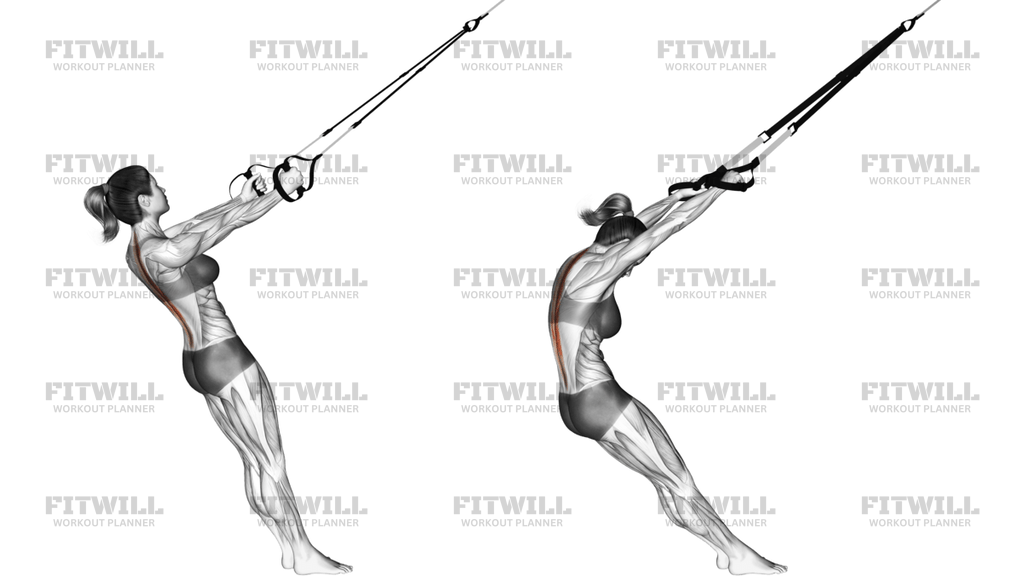
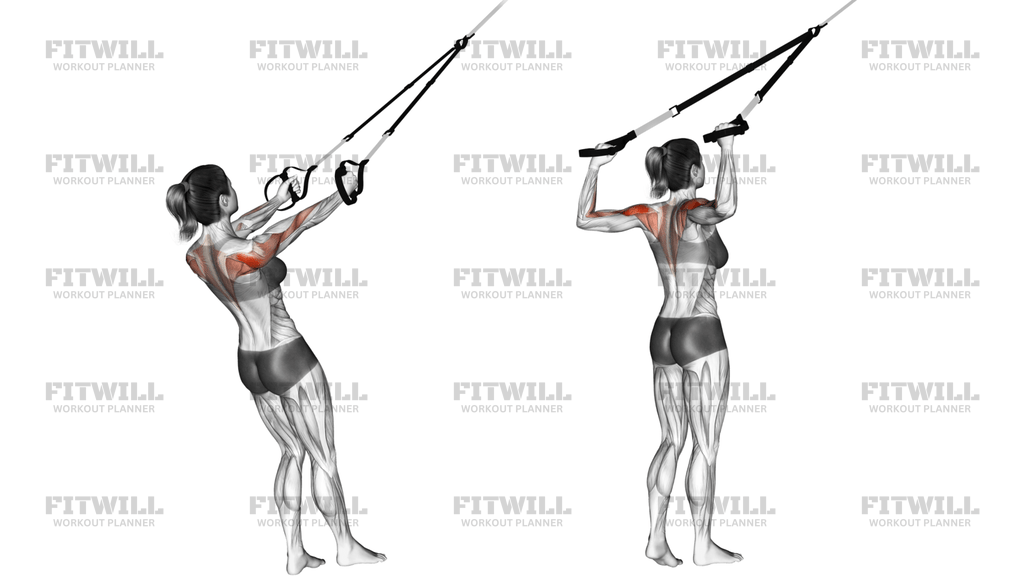
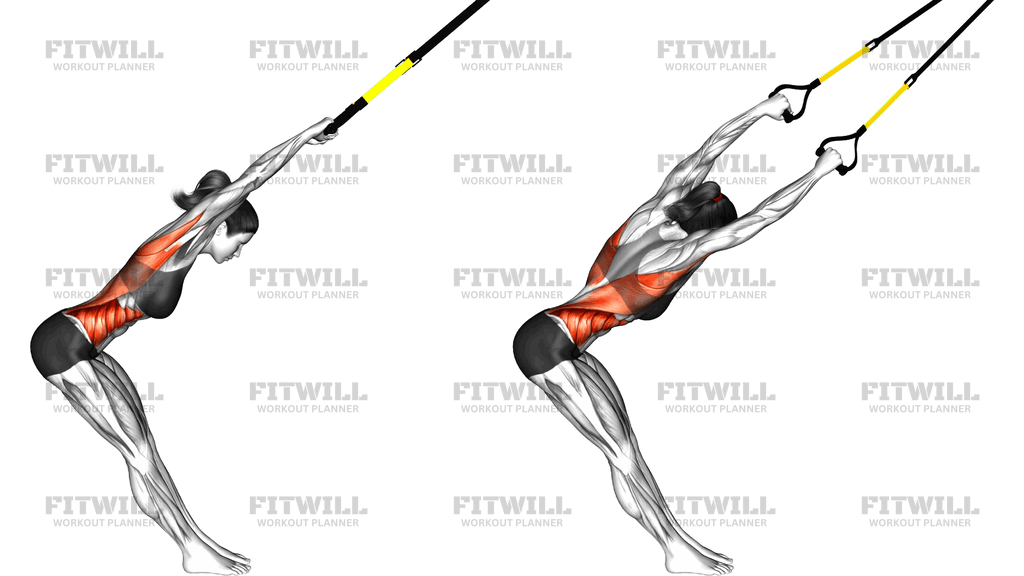
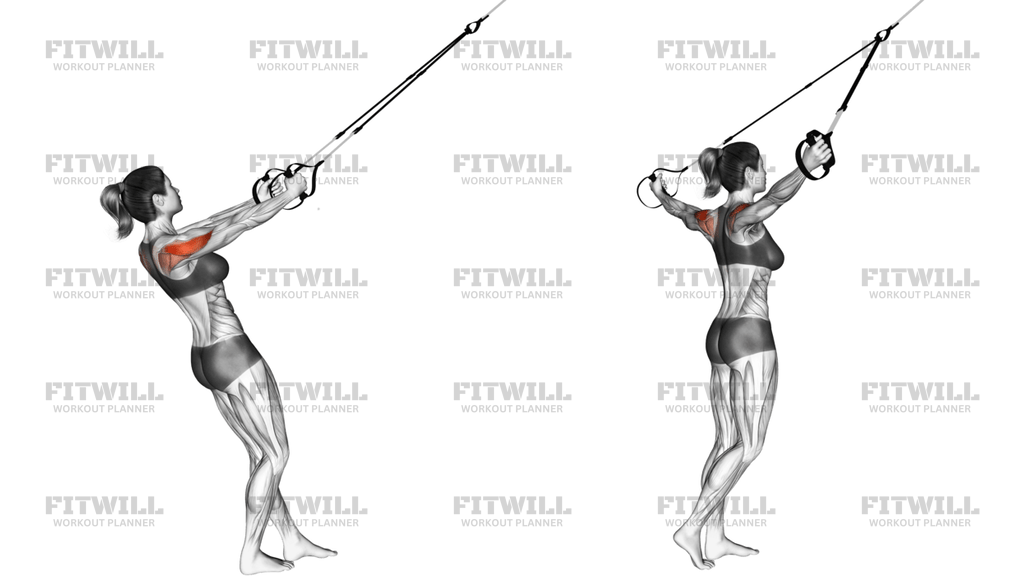
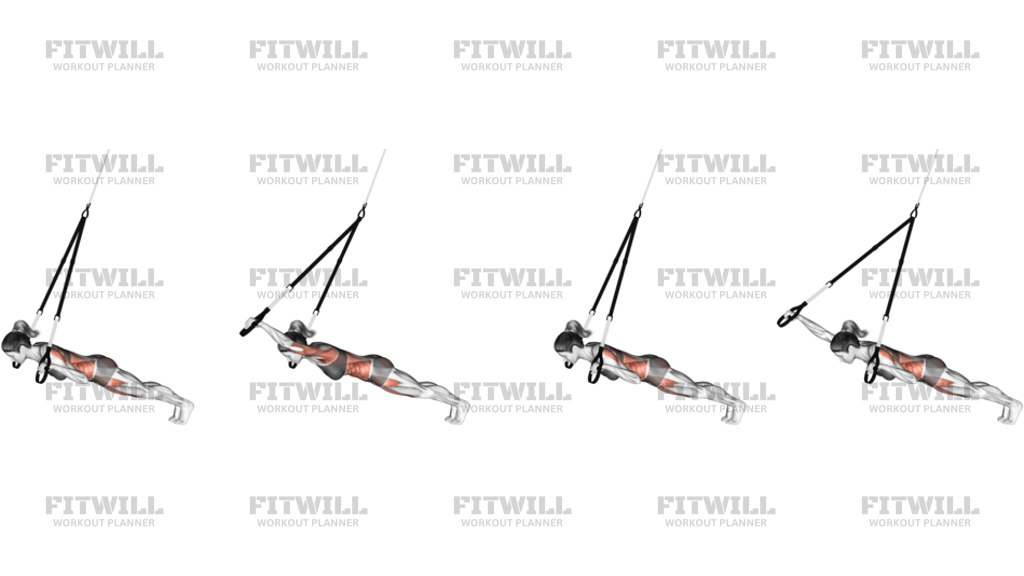
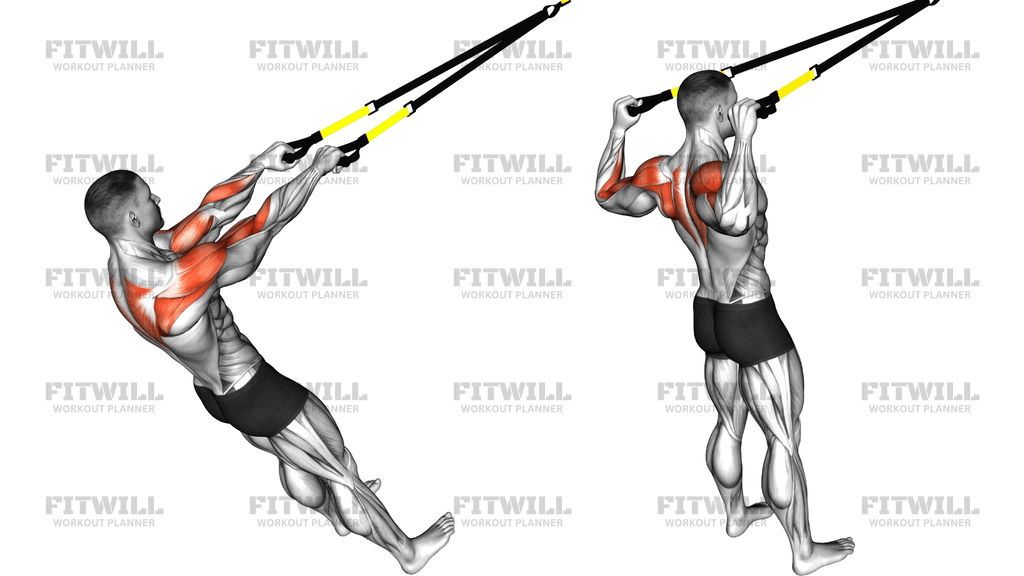
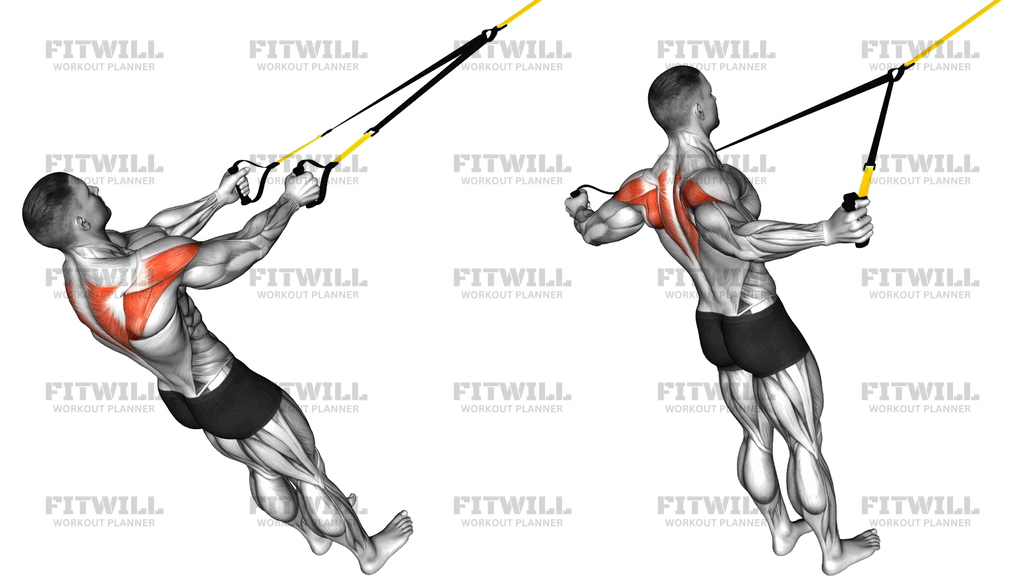
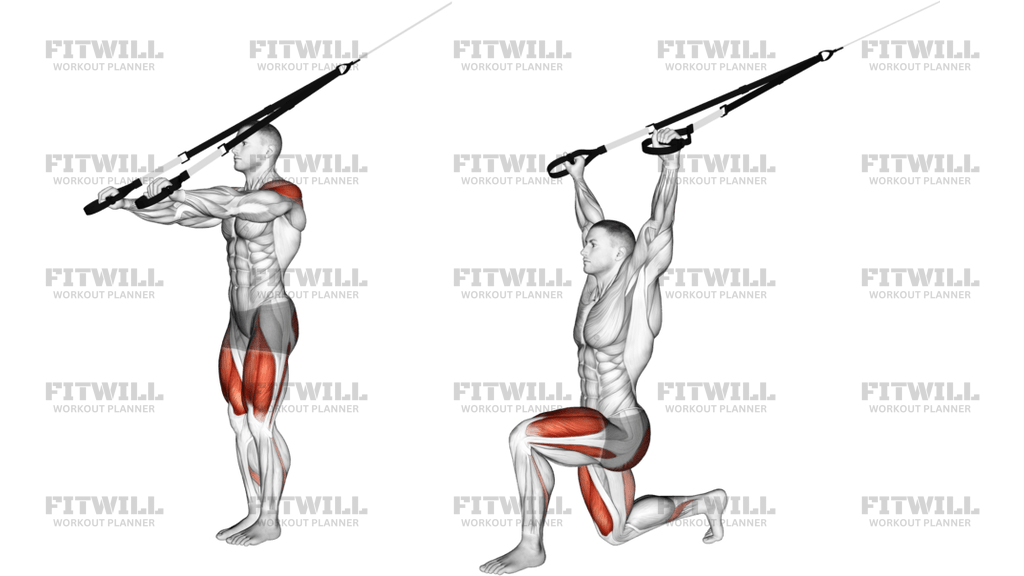
Suspender Wide Grip Inverted Row
The Suspender Wide Grip Inverted Row is a horizontal pulling exercise performed with suspension straps, your body held in a straight line, and your heels resting on a flat bench. Unlike a standard inverted row on a bar, the wide grip on separate hanging handles lets you flare your elbows out to the sides, which shifts the emphasis toward the mid-back — the rhomboids and mid-traps — along with the rear shoulders. Because the straps are unstable, your grip, forearms, and core also work hard to keep the whole line of your body from sagging or twisting.
This version is especially useful for lifters who want to build upper-back thickness without loading the spine the way a barbell row does. Elevating the heels on a bench increases the range of motion and makes the movement slightly harder than a floor-based row, and a weight plate placed on the hips adds resistance once bodyweight alone feels easy. It suits intermediate trainees who already own their basic suspension row, as well as anyone programming pulling volume to balance out pressing work.
Setup matters more here than in most rowing variations. The strap length determines your body angle, the bench height fixes where your feet go, and the wide grip dictates the elbow path. If any one of those is off — straps too long, bench too low, hands too close — the row turns into a different exercise or your lower back takes over a job it shouldn't. Take a minute to get the geometry right before your first rep.
To execute it well, keep your body rigid from heels to head and think of pulling your chest toward the handles rather than pulling your hands toward you. Drive the elbows wide and slightly back, squeeze the shoulder blades together at the top, and lower yourself under control until the arms are extended. The suspended handles will want to drift; controlling that drift is a big part of the training effect.
A few practical points: test the anchor point and strap handles with a partial pull before committing your full weight, and start without the plate until you can complete clean reps with a straight body. If your hips drop or your neck juts forward at the top, shorten the range or walk your feet toward vertical before adding load.
[ Workout Log & Planner ]
Put your next workout in Fitwill
Keep your plan and training log ready when you are.


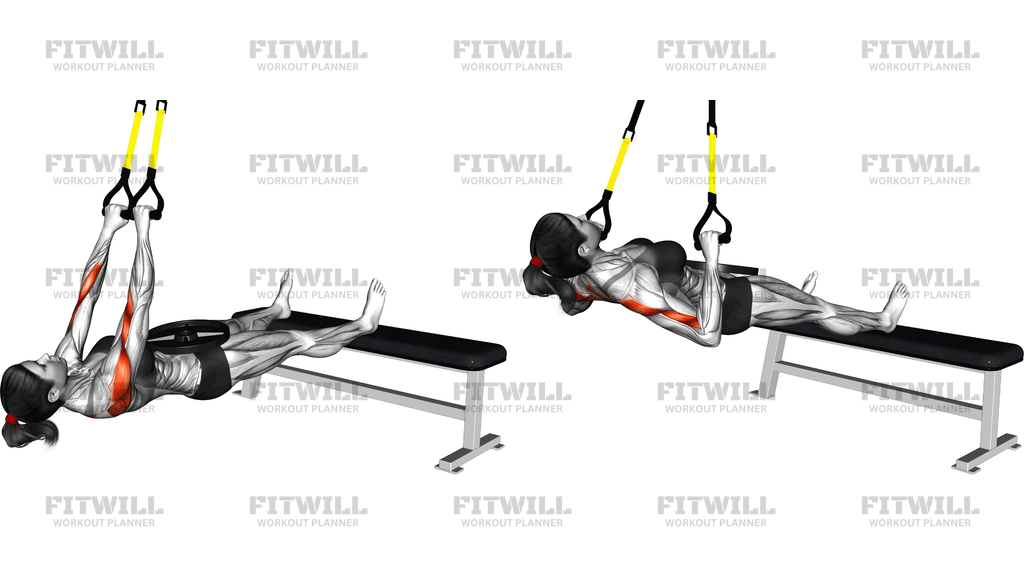
Instructions
- Anchor the suspension trainer overhead to a secure point and set both straps to equal length so the handles hang at the same height.
- Sit facing the anchor, place your heels on a flat bench with your legs straight, and take a wide grip on the handles with arms fully extended.
- Walk your body out until your shoulders, hips, and knees form one straight line, with your weight resting on your heels and your hands directly under the anchor.
- Rest a weight plate on your hips if you are using added resistance, and steady it with the hand on the same side until you brace.
- Brace your core and squeeze your glutes so your hips don't sag before you start the pull.
- Pull your chest up toward the handles, letting your elbows flare out wide to the sides rather than tucked close to your ribs.
- Finish the pull when your chest is close to your hands and your shoulder blades are squeezed together; avoid shrugging your shoulders toward your ears.
- Lower yourself slowly until your arms are fully extended and your body is back in the straight starting line.
- Exhale as you pull up, inhale as you lower down, keeping the breathing steady through the set.
- Complete your reps, then release one handle at a time and sit up carefully, keeping hold of the straps until your weight is back on the bench.
Tips & Tricks
- The most common mistake with the wide grip is turning it into a close-grip row — if your elbows end up narrow and near your ribs, consciously drive them out to about a 45-degree angle or wider.
- If your heels slide off the bench mid-set, dig them in and point your toes up slightly at the start of each rep rather than resetting halfway through.
- A plate that tips off your hips usually means your torso is rotating; check that both handles are level and pull evenly with both arms.
- Straps that are too long make the exercise easier and reduce the range — if the top of the row feels like nothing, shorten the straps so your chest can actually reach the handles.
- Keep your head in line with your spine; reaching forward with the chin to 'finish' the rep usually means the set is over or the resistance is too high.
- If the handles wobble uncontrollably, your grip is too loose — wrap your fingers fully around each handle and squeeze, and your forearms will stop shaking within a few sessions.
- Your hips will sag when your core tires before your back does; film one set from the side to catch this, because it's hard to feel from inside the movement.
- For a harder version, lower the bench or move your body closer to horizontal before reaching for more plate weight — angle changes load faster than adding iron.
- Stop the set if you feel strain in the front of the shoulders rather than the back of them; that usually means the elbows dropped low during the pull.
Frequently Asked Questions
Which muscles does the Suspender Wide Grip Inverted Row work?
The primary targets are the mid-back muscles — the rhomboids and middle trapezius — with strong contributions from the rear shoulders and lats. The biceps assist the pull, and the core and forearms stabilize your body on the unstable straps.
Why use a wide grip instead of a narrow grip on this row?
The wide grip lets your elbows flare out to the sides, which favors the upper back and rear shoulders over the lats. A narrow, tucked-elbow grip would shift the work down toward the lats and biceps.
Is the Suspender Wide Grip Inverted Row suitable for beginners?
Beginners can do it, but it's a step up from a basic suspension row because the elevated feet and unstable handles demand more core control. Start with the heels on the floor and a more upright body angle, then progress to the bench version.
How do I make the Suspender Wide Grip Inverted Row harder?
Shorten the straps or lower the bench so your body sits closer to parallel with the floor, then add a weight plate across your hips. Adjust the angle first — it changes the load more than adding plate weight does.
My hips sag during the row — what's going wrong?
Sagging hips usually mean the core isn't braced or the set has gone on too long. Squeeze your glutes and abs before the first rep, and end the set when you can no longer hold a straight line from heels to head.
Can I do this exercise without a bench?
Yes — the bench elevates your heels and increases the difficulty and range, but you can perform the same wide-grip row with your heels on the floor and a more angled body position.
How many reps should I do?
Because the load scales with your body angle, aim for 8 to 15 reps per set at an angle where the last two reps are challenging but your body line stays intact. Add a hip plate once you can't make it harder by adjusting the angle.
Is it safe to put a weight plate on my hips during this row?
It's generally fine if the plate sits flat across your hips and the bench is stable, but only add it after your bodyweight reps are solid. Make sure the plate can't slide toward your knees, and be ready to steady it as you lower.
What can I use instead of suspension straps?
A bar set at hip height in a rack allows a similar wide-grip inverted row, though the fixed bar removes the stability challenge. A pair of rings is the closest substitute if straps aren't available.
How close should my chest get to the handles at the top?
Pull until your chest is close to or lightly touching your hands and your shoulder blades are fully squeezed together. If you stall halfway up, your body angle is too aggressive — raise the handle height or shift your feet back.