Kettlebell Reverse Grip Row
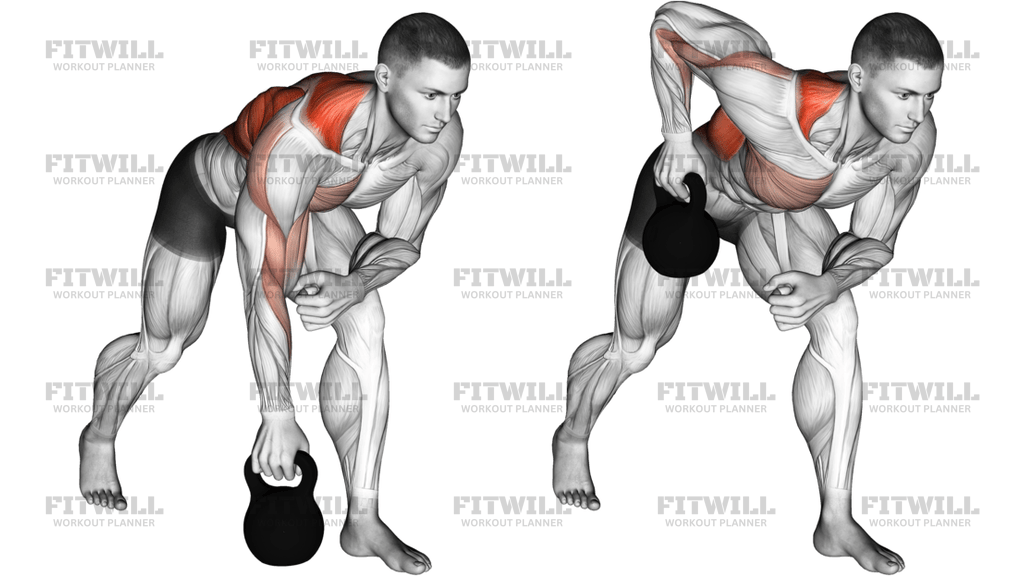
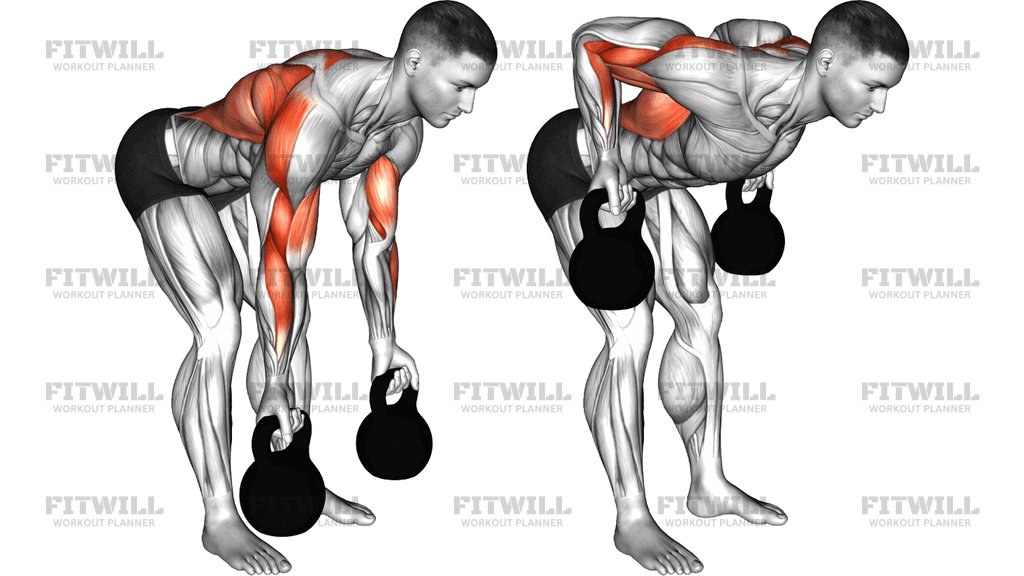
The Kettlebell Reverse Grip Row is a bent-over row performed with a kettlebell in each hand, using an overhand grip so your palms face behind you and your knuckles lead forward. From a hinged stance with knees softly bent, you pull both kettlebells up toward your lower ribs, driving the elbows back and close to the body before lowering them under control. The reversed hand position changes the rowing angle compared with a neutral or underhand grip and biases the pull toward the lats and upper back while still loading the biceps and rear shoulders.
This movement suits lifters who want a rowing variation without a bench or barbell. Because the kettlebell handles hang below the hands and the load sits in line with your arms, the pull feels smooth and the wrists stay in a fairly straight line. The reverse grip also tends to let the elbows tuck tighter to the torso than a wide-grip row, which many people find more comfortable on the shoulders.
The primary work comes from the lats, rhomboids, and mid traps as the shoulder blades retract, with the rear deltoids assisting the pull. The biceps and forearms handle the elbow flexion and grip demands, while the erector spinae, glutes, and hamstrings isometrically hold your torso in the hinged position. That makes it a demanding but efficient pull for the entire back side of the upper body.
Setup matters more here than in a supported row, since nothing is bracing your torso. Your hip hinge angle determines everything: hinge too high and the movement drifts toward an upright row, hinge too loosely and your lower back rounds under load. Aim for a torso angle of roughly 30 to 45 degrees from vertical, a braced core, and a neutral spine before the first rep starts.
Execution should feel like a pull with the elbows, not a lift with the hands. Keep the kettlebells traveling in a straight vertical line toward your hips, squeeze the shoulder blades together at the top, and resist the weights back down rather than dropping them. Momentum from a bouncing torso is the most common fault and the fastest way to turn a back exercise into a lower-back stress test.
Use the Kettlebell Reverse Grip Row as a main pulling movement in an upper-body or full-body session, or as a heavier back builder when you only have kettlebells available. Start with a weight you can row for 8 to 12 controlled reps without your torso angle changing, and progress only when you can keep the hinge solid through every rep.
[ Workout Log & Planner ]
Put your next workout in Fitwill
Keep your plan and training log ready when you are.


Instructions
- Place two kettlebells on the floor about shoulder-width apart in front of your feet, and stand with your feet hip-width apart.
- Hinge at the hips and grasp each handle with an overhand reverse grip, palms facing behind you, then bend your knees slightly so the kettlebells hang clear of the floor.
- Lower your torso to roughly 30-45 degrees from vertical, keep your back flat, and pack your neck in line with your spine so you are looking at the floor slightly ahead of you.
- Brace your core as if bracing for a light punch, and squeeze your glutes to lock your pelvis in place before initiating the pull.
- Start with your arms fully extended and the kettlebells hanging directly under your shoulders.
- Pull both kettlebells up toward your lower ribs by driving your elbows back and up, keeping them close to your sides throughout the path.
- At the top, squeeze your shoulder blades together and pause briefly with the kettlebells at hip height near your torso.
- Lower the kettlebells under control along the same vertical path until your arms are fully extended again, without letting your torso rise or round.
- Exhale as you pull the weights up, inhale as you lower them, and keep the breathing rhythm steady without holding your breath.
- Complete all reps, then set the kettlebells down on the floor and stand up slowly to reset before your next set.
Tips & Tricks
- If your torso rises with each rep, the kettlebells are too heavy or you are pulling with momentum; drop the load and treat your hips as fixed hinges.
- Pull to your lower stomach or hip area rather than your chest — pulling high turns this into an upright row and shifts stress to the traps and shoulders.
- Keep the kettlebell handles parallel to each other; letting one drift forward usually means one side is doing more work than the other.
- Do not let your chin poke up at the top of the pull; a lifting head almost always accompanies a lifting torso.
- If your grip fails before your back does, use chalk or perform the row with one kettlebell at a time instead of loosening your hinge to rest.
- Keep a small, consistent knee bend rather than locking the legs straight; locked knees push the hinge into your hamstrings and can pull your lower back into rounding.
- Think of pinching a coin between your shoulder blades at the top instead of just bending your elbows — the row is a scapular retraction first.
- Control the lowering phase to a 2-3 second count; the eccentric is where much of the lat and rhomboid work happens.
- If your lower back fatigues before your lats, shorten the set, or split the work into single-arm rows with your free hand braced on your thigh.
Frequently Asked Questions
What does the reverse grip mean in the Kettlebell Reverse Grip Row?
It refers to an overhand grip where your palms face behind you and your knuckles point forward as you hinge over. Compared with a neutral grip, it encourages the elbows to stay tucked close to the body as you row.
Which muscles does the Kettlebell Reverse Grip Row work the most?
The lats, rhomboids, and mid traps do most of the pulling, with the rear deltoids and biceps assisting. Your lower back, glutes, and hamstrings work statically to hold the bent-over position.
How bent over should I be during the Kettlebell Reverse Grip Row?
Aim for a torso angle of roughly 30-45 degrees from the floor with a flat back. The exact angle matters less than keeping it identical from the first rep to the last.
Is the Kettlebell Reverse Grip Row suitable for beginners?
Yes, but start light and learn the hip hinge first, ideally practicing the position without weight. Beginners often progress faster with single-arm kettlebell rows using a bench for support before attempting the unsupported two-arm version.
Why do my lower back muscles burn during this row?
Your erector spinae are working hard to hold the hinge, which is normal to a degree. If the burn turns into strain or your back starts rounding, the weight is too heavy or your sets are too long — reduce one or both.
Should I pull the kettlebells to my chest or my hips?
Pull toward your lower ribs or hip area with elbows close to your sides. Pulling to the chest forces the elbows wide, which changes the exercise and irritates the shoulders for many people.
What can I substitute if I do not have two kettlebells?
A barbell bent-over row with an overhand grip is the closest match, or you can use two dumbbells with the same palms-back grip. The hinge angle and pulling path stay essentially the same.
How can I stop my torso from swinging during the Kettlebell Reverse Grip Row?
Brace your core hard before the first rep, squeeze your glutes, and use a lighter weight you can move without momentum. Filming yourself from the side is a quick way to see whether your torso angle drifts.
How heavy should the kettlebells be for this exercise?
Choose a pair you can row for 8-12 strict reps while your back stays flat and your torso angle never changes. If the last reps require bouncing or shortening the range, the load is beyond your current hinge strength.