Cable Twin Handle Reverse Grip Lat Pulldown
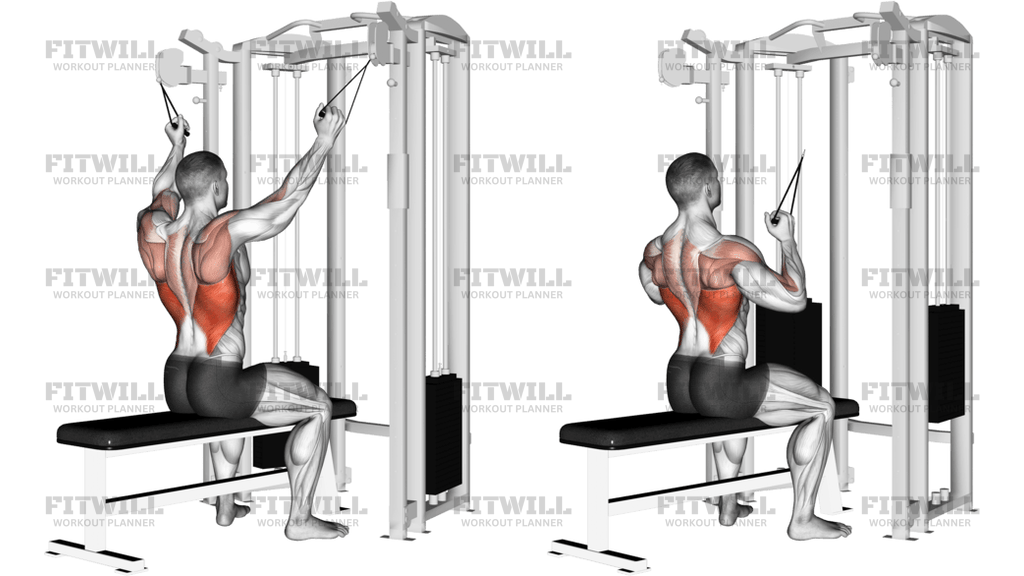
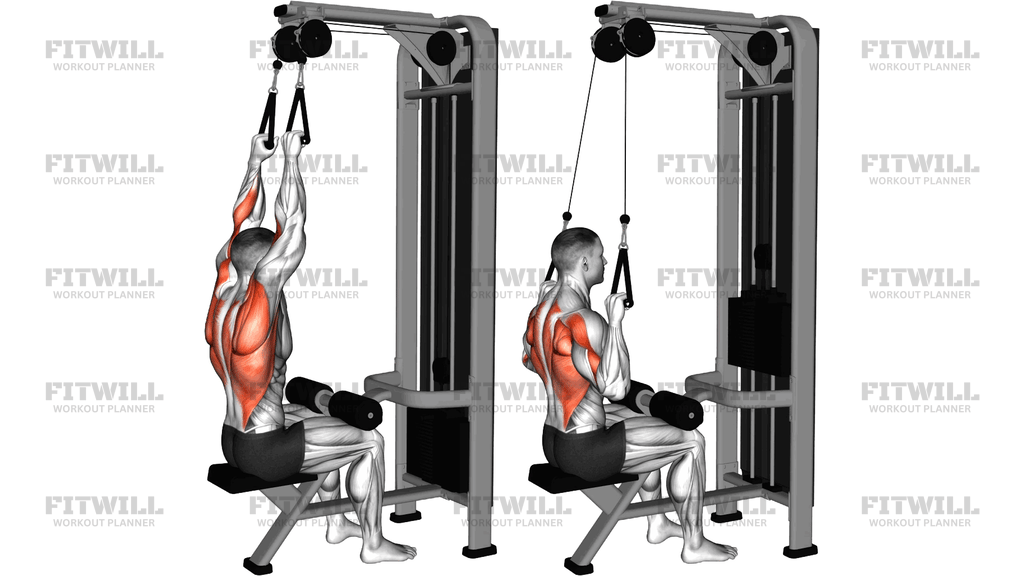
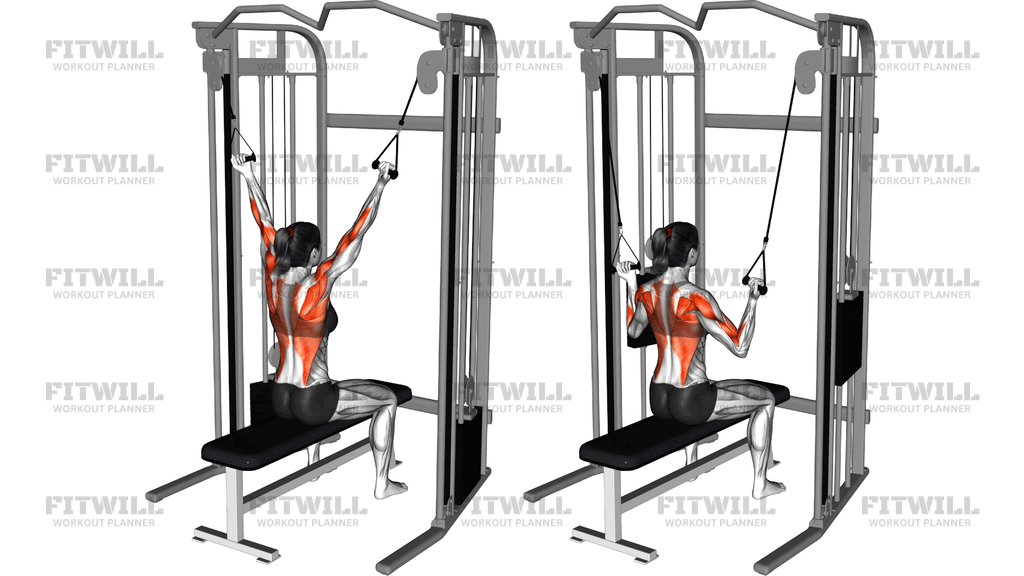
The Cable Twin Handle Reverse Grip Lat Pulldown is a vertical pulling exercise performed on a dual-cable machine while seated. Instead of a long bar, you hold a single handle in each hand with a reverse (underhand) grip, so your palms face behind you as your arms reach overhead. You pull the handles down together until your hands are at shoulder height beside your head, then control the weight back up to a full overhead stretch.
This variation is useful for anyone who wants lat work with a more natural arm path than a fixed bar allows. Because each cable and handle moves independently, your shoulders can track along their own line rather than following a rigid bar trajectory, which many lifters find easier on the shoulder joints. The reverse grip also shifts some of the pulling demand toward the biceps, so people with grip or upper-back fatigue from overhand pulling often get a better lat contraction in this position.
The primary muscles worked are the lats, which drive the arms down and back from the overhead position. Supporting work comes from the biceps, rear shoulders, rhomboids, and mid-traps as the shoulder blades depress and pull together at the bottom of each rep. The core and upper back work isometrically to keep your torso upright instead of leaning back and turning the movement into a row.
Setup matters more here than with a bar pulldown because two independent handles can drift into different paths if your position is loose. Sit facing the machine with your thighs secured under the pads if your station has them, plant your feet flat, and reach up symmetrically so both cables have even tension before the first rep. Your torso should stay tall with only a small, deliberate backward lean.
To execute well, start each rep from a full overhead stretch, drive your elbows down toward your ribs and slightly behind your body, and pause briefly when your hands reach shoulder height. Let the handles rise under control until your arms are extended again and your shoulder blades are allowed to travel up with them. Moving slowly on the way up is where most of the stretch and growth stimulus for the lats actually comes from.
This exercise fits well as a main vertical pull on back day, as a joint-friendly alternative when a straight bar bothers your shoulders or wrists, or as a higher-rep finisher where the independent handles help you focus on each side working evenly. It pairs naturally with horizontal rowing to cover the full back.
[ Workout Log & Planner ]
Put your next workout in Fitwill
Keep your plan and training log ready when you are.


Instructions
- Set both pulleys on the dual-cable machine to their highest position and clip a single handle to each cable.
- Sit on the bench facing the machine with your feet flat on the floor and your thighs anchored under the pads if your station has them.
- Reach up and take one handle in each hand with a reverse grip, palms facing behind you, so both cables carry even tension overhead.
- Sit tall, brace your abs lightly, and lift your chest while keeping only a slight backward lean of about 10 to 15 degrees.
- Exhale as you pull both handles down together, leading with your elbows and driving them down toward and slightly behind your ribs.
- Finish with your hands beside your head at shoulder height, elbows bent and squeezed down, and your shoulder blades pulled down and together.
- Pause for a beat at the bottom and consciously squeeze your lats rather than just hanging on your arm strength.
- Inhale as you let the handles travel back up slowly until your arms are fully extended and your shoulder blades rise into a stretch.
- Complete your reps, then release one handle at a time and let the weight stack settle gently before standing up.
Tips & Tricks
- If one handle keeps arriving lower than the other, the weaker side is being covered by the stronger one; slow the tempo or drop the weight until both hands finish at the same height.
- Pulling the handles down in front of your face instead of beside your ears usually means the weight is too heavy and your elbows are flaring forward — reduce the load and aim your elbows at your back pockets.
- Avoid leaning back further as the set gets hard; once your torso drops past a small lean, the set turns into a row and your lats stop doing the vertical work.
- Keep your wrists neutral with the handles resting in your fingers; bending the wrists back under the reverse grip shifts tension into the forearms and away from the lats.
- Let your shoulders rise at the top of each rep instead of holding them pinned down — the scapular stretch overhead is part of what makes this version effective.
- Because the reverse grip places the biceps in a stronger line, it is easy to turn reps into arm curls; think 'elbows to ribs' rather than 'hands to shoulders' to keep the pull in your back.
- Use a smooth two-count pull and a three-to-four-count return; the cable provides constant tension, so fast, bouncy reps waste the stretch phase.
- If the seat or pads are the wrong height, your thighs won't stay anchored and your hips will lift as you pull; adjust the pads before adding weight rather than muscling through it.
- Check the handle attachments are fully clipped before your first rep — a loose carabiner on a loaded cable is a hazard you can fix in two seconds.
Frequently Asked Questions
Which muscles does the Cable Twin Handle Reverse Grip Lat Pulldown work?
The lats are the primary movers, with strong support from the biceps because of the underhand grip. The rhomboids, mid-traps, and rear shoulders assist as your shoulder blades pull down and together.
Why use two separate handles instead of a straight bar for a reverse grip pulldown?
Independent handles let each shoulder and elbow follow its own natural path instead of a fixed bar line, which many lifters find more comfortable. It also makes it obvious if one side is doing more work than the other.
Is the reverse grip better than an overhand grip for the lats?
Both grips train the lats well; the reverse grip simply gives the biceps a more favorable pulling angle and changes the shoulder position slightly. Choose based on comfort and how well you feel your lats contracting.
Can beginners do the Cable Twin Handle Reverse Grip Lat Pulldown?
Yes, it is actually a good beginner pull because the seated position is stable and the handles are easy to control. Start light, focus on driving the elbows down, and only add load once both sides move evenly.
How far down should I pull the handles?
Pull until your hands are beside your head at about shoulder height with your elbows driven down and slightly behind your torso. Going lower than that usually just adds backward lean without extra lat work.
Why do I feel this mostly in my biceps?
The reverse grip puts the biceps in a strong position, so they take over when the weight is too heavy or you are leading with your hands. Lighten the load and cue 'elbows to the ribs' so the lats initiate each rep.
What can I substitute if my gym has no dual-cable station?
A standard lat pulldown with a narrow underhand grip on a straight bar, or a single-cable half-kneeling lat pulldown with one handle, covers the same pattern. A chin-up or assisted chin-up is another close alternative.
How much should I lean back during the pull?
Only a slight, fixed lean of roughly 10 to 15 degrees from vertical. If your torso keeps swinging backward as the set progresses, the load is too heavy for your lats to move without momentum.
Is this exercise safe for people with shoulder discomfort?
The independent handles and reverse grip often feel friendlier to the shoulders than a fixed bar, but comfort varies from person to person. Keep the range pain-free, avoid forcing the elbows deep behind the torso, and stop if you feel pinching.