Kettlebell Bird Dog Row
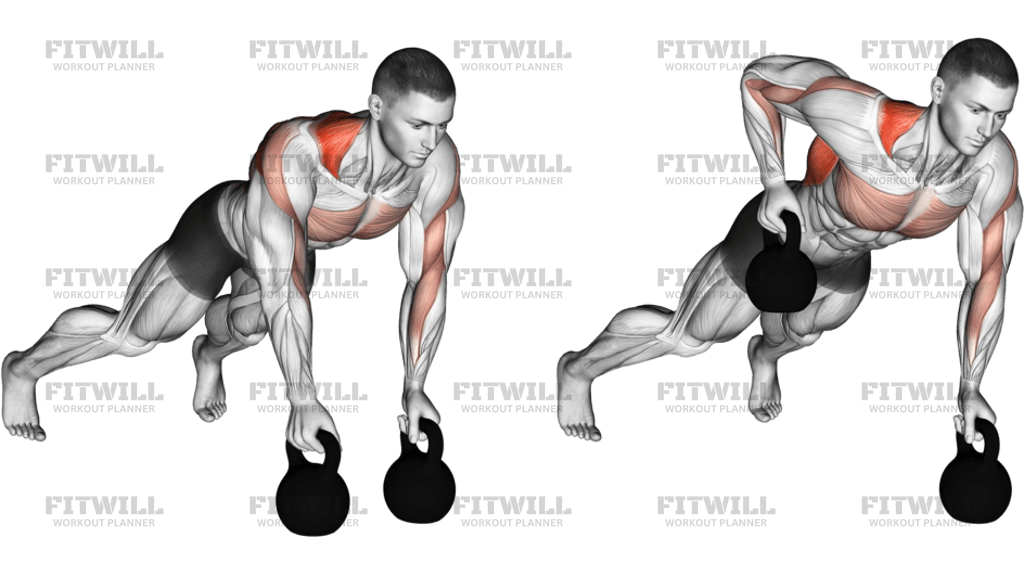
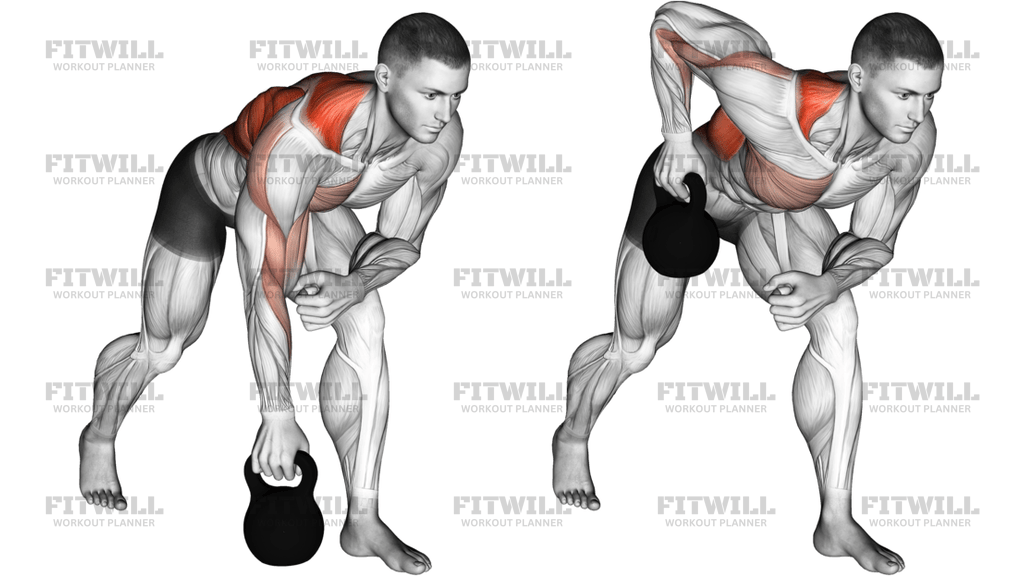
The Kettlebell Bird Dog Row combines a horizontal row with the bird dog position, one of the most demanding anti-rotation holds you can do on the floor. You kneel with two kettlebells, extend one leg straight behind you with only one knee down for support, and row one kettlebell while your free hand stays planted on the other. Every rep forces your torso to resist twisting while one side of your body works and the other side stabilizes.
This is a two-for-one movement. The rowing arm trains the lats, rhomboids, and rear delts through a full pull, while the supporting side, the hips, and the lower back work isometrically to keep your shoulders and hips square to the floor. Because one knee and one extended leg form your base, your core, especially the obliques and deep stabilizers, has to fight rotation far more than in a standard three-point dumbbell row.
The setup matters more here than in most rows. Your support kettlebell and your rowing kettlebell should sit level on the floor, your supporting shoulder stacked directly over the planted kettlebell, and your working knee roughly under your hip. If your base is sloppy, the first heavy rep will expose it: the hips will swing open, the shoulders will tip, and the row turns into a torso rotation instead of a back exercise.
To execute it well, think of pulling the kettlebell toward your lower ribs with your elbow tracking close to your body, while the extended leg stays active and the hips stay level. The leg is not decoration; squeezing the glute of the extended leg is what locks your pelvis in place and gives the row a stable platform. Exhale as you pull, inhale as you lower, and keep the kettlebell path short and controlled rather than yanking it upward.
This exercise suits lifters who already own a solid dumbbell row and want to challenge their midsection at the same time, as well as anyone training at home with limited equipment, since two kettlebells and a patch of floor are enough. It also works well as a warm-up or accessory drill for lifters who want to reinforce bracing before heavier pulls. Keep the weight modest at first; a load you can row standing will often feel dramatically harder with one leg extended behind you.
For safety, start lighter than you think you need and prioritize a level pelvis over a heavier bell. If you feel the work shifting into your lower back or your hips rotating with each pull, drop the weight or shorten the range. Anyone with acute knee discomfort may want a folded mat or pad under the kneeling side, since the knee carries your weight throughout the set.
[ Workout Log & Planner ]
Put your next workout in Fitwill
Keep your plan and training log ready when you are.


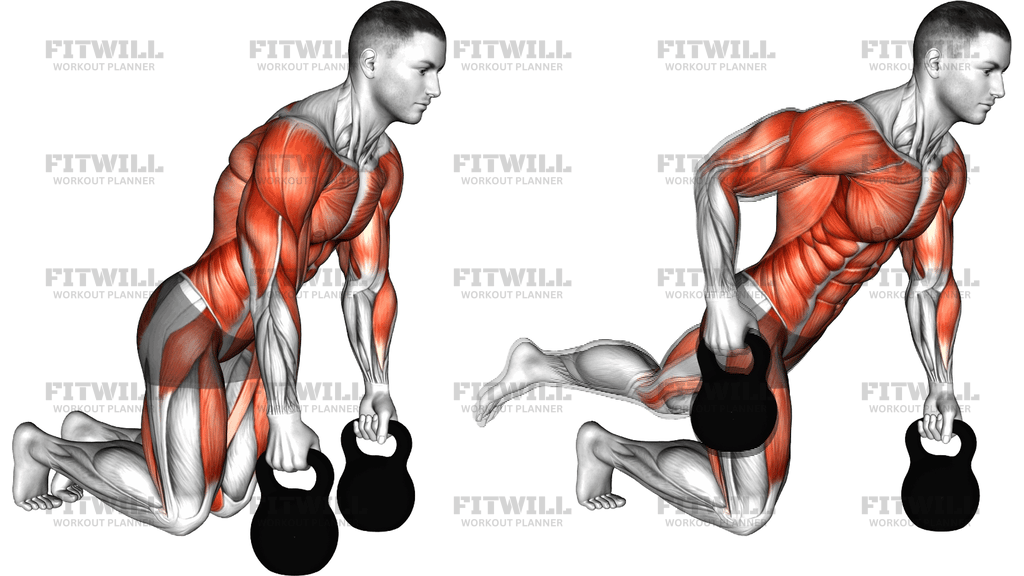
Instructions
- Place two kettlebells on the floor about shoulder-width apart and kneel upright behind or between them, gripping the handles with a neutral grip so the bells rest beside your hands.
- Lower your hands to the kettlebells, then shift your weight so one knee is planted on the floor directly under your hip and your supporting arm is stacked straight under your shoulder on the other kettlebell.
- Extend your free leg straight back behind you with the toes on the floor, squeeze the glute of that leg, and set your head in line with your spine, eyes on the floor.
- Brace your core and tighten your trunk as if bracing for a light punch, keeping both hips square and level before any weight moves.
- Row the working kettlebell by driving your elbow up and back toward your lower ribs, keeping the elbow close to your torso rather than flaring it wide.
- Pull until your hand reaches your side and your shoulder blade draws back and down, pausing briefly at the top without letting your torso twist toward the working arm.
- Lower the kettlebell under control until your arm is fully extended and your shoulder blade settles forward, without dropping it or letting it bounce at the bottom.
- Breathe out on the pull and in on the descent, keeping the brace steady through the entire rep instead of holding your breath.
- Complete all reps on one side, then set the kettlebell down, switch the kneeling knee and working arm, and repeat on the other side.
- Between sets, stand up out of the position to reset, then re-establish your kneeling stance and brace before the next set rather than rushing straight back down.
Tips & Tricks
- The most common mistake is letting the hips swing open toward the rowing side. Fix it by squeezing the glute of the extended leg and pretending a glass of water is balanced on your lower back.
- If your shoulder blade shrugs up toward your ear as you pull, the weight is likely too heavy; reduce the load and focus on drawing the shoulder blade back and down instead of lifting with the upper trap.
- Keep the supporting arm completely straight and stacked over the kettlebell. A soft, bent support arm turns the hold into a partial push-up and bleeds stability from the row.
- Avoid yanking the bell off the floor at the start of the rep. Take up the slack first by slightly engaging the lat, then pull, so your lower back never absorbs the jerk.
- Place a folded mat or pad under the kneeling knee. A hard floor will make you subtly shift weight off the knee, which tilts your hips and undermines the whole position.
- Keep the rowing path short and toward your lower ribs. Pulling toward your chest or behind you usually means the torso has started rotating to finish the rep.
- Pick a kettlebell you can row for strict, smooth reps rather than your standing row weight. The three-point base makes the same load feel far heavier on your core.
- Keep your neck long and your gaze on the floor a few inches ahead of your hands. Craning up to watch yourself compresses the neck while the rest of you is bracing hard.
- If you cannot keep the hips level even with a light bell, shorten the range by rowing only partway up, or regress to a standard three-point row with the back knee down and toes tucked until your anti-rotation strength improves.
Frequently Asked Questions
What muscles does the Kettlebell Bird Dog Row work?
The rowing arm primarily targets the lats, rhomboids, and rear delts, while the lats and biceps assist on the pull. Meanwhile the obliques, deep core, lower back, and glute of the extended leg work isometrically to keep your torso from rotating.
Why does the Kettlebell Bird Dog Row use two kettlebells instead of one?
One kettlebell acts as the rowing load and the other serves as a stable, raised handle for your supporting hand. This keeps your supporting wrist straight and your shoulder stacked, which makes the hold more comfortable and consistent than balancing on a flat palm.
Is the Kettlebell Bird Dog Row suitable for beginners?
It can be, but most lifters should master a standard three-point kettlebell row and a bodyweight bird dog first. Beginners should use a light bell, focus entirely on keeping the hips level, and expect the core challenge, not the row, to be the limiting factor.
Why does one leg stay extended behind me during the Kettlebell Bird Dog Row?
The extended leg narrows your base from four points to three and turns the movement into an anti-rotation challenge. Squeezing the glute of that leg locks your pelvis in place so the row trains your back instead of twisting your spine.
How heavy should the kettlebells be for the Kettlebell Bird Dog Row?
Choose a weight you can row for strict reps with zero hip rotation, which is usually well below your standing one-arm row weight. Many lifters use two identical bells, though the supporting side can technically hold a slightly heavier one if that is all you have.
What is the most common mistake in the Kettlebell Bird Dog Row?
Rotating the torso and swinging the hips open on each pull, which turns the exercise into a twisted row and offloads the core. Cue yourself to keep both hip points facing the floor and pull slightly lighter until that holds true on every rep.
Can I substitute a dumbbell for the kettlebell in the Kettlebell Bird Dog Row?
Yes, a dumbbell works for the rowing side, though the handle geometry is less comfortable than a kettlebell's. For the supporting hand, a kettlebell, low step, or stacked platform works better than a round dumbbell, which can roll.
How many reps and sets of the Kettlebell Bird Dog Row should I do?
Two to four sets of 6 to 10 controlled reps per side works well as a back and core accessory. Because the stabilizing demand is high, treat strict, level-hipped reps as the standard and end the set when your torso starts to twist.
Is it safe for my knees and lower back to kneel during the Kettlebell Bird Dog Row?
For most people the kneeling position is fine, especially with a pad under the knee, since the joint is only bearing weight, not moving under load. Stop if you feel sharp knee pain from the kneel itself, and keep the brace strong so your lower back never rounds or arches under the row.