Seated Knee Down
The Seated Knee Down is a simple floor-based exercise that targets the quadriceps through a controlled press of the knee toward the ground. You sit on the floor with one or both legs extended straight in front of you, rest the back of your ankle or calf on a small half-round roll or padded cushion, and place your hands on the floor behind your hips for support. From there, you actively push the knee down toward the floor, squeezing the front of the thigh, then release with control.
This movement is especially popular in knee rehabilitation and warm-up routines because it trains the quadriceps in a straight-leg position, which loads the thigh without bending the knee under weight. The cushion under the ankle creates a slight gap between the back of the knee and the floor, giving the knee somewhere to travel as you press down. That small detail is what makes the contraction effective: without the roll, the knee would simply rest on the ground and the quadriceps would have little work to do.
The primary muscles worked are the quadriceps at the front of the thigh, particularly the vasti muscles that straighten the knee. Because the leg stays long and the torso leans back on the hands, the hip flexors and deep core also work lightly to hold your seated posture. The movement is low-load and slow-paced, so it suits beginners, people returning from knee discomfort, and anyone who wants to re-establish a clean mind-muscle connection with the front of the thigh before moving to harder knee exercises.
Setup matters more than it appears. Sit tall enough that your spine stays neutral, keep the leg fully extended with the toes relaxed, and make sure the roll sits under the lower calf or Achilles area rather than directly behind the knee. If the roll drifts too close to the knee crease, pressing down can feel pinched or uncomfortable; too far toward the foot and the leverage changes and the contraction feels weaker.
To execute well, think of pushing the back of the knee long and down while the thigh stays heavy on the floor. The heel should not lift off the roll, and the hips should not rock backward as you press. A one-to-two-second hold at the bottom of the press, followed by a slow release, gives the quadriceps far more useful work than rapid, bouncy repetitions.
You will see the Seated Knee Down used in physiotherapy progressions, in warm-ups before squats or leg presses, and as a finishing pump for the thighs on lower-body days. Because it requires only a small roll and floor space, it is easy to do at home, and it pairs naturally with straight-leg raises or short-arc knee extensions in the same session.
[ Workout Log & Planner ]
Put your next workout in Fitwill
Keep your plan and training log ready when you are.


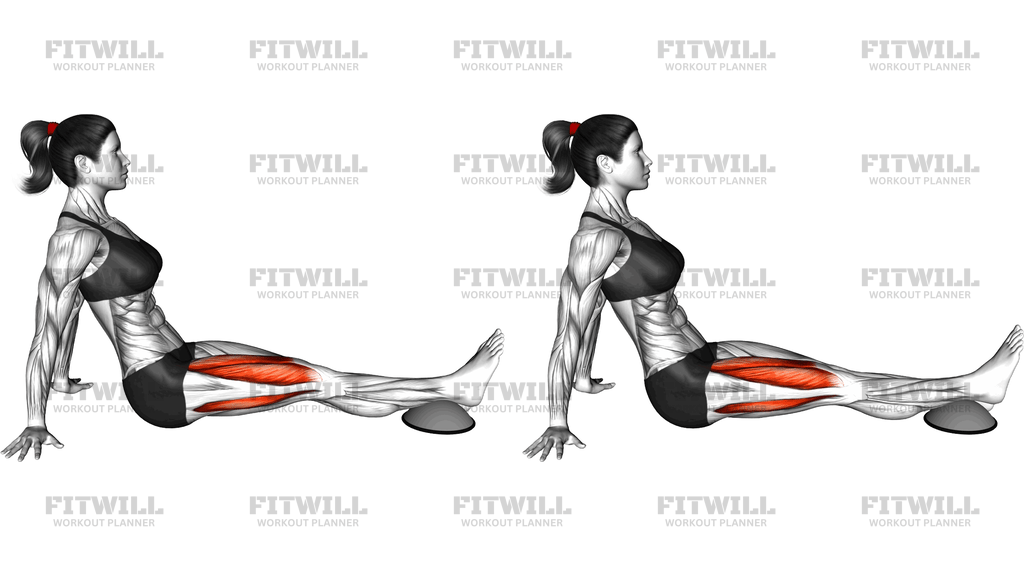
Instructions
- Sit on the floor or an exercise mat with both legs extended straight in front of you and your hands resting on the floor beside your hips, fingers pointing forward.
- Place a half-round roll or firm padded cushion under your lower calves so there is a small space between the backs of your knees and the floor.
- Sit up tall through your spine, roll your shoulders back, and let your legs relax fully with feet upright and toes pointing toward the ceiling.
- Brace your trunk lightly and keep your weight even on both sit bones so your torso does not twist as you work.
- Press one knee down toward the floor by tightening the front of that thigh, keeping the leg completely straight and the heel in contact with the roll.
- Hold the pressed position for one to two seconds, feeling the quadriceps squeeze hard at the front of the thigh.
- Release the press slowly and let the knee rise back to its resting height without letting the leg go slack or the foot flop outward.
- Complete all repetitions on one leg, then switch to the other knee, or alternate sides if that feels more natural.
- Breathe steadily throughout: exhale as you press the knee down, inhale as you release.
- Between sets, gently shake out the thighs and reposition the roll so it still sits under the lower calf, not behind the knee.
Tips & Tricks
- If you feel pressure behind the knee instead of a thigh contraction, the roll has drifted into the knee crease — slide it a few centimeters toward the ankle.
- A common mistake is lifting the heel or toes off the roll to force the knee lower; keep the whole lower leg resting on the roll and let the quadriceps do the pressing.
- Avoid leaning your torso further back to gain range — extra lean changes the hip angle but does not improve the knee press and often rounds the lower back.
- The contraction should feel like a firm squeeze across the front of the thigh; if you only feel the kneecap area being pulled, reduce the effort to about seventy percent and rebuild the feeling.
- Do not let the opposite leg bend or slide — keeping both legs long keeps your pelvis level and makes each side work from the same position.
- If your hamstrings feel tight and pull your posture backward, sit on a folded towel or low step to tilt the pelvis slightly forward while keeping the legs extended.
- Keep the kneecap tracking straight up toward the ceiling; if the knee rolls outward as you press, cue yourself to point the toes squarely upward.
- Slow the release phase down rather than adding more reps — the lowering control is where most of the coordination benefit for this position comes from.
Frequently Asked Questions
What muscles does the Seated Knee Down work?
The quadriceps on the front of the thigh are the main movers, since they straighten the knee as you press it down. The hip flexors and deep core work lightly to hold your upright seated position.
Why is a roll placed under the calf for the Seated Knee Down?
The roll props the lower leg up so the back of the knee starts slightly above the floor. This gives the knee a small distance to travel, which lets the quadriceps actually contract instead of just resting.
Is the Seated Knee Down suitable for beginners?
Yes. It is a low-load, body-weight exercise performed on the floor, so it is one of the easiest ways to learn to feel and control the quadriceps before progressing to straight-leg raises or weighted knee extensions.
Can I do the Seated Knee Down without a roll?
You can substitute a firmly rolled towel, a small cushion, or a foam pad under the calves. The key is that the prop is thick enough to lift the back of the knee off the floor while still supporting the lower leg.
Should I press both knees down at the same time or one at a time?
Either works, but pressing one knee at a time makes it easier to focus on the contraction and to notice differences between sides. Alternate sides if you are rehabbing one knee, or work both together for a quicker set.
How long should I hold the knee-down position?
One to two seconds per repetition is enough for general use. If you are using the exercise for knee rehabilitation, some programs call for five to ten second holds, so follow the duration your program or therapist specifies.
My knee feels pinched when I press down — what should I change?
Check that the roll sits under the lower calf rather than directly behind the knee, and ease off the pressing force. If discomfort continues, shorten the hold, reduce the range, and consult a professional before continuing.
How is the Seated Knee Down different from a straight-leg raise?
A straight-leg raise lifts the whole leg against gravity and challenges the hip flexors heavily, while the Seated Knee Down keeps the leg still and isolates the knee-straightening action of the quadriceps. The two complement each other well in the same session.
How many sets and reps of the Seated Knee Down should I do?
For general thigh activation, two to three sets of ten to fifteen slow presses per leg works well. Because the load is low, quality of the squeeze matters more than the total number of repetitions.
Can I use the Seated Knee Down as a warm-up before squats?
Yes, a set of knee presses is a useful primer because it wakes up the quadriceps and reinforces full knee straightening before you load the joint. Keep it brief — one or two light sets is plenty before a heavier lower-body session.