Resistance Band Squat Step Out
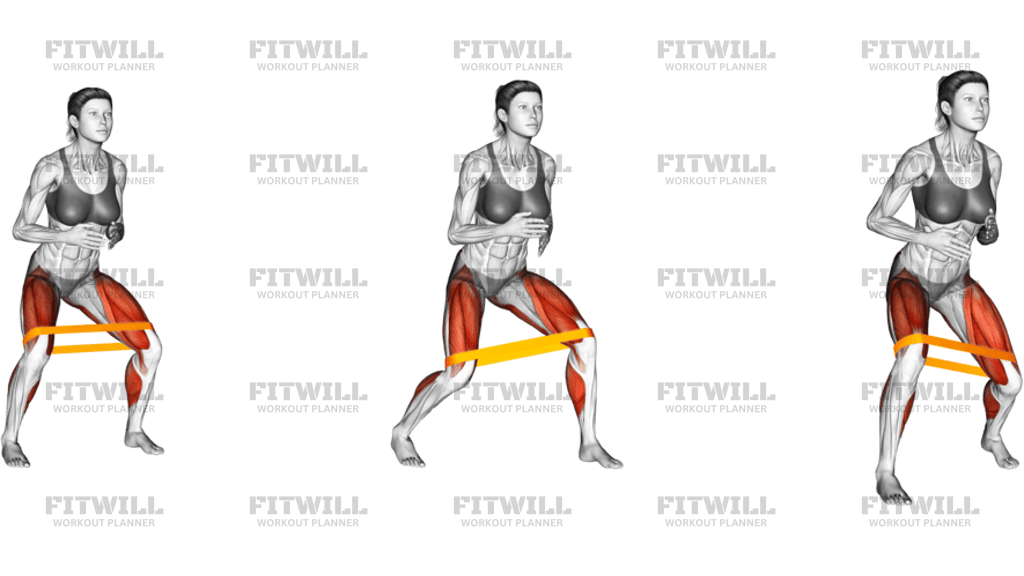
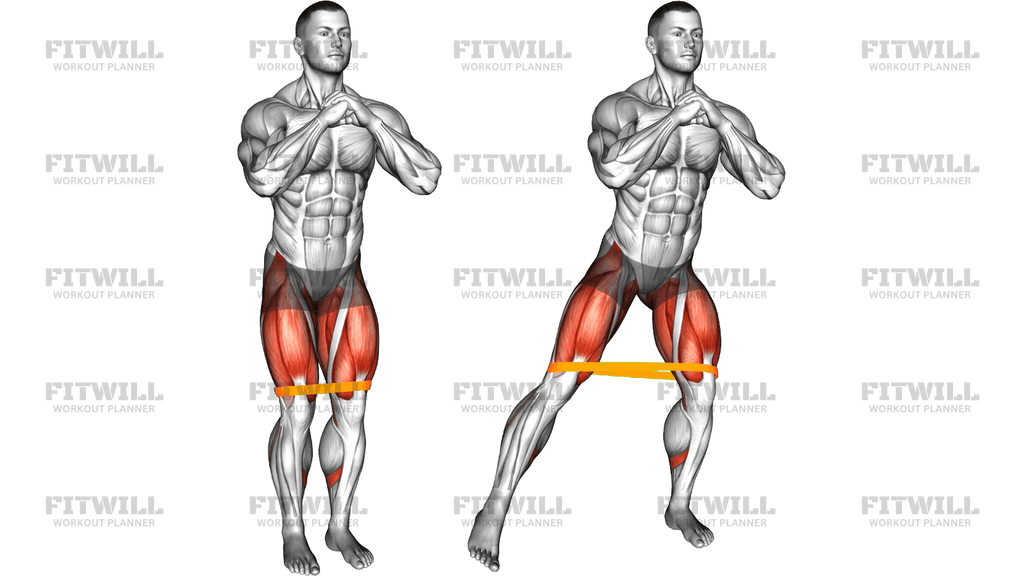
The Resistance Band Squat Step Out combines two proven lower-body tools into one movement: a loop band placed around the thighs just above the knees, and a shallow, held squat position. From that stance, you step one foot out to the side against the band's pull, bring it back or alternate, and keep tension on the band the entire time. The result is a hybrid drill that trains the side-stepping action of the hip muscles while your legs stay loaded in a partial squat.
This exercise is especially useful for anyone whose knees tend to cave inward during squats, lunges, or running. The band actively pulls your knees toward each other, and your job is to resist it by pressing outward. That constant outward pressure wakes up the gluteus medius and the muscles along the outer hip, which are key stabilizers for knee tracking, single-leg balance, and lateral movement. Because the squat position also loads the quads and gluteus maximus, you get both a strengthening and a stabilizing effect in one drill.
Setup matters more here than in most band exercises. If the band sits too high on the thighs, the pull loses leverage at the hips; too low, and it can drag on the knees and encourage poor tracking. A medium-tension loop band placed just above the knees works for most people. Your stance should start about hip-width, with enough bend in the hips and knees that you can feel your weight settle into your mid-foot and heels rather than your toes.
To perform it well, drop into a quarter squat, clasp your hands in front of your chest for balance, and step one foot out to the side wide enough that the band stretches noticeably. Keep both knees pressed outward against the band as you step, then control the return as the band pulls the leg back in. Alternate sides or complete all repetitions on one side before switching. The torso stays tall and relatively still throughout; most of the action should come from the hips and legs.
Common use cases include warm-ups before squatting or sprinting, rehabilitation-style strengthening for hip stability, glute-focused home workouts, and activation work for people who sit for long hours and have dormant hip muscles. It requires only a small loop band and about a yard of floor space, which makes it easy to program almost anywhere.
A few practical points keep the movement safe and effective: stay in a squat depth you can hold without your lower back rounding, keep the band flat against your thighs so it does not roll, and stop stepping out once you cannot keep your knees aligned over your feet. Slow, deliberate steps with steady tension will do far more than fast, bouncy ones.
[ Workout Log & Planner ]
Put your next workout in Fitwill
Keep your plan and training log ready when you are.


Instructions
- Place a loop resistance band around both thighs, just above your knees, so it lies flat against the skin or clothing without twisting.
- Stand with your feet about hip-width apart, toes pointing forward or slightly out, and clasp your hands together in front of your chest.
- Push your hips back and bend your knees to lower into a quarter squat, keeping your chest up and your weight spread across your whole foot with a slight bias toward the heels.
- Brace your abdominals and press both knees outward against the band so you feel light tension before you even step.
- Keeping the squat depth constant, step your right foot out to the side far enough that the band stretches firmly across both thighs.
- Hold the new stance for a brief moment, keeping both knees pushed outward and your torso upright.
- Step your left foot out to meet the right, or step the right foot back in, maintaining band tension the whole time rather than letting your feet snap together.
- Continue alternating steps or complete all reps on one side before switching, keeping your breathing steady: exhale on each step out, inhale as you recover the foot.
- To finish, step the feet back to hip-width, rise out of the squat with control, and slide the band off your thighs.
Tips & Tricks
- If your knees drift inward between steps, the band tension is too heavy for your current hip strength; drop to a lighter band and rebuild the outward press first.
- Keep your squat depth identical on every step. A common fault is standing taller as fatigue sets in, which shifts the work away from the hips and quads.
- Drive each step through the working leg's heel and mid-foot rather than toe-tapping the ground. This keeps the glutes loaded instead of letting the calves take over.
- Do not let the band roll up your thighs. Flatten it against your skin before starting, and if it keeps rolling, the band is either too loose or positioned too high.
- Keep your hands clasped at chest height and your elbows relaxed; swinging the arms for momentum defeats the purpose of controlled hip work.
- Avoid letting your torso lean toward the stepping leg. Imagine a string pulling the crown of your head straight up while only your hips travel sideways.
- Your feet should not click together on the return. Controlling the inward step against the band is half the exercise and where many people lose the benefit.
- For a harder version, pause two to three seconds at the widest point of each step, or use two bands stacked just above the knees.
- If you feel the work mostly in the front of your thighs and outer knees rather than your glutes, sit slightly deeper into the squat and consciously drive your knees apart.
Frequently Asked Questions
What muscles does the Resistance Band Squat Step Out work?
The main targets are the glutes, especially the gluteus medius on the outer hip, along with the quads from the held squat position. The hamstrings, inner thighs, and core also work to keep you stable as you step against the band.
Where should the resistance band sit during this exercise?
Just above your knees, lying flat against both thighs. This position gives the hips good leverage to press outward without the band interfering with knee tracking.
How deep should the squat be during the Resistance Band Squat Step Out?
A quarter squat is enough for most people, deep enough that your hips and knees are clearly bent but shallow enough to hold comfortably for the whole set. The key is keeping the depth consistent on every step.
Is this a good exercise for beginners?
Yes. It is low-impact, requires only a band, and teaches knee alignment that carries over to squats and lunges. Beginners should start with a light band and fewer, slower steps to master the outward knee press.
Why do my knees cave inward when I do the Resistance Band Squat Step Out?
That usually means the outer hip muscles are fatigued or the band is too heavy. Reduce the band tension, shorten the set, and focus on pressing both knees outward before each step.
How far should I step out to the side?
Step out wide enough that the band stretches firmly and you feel your outer hips working, but not so far that your knee collapses inward or your torso leans. If you lose knee alignment, the step is too wide.
Should I step back in or bring the other foot over between reps?
Both work. Stepping the moving foot back in keeps the emphasis on one side at a time, while traveling sideways and bringing the trailing foot over turns it into a lateral walk. Keep band tension either way.
Can I substitute anything if I do not have a resistance band?
A band-less squat step-out still trains the pattern, but you lose the outward pull that targets the outer hips, so the effect is weaker. A light band is inexpensive and is really what makes this exercise distinct.
Is the Resistance Band Squat Step Out safe for people with knee discomfort?
It is often used as a gentle stability exercise because the feet stay close to the floor and the load is only the band. Still, keep the squat shallow, move slowly, and skip the exercise if any movement causes sharp pain.
How many sets and reps should I do?
For activation or warm-up, two to three sets of ten to fifteen steps per side with a light band works well. For strength-focused glute work, use a heavier band and slower steps with brief pauses at the widest position.