Kettlebell Single Arm Row (Bird Dog Stance On Ben)
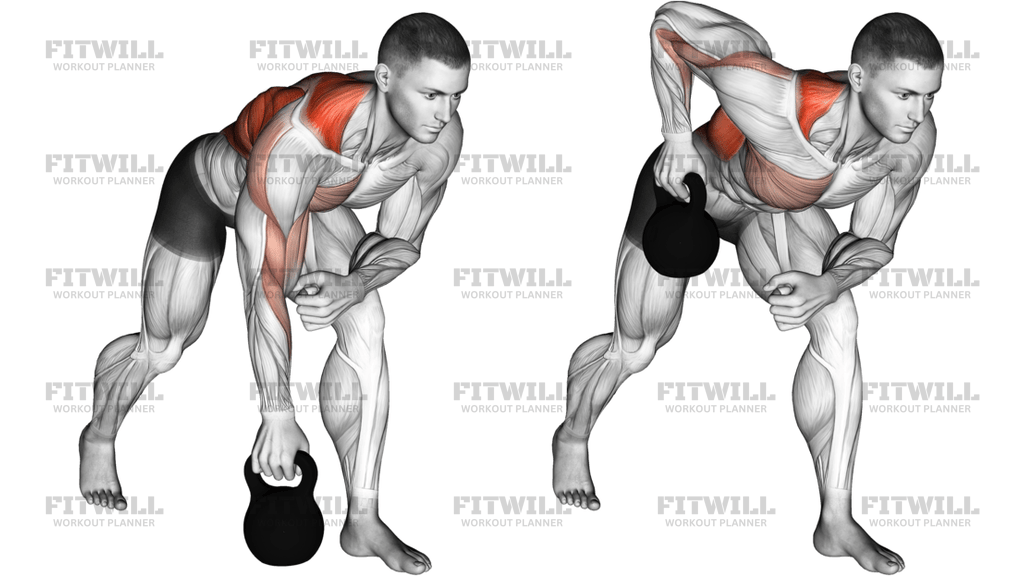
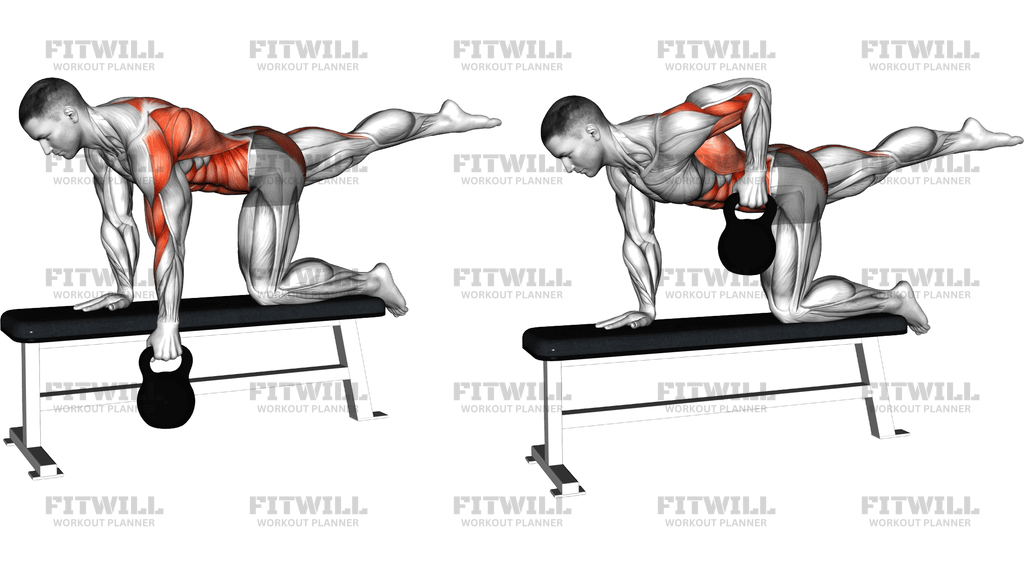
The Kettlebell Single Arm Row (Bird Dog Stance On Bench) is a rowing variation that trades the usual three points of bench contact for a more demanding two-point setup. Instead of bracing with both a hand and a same-side knee while the opposite foot stays planted, you support yourself with one hand and one knee on the bench while the trailing leg extends straight back behind you, hovering off the floor. The free hand pulls the kettlebell from a hanging position up toward your hip.
This movement is most useful for lifters who already row well in a standard stance and want to make their trunk work harder without adding load. Because only one knee rests on the bench and the extended leg acts as a counterbalance, your obliques, deep core, and hip stabilizers have to resist rotation on every rep. The lats, rhomboids, and mid traps still do the bulk of the pulling work, and the biceps and forearms assist through the grip.
The setup matters more here than in a conventional bench row. With the standard hand-and-knee position, the bench blocks much of the rotational stress. Take the same-side knee away and put the opposite leg in the air, and suddenly every uneven pull tries to twist your torso toward the working side. Keeping your shoulders square to the bench and your hips level is the difference between a disciplined back exercise and a sloppy torso swing.
To execute it well, keep the kettlebell path vertical and tight to your body. Pull the handle toward the top of your hip or lower rib rather than toward your shoulder, letting the elbow travel close behind you. Pause briefly at the top with the shoulder blade pulled back, then lower the weight under control until the arm is fully extended and the lat has lengthened. Avoid jerking the weight off the bottom or letting the torso rotate as the arm straightens.
You will see this row used in back-focused sessions as a secondary pulling lift, in core-focused blocks as an anti-rotation drill with load, and by kettlebell lifters who want rowing volume that also challenges balance. Start lighter than you would for a supported single-arm row, because the bird dog position removes a lot of stability you may not realize you were borrowing.
Safety-wise, the main concerns are losing your balance off the narrow base and letting the lower back round or twist under fatigue. Choose a bench that will not tip, keep the extended leg engaged rather than limp, and set the kettlebell down between sets instead of fighting a failing grip. If you cannot keep your hips square, drop the weight or return to the standard three-point row until the position feels natural.
[ Workout Log & Planner ]
Put your next workout in Fitwill
Keep your plan and training log ready when you are.


Instructions
- Place a flat bench on stable flooring and set a kettlebell next to it within easy reach.
- Kneel onto the bench and place your left hand and left knee on the pad, then step your right leg straight back behind you with the foot lifted off the floor so your body forms a straight line from head to heel.
- Pick up the kettlebell with your right hand using a firm overhand grip on the handle, and let it hang straight down from your shoulder.
- Brace your abs, squeeze the glute of your extended leg, and square your shoulders and hips to the bench before the first pull.
- Row the kettlebell up and back toward the top of your right hip, keeping the elbow close to your body and driving the shoulder blade toward your spine.
- Pause at the top with the handle near your lower ribs and your torso still square to the bench.
- Lower the kettlebell slowly until the arm is fully extended and you feel a stretch across the upper back, resisting the pull of the weight toward the floor.
- Exhale as you pull the weight up and inhale as you lower it, keeping your breathing steady and your trunk tight throughout.
- Complete all reps on the right side, set the kettlebell on the floor, then switch sides so your right hand and right knee support you on the bench and your left hand rows.
Tips & Tricks
- Point the toes of your extended leg and actively reach it back toward the wall behind you. A limp hanging leg is the most common reason lifters wobble or tip toward the bench in this stance.
- If your torso rotates toward the working arm at the top of each rep, the weight is too heavy. Rotate-proof the position first with a lighter bell, then build the load back up.
- Keep the kettlebell handle parallel to the bench and pull toward your hip, not your armpit. Pulling high and wide shifts work away from the lats and flares the elbow out.
- Do not let the rowing shoulder sag into the socket at the bottom. Let the weight lengthen the lat, but keep tension in the upper back so the joint stays supported.
- Set the kettlebell on the floor or re-grip between sets rather than holding a dead hang for extra time. Grip fatigue in this position tends to break your posture before your back is tired.
- Widen your extended leg slightly or slow the lowering phase if you feel the movement only in your arms. Both adjustments increase lat involvement without changing the load.
- Check that your supporting knee sits directly under your hip, not out to the side. A splayed knee shortens your base and makes the anti-rotation demand much harder than intended.
- Warm up the bird dog position with a bodyweight set first. If you cannot hold the square, level pelvis without a kettlebell, fix that before adding weight.
- Keep your neck in line with your spine by looking at the bench a few inches ahead of your supporting hand rather than craning up to watch the mirror.
Frequently Asked Questions
What muscles does the Kettlebell Single Arm Row (Bird Dog Stance On Bench) work?
The lats and upper back muscles such as the rhomboids and mid traps do the main pulling, with the biceps and forearms assisting. The bird dog stance adds significant work for the obliques, deep core, lower back, and the glute of the extended leg as they fight rotation.
How is this different from a regular single-arm kettlebell row on a bench?
In the standard version you brace with the same-side hand and knee plus the opposite foot on the floor, which gives you three contact points. Here the opposite leg extends behind you, removing a support point and forcing your trunk to resist rotation much more actively.
Which hand and knee go on the bench in this exercise?
Your supporting hand and knee are on the same side, and you row with the arm opposite the kneeling leg. If your left hand and left knee are on the bench, your right hand pulls the kettlebell while your right leg extends back.
Is the Kettlebell Single Arm Row (Bird Dog Stance On Bench) suitable for beginners?
Beginners can learn it, but it helps to be comfortable with both a standard three-point bench row and a bodyweight bird dog first. Starting with a light kettlebell and fewer reps keeps the balance and anti-rotation demands manageable.
How heavy should the kettlebell be for this row?
Use noticeably less weight than you would for a supported single-arm row, since the two-point base reduces stability. A good test is whether you can keep your shoulders and hips square to the bench through every rep of a set.
Why does my torso want to twist during the pull?
Rotation usually means the load exceeds what your obliques and hip stabilizers can control, or the kettlebell is drifting away from your body. Pull the handle tight to your hip, squeeze the glute of the extended leg, and reduce the weight until the twist disappears.
Can I do a substitution if my balance is poor?
A standard single-arm kettlebell row with both the hand and knee on the bench and the opposite foot planted trains similar pulling muscles with far more stability. You can also hold the bird dog position without weight to build the balance first.
Should the extended leg touch the floor during the set?
No, the trailing leg stays lifted and reaches straight back as a counterbalance. Resting it on the floor turns the exercise back into a standard supported row and removes the anti-rotation challenge.
Where exactly should I pull the kettlebell toward?
Pull the handle toward the top of your hip or lower ribs, keeping the elbow close to your body and pointing behind you. Pulling toward the shoulder or out to the side reduces lat involvement and rounds the shoulders forward at the top.
Is it safe to do this exercise with a heavy kettlebell?
Heavier loads are possible once your balance and core control are solid, but the narrow base means a loss of stability can drop you off the bench or strain your lower back. Progress the weight gradually and set the bell down when your grip or posture starts to fail.