Resistance Band Half Kneeling Horizontal Pallof P
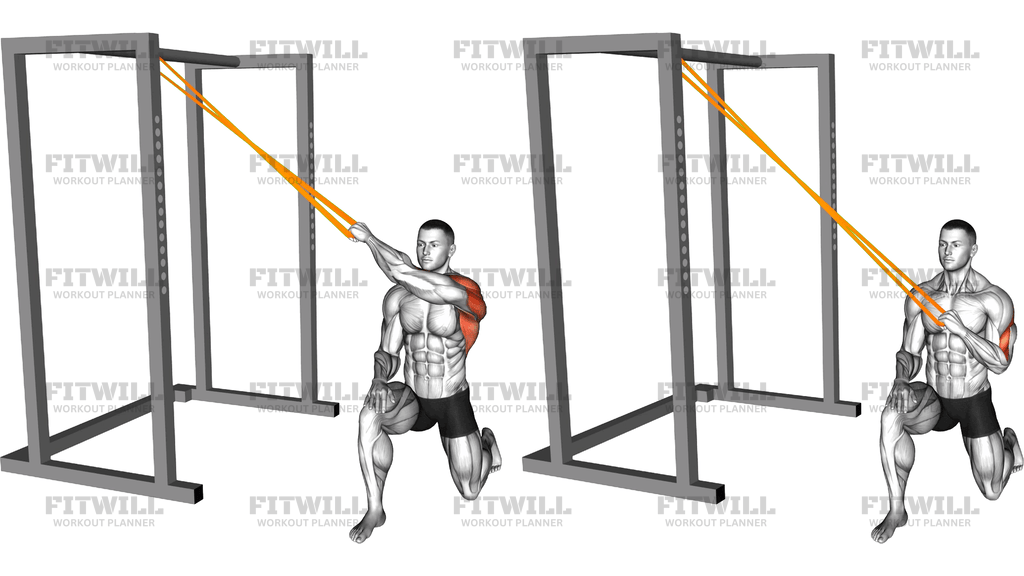
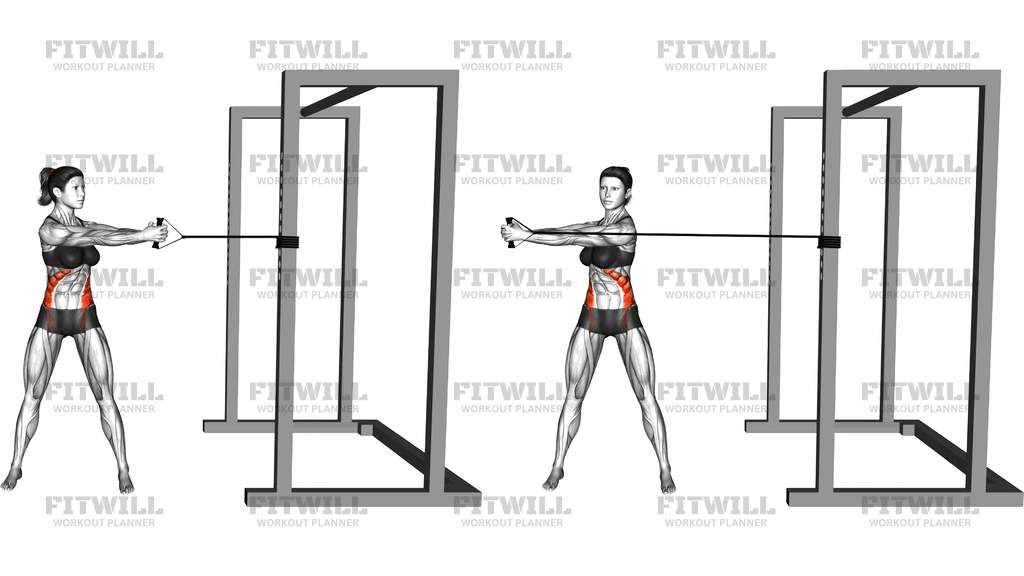
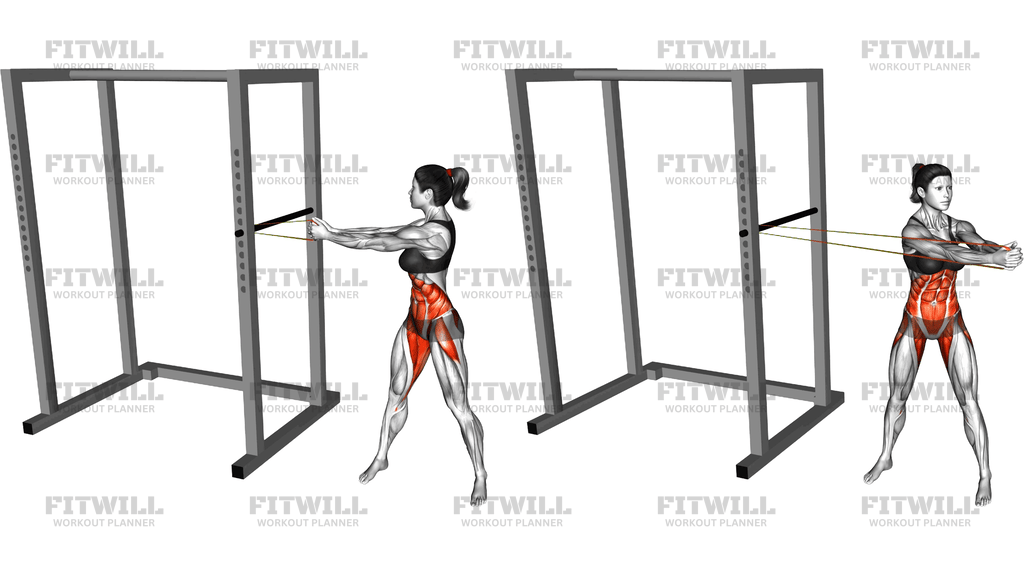
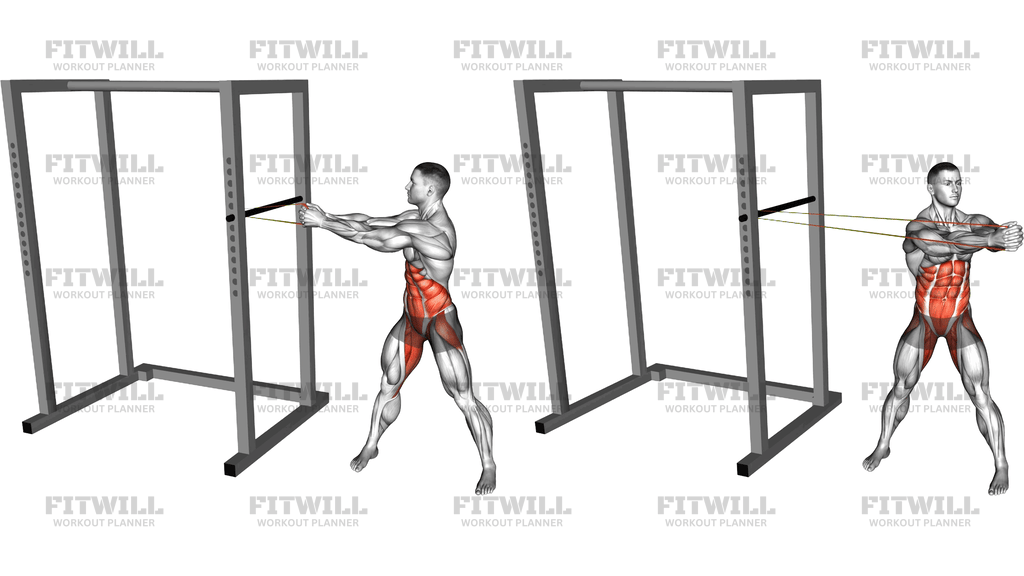
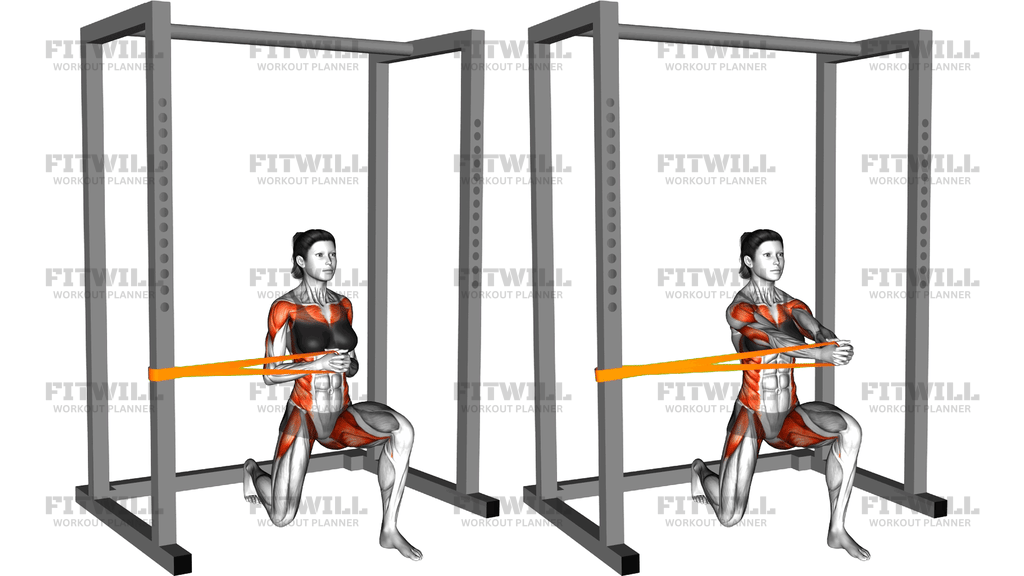
The Resistance Band Half Kneeling Horizontal Pallof Press is an anti-rotation core exercise that trains your trunk to resist being twisted. A resistance band is anchored at roughly chest height to your side, and from a half-kneeling position you press your clasped hands straight out in front of your chest, fighting the band's pull toward the anchor point. The moment your arms extend, the rotational torque on your torso peaks, and your obliques and deep core have to work hard to keep your ribs and hips square to the front.
The half-kneeling stance is what separates this version from the standing Pallof Press. With one knee down and the other foot planted in front, your base is narrow and stable in the side-to-side sense, but you cannot cheat with your legs. That forces the front hip and glute to stabilize the pelvis while the core handles the rotation force, making this a favorite for people who rotate or extend through their lower back when they press or carry. It is especially useful for lifters who feel their back instead of their abs, for athletes in rotational sports, and for anyone rebuilding trunk control after a layoff.
Setup matters more here than in most core work. Anchor the band at chest height, stand or kneel far enough away that there is tension before you even start pressing, and position yourself so the band pulls directly sideways across your body. If the anchor is too low, too high, or too slack, the challenge drifts away from pure anti-rotation and the exercise loses its point. Take your time getting the distance right before your first rep.
Execution is deliberately slow. From the hands-at-chest position, extend your arms straight forward until your elbows are locked out at roughly shoulder height, pause for two to three seconds while the band tries to rotate you, then draw your hands back in under control. Your torso should not move at all during the press; if you notice your shoulders turning toward the anchor or your hips drifting, the band tension is too high or you are rushing.
Because the band pulls sideways, the return path is where most people get sloppy. The band accelerates your hands back toward your chest, so the lowering phase needs just as much attention as the press. Complete all reps on one side before switching so you can honestly compare how each side resists the twist.
A pad under the down knee makes longer sets comfortable, and the exercise pairs well with carries, dead bugs, or planks as part of a core finisher. Two to three sets of eight to twelve slow reps per side is plenty; this is a control exercise, not a rep-race.
[ Workout Log & Planner ]
Put your next workout in Fitwill
Keep your plan and training log ready when you are.


Instructions
- Anchor a resistance band at chest height to a rack or sturdy upright, then position yourself half-kneeling sideways to the anchor with your outside knee down and your inside knee up, foot flat on the floor.
- Grip the band with both hands, fingers interlaced or one hand over the other, and scoot sideways until the band pulls taut against the side of your chest with your hands held at your sternum.
- Tuck your tailbone slightly, squeeze the glute of the down-knee leg, and brace your abs as if bracing for a light poke to the stomach.
- Keep your gaze forward and your chest facing squarely ahead; do not let your shoulders angle toward the anchor.
- Exhale and press both hands straight out in front of your chest until your elbows are fully extended, keeping the band path horizontal and level with your sternum.
- Hold the extended position for two to three seconds, actively resisting the band's pull toward the anchor without letting your torso rotate.
- Inhale and slowly draw your hands back to your chest, controlling the band rather than letting it snap you back.
- Finish all reps on one side, then reposition and repeat with the band anchored on the opposite side to train the other direction.
- Between sets, step away from the band before releasing your grip so it cannot snap back toward you.
Tips & Tricks
- If your shoulders start turning toward the anchor as you press, drop to a lighter band; the exercise only works when your trunk stays square.
- Watch that the knee of your front leg does not cave inward. Drive that knee slightly outward over your toes to lock the pelvis in place.
- A common error is pressing the hands out and slightly across the body's midline. Press directly forward from the sternum so the band path stays horizontal and symmetrical.
- Do not hold your breath through the press. Exhaling as you extend makes your brace stronger, not weaker, and keeps the ribs from flaring.
- If your down knee aches, place a folded mat or pad under it and check that your front shin is roughly vertical rather than reaching far forward.
- The end position is a full elbow lockout, not a partial press. Stopping short cuts the moment of peak torque where most of the benefit lives.
- If the band slackens when your hands come back to your chest, you are too close to the anchor; scoot out until tension exists even at the start position.
- Keep your hips facing forward instead of letting them rotate toward the band. Your pelvis should stay as square as your shoulders.
- Progress by pausing longer at full extension or using a stiffer band before you think about adding more repetitions.
Frequently Asked Questions
What muscles does the Resistance Band Half Kneeling Horizontal Pallof Press work?
The primary work is done by the obliques and deep core muscles as they resist rotation. The glutes, especially on the kneeling side, and the hip stabilizers support the pelvis, while the shoulders and arms simply hold the pressing position.
Why half-kneeling instead of standing for the Pallof Press?
The half-kneeling stance narrows your base so you cannot brace against the band with your legs, which places the anti-rotation demand squarely on your trunk and front hip. It is a good intermediate step between kneeling and standing versions.
How high should I anchor the band?
Anchor it at chest or sternum height so the band pulls horizontally across your torso. A low or high anchor adds pulling angles that change the exercise into something closer to a lift or chop.
How far should I kneel from the anchor point?
Far enough that the band is already taut when your hands are at your chest, before you press. If the band goes slack at the start, you are too close and will lose tension mid-rep.
Is this a good exercise for beginners?
Yes, provided you start with a light band and short holds. Beginners often benefit more from this than from crunches because it teaches trunk control without loading the spine.
Should my torso move at all during the press?
No. Your arms travel while your chest, ribs, and hips stay facing forward. Any rotation means the band is too strong or you are extending too quickly.
How long should I hold the press at full extension?
Two to three seconds is a solid default. If you cannot hold the extended position without twisting, reduce band tension before shortening the pause.
What can I use if I do not have a rack to anchor the band?
Any sturdy upright at chest height works, such as a squat rack post, a heavy piece of equipment, or a band looped around a fixed object. Avoid door anchors at this height unless the door is very solid, since the band pulls sideways with real force.
Do I need to train both sides?
Always. Complete all reps with the band on one side, then switch anchors so the opposite obliques get the same challenge. Most people notice one side rotates more easily, which is useful feedback.
Is the Pallof Press safe for people with lower back sensitivity?
It is often well tolerated because the spine stays neutral and the load is rotational resistance rather than compression. Still, keep the tension modest, move slowly, and stop if the exercise produces discomfort rather than muscular effort.