Resistance Band Kneeling Cross Body Lat Pulldown
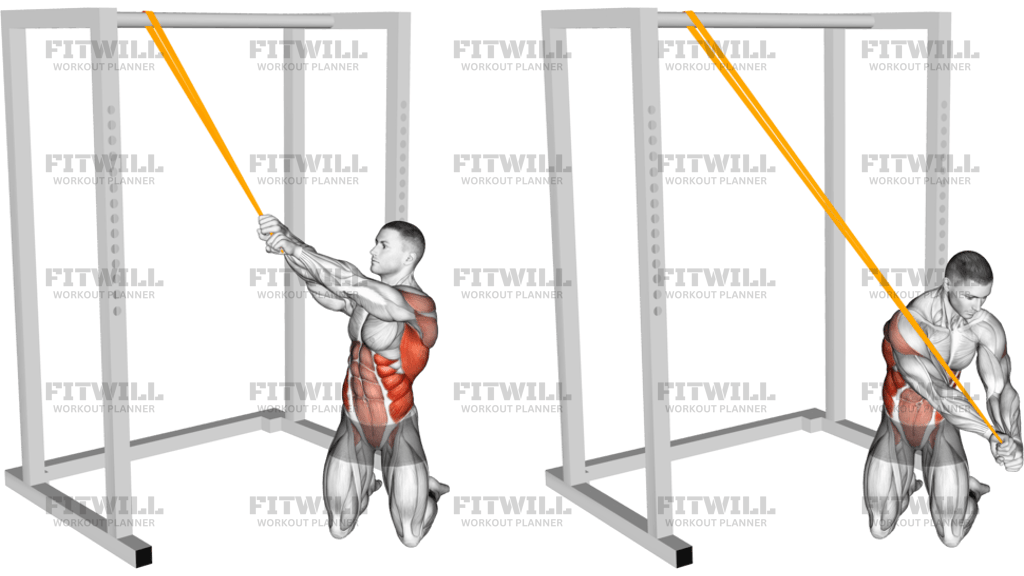
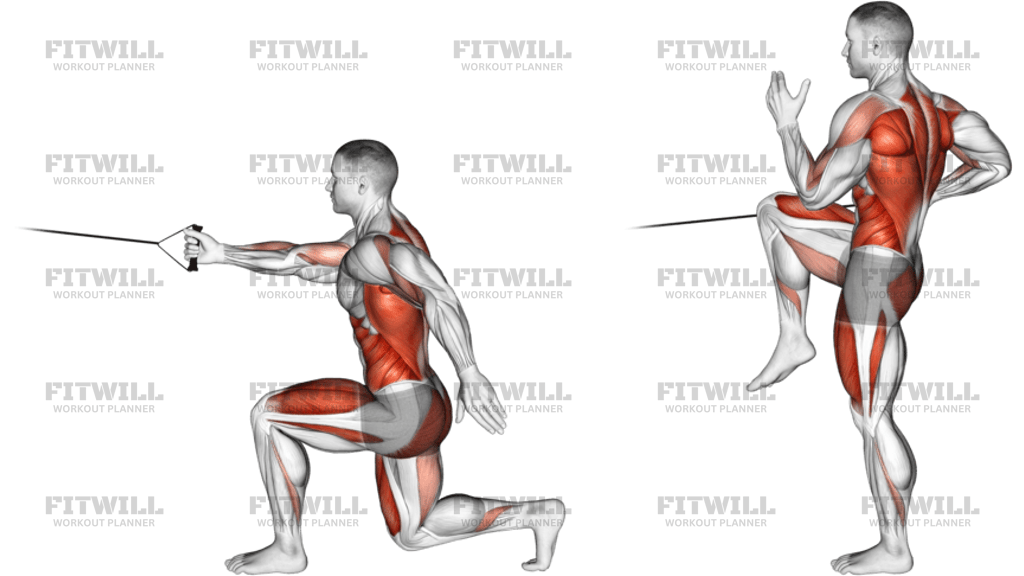
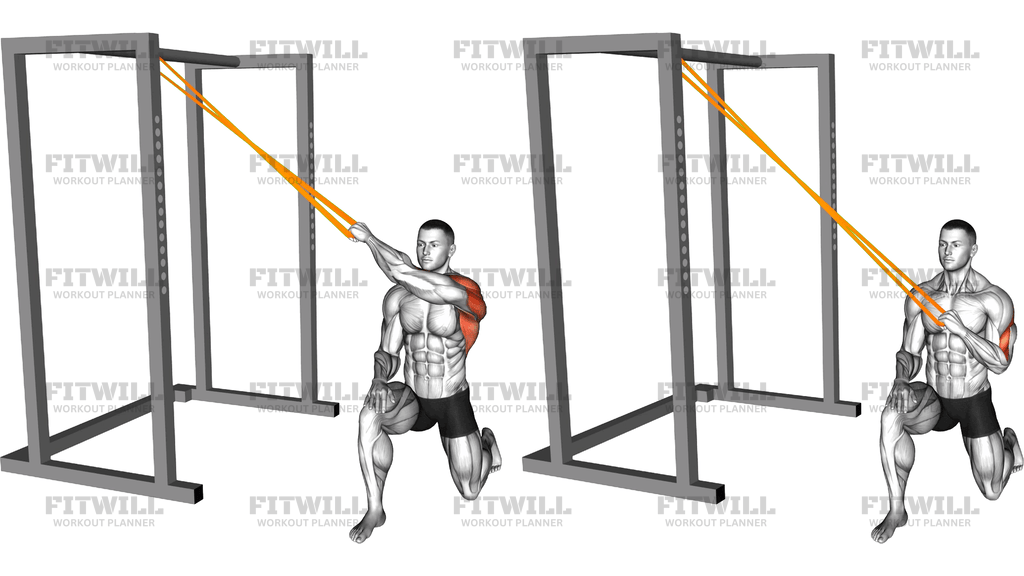
The Resistance Band Kneeling Cross Body Lat Pulldown is a single-arm, diagonal pulling exercise performed from a half-kneeling position. A resistance band is anchored high on a rack or pull-up frame, and you pull the band down and across your torso toward the opposite side of your chest, finishing with your hand near your sternum. Because the pull travels at an angle rather than straight down, it challenges the lats through a slightly different line than a standard pulldown and adds a rotational control demand that most pulldown variations don't have.
This movement suits lifters who want lat work without a cable machine, people training at home with minimal equipment, and anyone recovering from heavy barbell pulling days who still wants directed lat volume. It's also a good teaching tool: the kneeling stance removes momentum from the legs, so it's much harder to cheat the rep by leaning back and dropping your shoulders.
The primary muscles worked are the lats, with the teres major and rear delts assisting as the arm travels down and across. The biceps and forearm flexors work to hold the band, and the core — especially the obliques on the side you're pulling toward — has to resist rotation as the band tries to twist your torso. The half-kneeling stance also lightly loads the front hip flexors and demands stability through the pelvis.
Setup matters more than it looks. Anchor the band at or slightly above head height and give yourself enough distance that tension is already present when your working arm is extended up toward the anchor. Your front shin should be roughly vertical and your torso tall; if you're collapsing toward the band or drifting forward off the front foot, the pull angle and the muscle emphasis both change.
To execute well, start with your arm extended up and out toward the anchor, then drive the elbow down and across your body until your hand arrives near the opposite side of your chest. Think about pulling with the armpit, not the hand. Pause briefly at the bottom, then let the arm travel back along the same diagonal path under control. Keep the ribcage stacked over the pelvis and avoid twisting the shoulders toward the band.
Because band tension is highest at the bottom of the rep, the hardest part of each rep is the position where the lats are fully shortened — which is exactly where form tends to break down. Use a band tension you can pull all the way across without shrugging or yanking, and treat this as a control exercise first. Do equal work on both sides, and expect the side closer to your weaker rotation direction to feel different at first.
[ Workout Log & Planner ]
Put your next workout in Fitwill
Keep your plan and training log ready when you are.


Instructions
- Anchor a resistance band securely at or just above head height on a rack upright or pull-up frame, and step back until the band is taut with your arm extended.
- Get into a half-kneeling position facing slightly toward the anchor: front knee bent to about 90 degrees over the ankle, back knee on the floor, back foot relaxed behind you.
- Grip the band with the hand on the side closer to the anchor, arm extended up and diagonally toward the anchor point, and rest your free hand on your front thigh for support.
- Brace your core and pull your ribs down so your torso is tall and square before the rep starts.
- Pull the band down and across your body, driving your elbow toward your lower ribs on the opposite side until your hand reaches the far side of your chest.
- Squeeze at the bottom for a beat, keeping the front knee planted and the shoulders level — do not lean or rotate the torso into the pull.
- Slowly return the band along the same diagonal path until the arm is fully extended and the lat is stretched at the top.
- Exhale as you pull across, inhale as you extend back up.
- Complete all reps on one side, switch the kneeling stance, and work the other arm with the band anchored on the opposite side.
Tips & Tricks
- If your torso twists toward the working arm at the bottom of the pull, the band is too heavy — drop to a lighter band or shorten your range slightly until you can keep your chest square.
- Do not let the shoulder ride up toward the ear as you pull; think of pushing the working shoulder blade down into your back pocket before the arm moves.
- The free hand on the front thigh is there for balance, not leverage — pressing down hard to help yourself lean is a sign the tension is too high.
- Anchor height changes the emphasis: a higher anchor shifts the pull closer to a true pulldown, while an anchor near shoulder height makes it feel more like a cross-body row. Pick one and stay consistent.
- Keep the front shin vertical. If your front knee drifts forward or your hips shift toward the band, you're losing the stable base that makes the kneeling position worthwhile.
- Control the return just as much as the pull. Letting the band snap the arm back up wastes the stretch portion of the rep, which is where a lot of the lat benefit lives.
- If you feel it mostly in the biceps, slow the pull down and focus on leading with the elbow instead of the hand.
- Kneel on a pad if your back knee is uncomfortable — a sore knee will make you shift position mid-set without noticing.
- Match reps and band tension between sides, and start every set with your less coordinated side.
Frequently Asked Questions
Which muscles does the Resistance Band Kneeling Cross Body Lat Pulldown work?
The lats are the prime mover, supported by the teres major and rear delts along the diagonal pull. The biceps grip and assist, the obliques resist rotation, and the hip and trunk stabilizers work to hold the half-kneeling position.
Why kneel instead of standing for this exercise?
Kneeling removes the legs from the equation, so you can't use hip drive or backward lean to move the band. It also lowers the center of mass, making it easier to keep the torso tall and square while the band pulls you off line.
Which knee should be down during the Resistance Band Kneeling Cross Body Lat Pulldown?
Use whichever kneeling stance lets you sit tall and stay balanced — most people prefer the back knee on the same side as the working arm with the free hand resting on the front thigh. The key is a stable base, not a strict rule.
Can beginners do the Resistance Band Kneeling Cross Body Lat Pulldown?
Yes, and it's actually a good beginner lat exercise because the light band and kneeling position make cheating difficult. Start with a light band and focus on feeling the pull come from the armpit rather than the hand.
Why does the band feel hardest at the bottom of the pull instead of the top?
Band resistance increases as the band stretches, so tension peaks when your hand is pulled across your chest. Choose a band you can pull fully across without shrugging, since that endpoint is where the lats do their shortest, hardest work.
What's the most common mistake with the cross body angle?
Rotating the torso and throwing the shoulder toward the band instead of pulling with the arm. Keep your chest square and let the hand travel across the body while the shoulders stay level.
What can I use if I don't have a rack to anchor the band?
Any sturdy overhead anchor works — a pull-up bar, a door frame anchor, or a heavy overhead beam. Just make sure the attachment point is secure and above head height so the pull angle matches the exercise.
How does this differ from a regular single-arm lat pulldown?
The diagonal, cross-body path adds a rotational resistance component and pulls the lat through a slightly different line than a straight vertical pulldown. It also naturally targets the obliques as anti-rotators, which a standard pulldown doesn't.
Is it safe for the shoulder, and how do I know my range is appropriate?
The band's smooth resistance makes this a joint-friendly pulling option, but stop the pull if you feel pinching at the front of the shoulder or pain in the kneeling knee. Stay within a range where you can keep the shoulder blade controlled and the torso square throughout.