Resistance Band Standing Wood Chopper
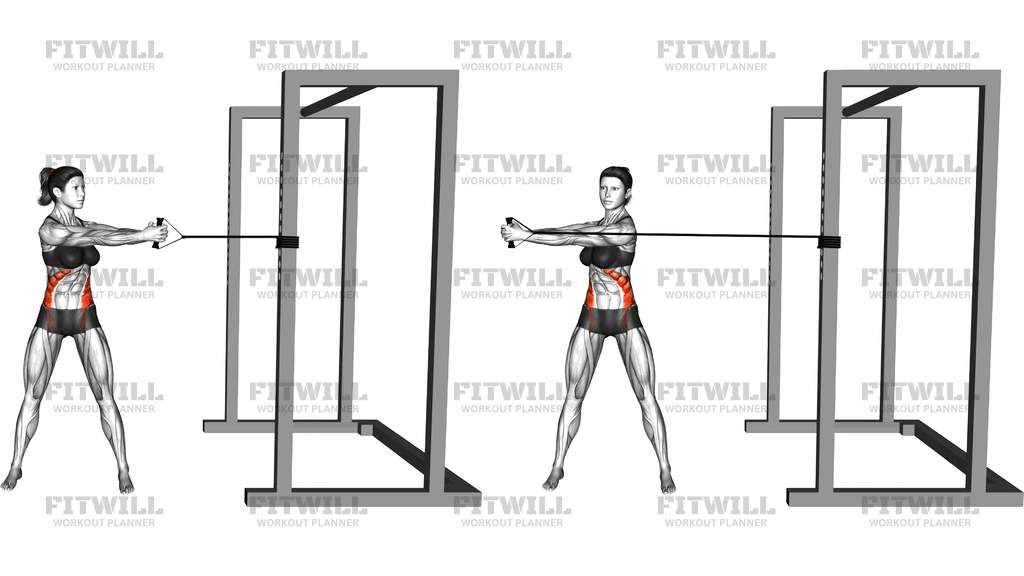
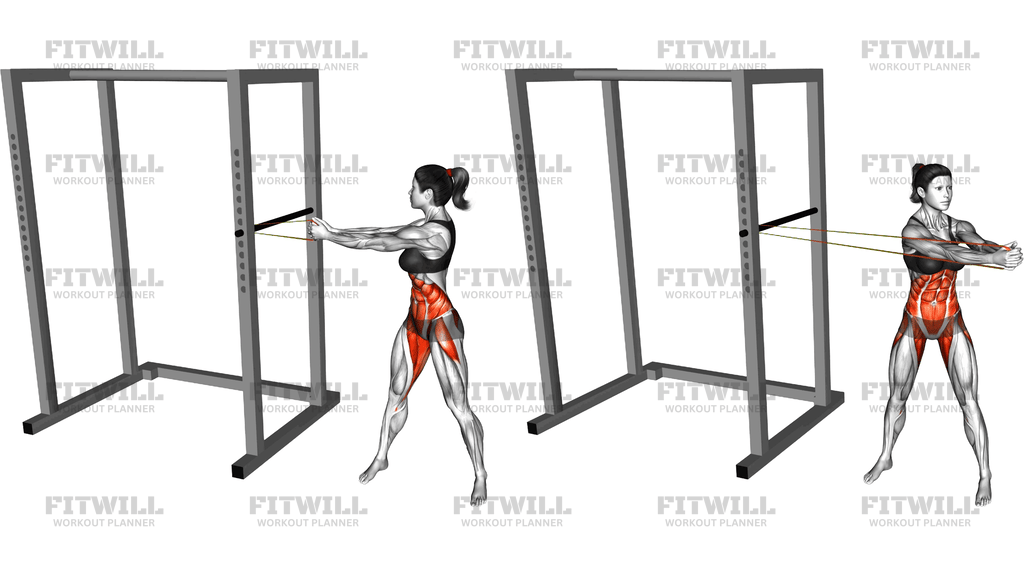
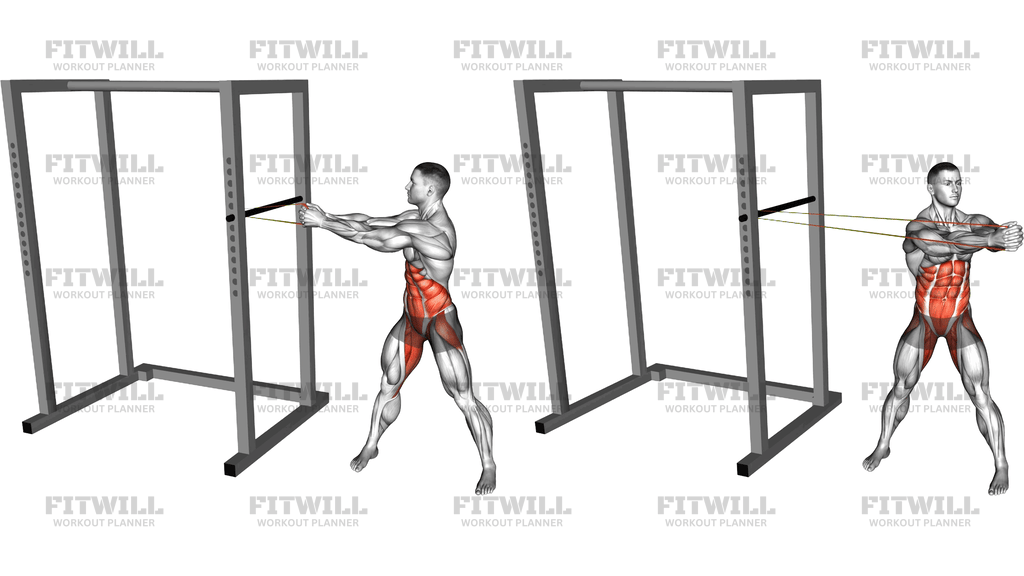
The Resistance Band Standing Wood Chopper is a rotational core exercise that mimics the diagonal pulling action of chopping wood, done here in a horizontal plane with a band anchored at chest height. You stand sideways to the anchor point, grip the band with both hands, and rotate your torso away from the anchor while the arms stay extended, letting the trunk do the work instead of the shoulders.
This movement is one of the most practical ways to train rotation. The obliques on the side of your torso do the bulk of the turning, but your rectus abdominis braces hard to keep the ribcage and pelvis connected, and your hips and legs create a stable base so the force travels through your midsection rather than leaking through a loose spine. Because the band resists you both on the way out and on the way back, you train the chop and the controlled return in one rep.
Athletes in rotational sports get the most obvious benefit from this pattern — swinging a bat, racket, or club all reward a strong, controlled trunk turn. But it is just as valuable for anyone who lifts, carries, or twists in daily life, and it works well as a warm-up activator before heavier lifting because the band load is easy to scale.
Setup matters more than most people expect. Anchor the band at roughly chest height and stand far enough away that there is tension before you even start the rep. Keep your feet wide, your weight spread across both legs, and your arms locked into a straight, extended position — if your elbows bend and your arms do the pulling, the exercise turns into a band press and the obliques stop being the limiting factor.
Execute the chop by rotating from the ribcage and pelvis together, exhaling as you turn, and finishing with your chest facing away from the anchor and the band pulled across your body. Pause briefly at the end range, then resist the band on the way back rather than letting it whip you around. Two to three sets of 10 to 15 reps per side covers most goals, and switching the band to the opposite anchor point lets you train both directions evenly.
The main safety point is spinal control: the movement should come from a braced trunk rotating over a stable lower body, not from bending, rounding, or hyperextending the lower back. Start with a light band, master the timing, and only add resistance once you can stop the end range cleanly without your knees collapsing or your heels lifting.
[ Workout Log & Planner ]
Put your next workout in Fitwill
Keep your plan and training log ready when you are.


Instructions
- Anchor a resistance band at chest height to a sturdy rack or post, and stand sideways to the anchor point with the band on the side you are chopping away from.
- Take hold of the band with both hands, fingers interlaced or one hand over the other, and step out so the band has steady tension before the rep begins.
- Set a wide stance with your feet roughly shoulder-width apart or wider, toes turned slightly out, and distribute your weight evenly across both feet.
- Extend both arms straight out in front of your chest toward the anchor and brace your core as if preparing to take a light push.
- Exhale and rotate your entire torso away from the anchor, sweeping the band across your body while keeping the arms straight and locked at chest height.
- Finish with your chest facing away from the anchor, the band stretched across your torso, and your hips turned to match your shoulders.
- Pause for a beat at the end of the chop, feeling the tension across your obliques on the trailing side.
- Inhale and slowly rotate back toward the anchor, resisting the band's pull the whole way instead of letting it snap you back.
- Complete all reps on one side, then re-anchor or turn around and perform the same number of reps in the opposite direction.
- Between sets, release tension gently, stand tall, and reset your stance and brace before the next set.
Tips & Tricks
- If your elbows start bending mid-rep, the band is too heavy or you are rushing — drop the resistance so the rotation, not the arms, drives the movement.
- Keep the band path level with your chest. If your hands drift up or down as you chop, your shoulder is taking over and the diagonal line of the exercise is lost.
- Let your back heel and hip rotate naturally as you turn; forcing the back foot flat while twisting is a fast track to cranky knees.
- Do not let the band yank you back to the anchor on the return — the eccentric half of this exercise is where a lot of the oblique work happens.
- If your lower back arches or rounds as you rotate, squeeze your glutes lightly and re-brace your abs; the pelvis should stay stacked under the ribcage.
- Start each set standing closer to the anchor with slack and step back to add tension, so you can fine-tune resistance without changing bands.
- Chop away from the anchor on one side and set up on the other side for the second set — training only your stronger direction builds an imbalance over time.
- Control the pause at the finish; a one-second hold at full rotation teaches you to own the end range instead of flinging through it.
Frequently Asked Questions
What muscles does the Resistance Band Standing Wood Chopper work?
The obliques are the primary movers, with the rectus abdominis bracing throughout each rep. Your shoulders, chest, glutes, and legs assist by holding the arms extended and stabilizing the wide stance.
How high should I anchor the band for the Resistance Band Standing Wood Chopper?
Anchor it at about chest height so the band travels in a level line across your torso as you rotate. This keeps the resistance pulling straight across the obliques instead of dragging your arms up or down.
How far should I stand from the anchor point?
Stand far enough that the band is already under moderate tension with your arms extended toward the anchor. If there is slack at the start, the first part of every rep is wasted.
Should my arms stay straight during the Resistance Band Standing Wood Chopper?
Yes. The arms act as a fixed lever holding the band at chest height, and the rotation should come from your trunk. Bent elbows turn the exercise into an arm press and take the load off the obliques.
Can beginners do the Resistance Band Standing Wood Chopper?
It is actually a good beginner rotation exercise because the band load is light and easy to adjust. Start with a thin band, a shorter range, and slow tempo before adding resistance or speed.
Why do my arms get tired before my core in this exercise?
That usually means the band is too heavy, so your arms strain just to hold it. Use less resistance so your trunk, not your grip and shoulders, is the limiting factor in each rep.
Can I substitute a cable machine for the Resistance Band Standing Wood Chopper?
Yes, a cable set at chest height with a single handle reproduces the same horizontal chop. The band version adds a slightly springier return resistance, while the cable feels smoother on the way back.
How many reps and sets should I do of the Resistance Band Standing Wood Chopper?
Two to three sets of 10 to 15 controlled reps per side works well for most lifters. If you use it as a warm-up activator, drop to one or two lighter sets of 8 to 10 per side.
Is it safe for my lower back?
When done with a braced core and rotation coming from the trunk over a stable stance, it is generally a back-friendly way to train rotation. Keep the load modest, avoid rounding or overarching your spine, and stop if you feel sharp pain rather than muscular effort.