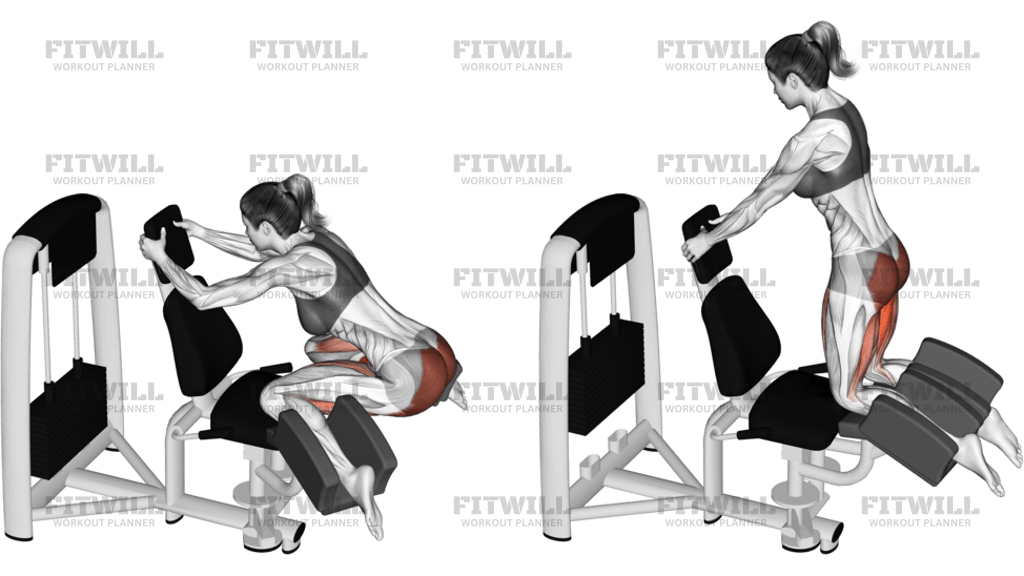
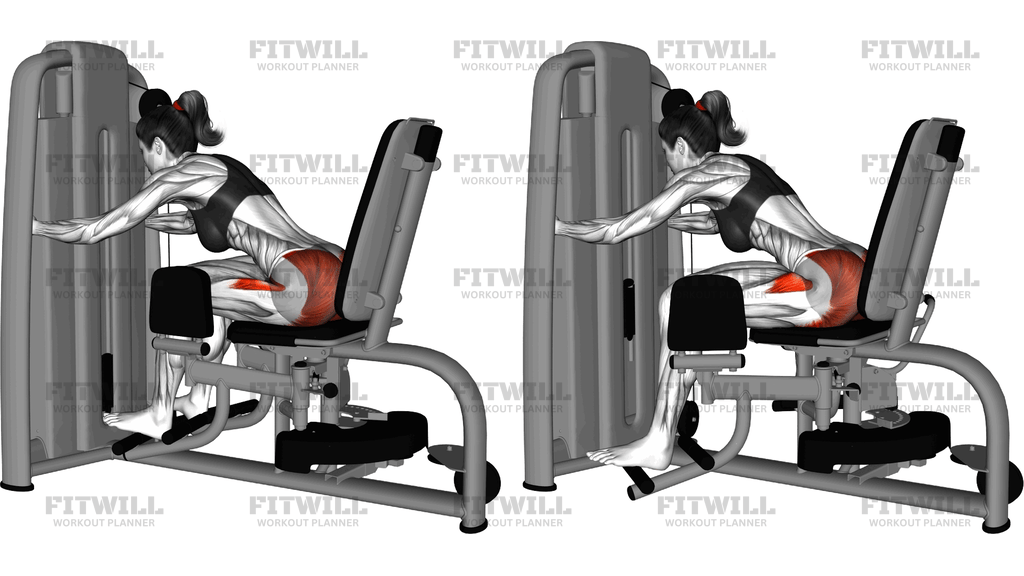
Lever Seated Leaning Forward Hip Abduction
The Lever Seated Leaning Forward Hip Abduction is a machine-based exercise that targets the muscles on the outside of the hip, primarily the gluteus medius, with support from the gluteus maximus and the tensor fasciae latae. You sit sideways on a leverage machine, fold your torso forward over a padded chest support, and drive one leg out to the side against a resistance pad. The forward-lean position is what separates this from a standard seated abduction: tilting the torso changes the angle of the hip joint and biases the upper glutes more directly than an upright torso does.
This movement is especially useful for people who want to build the side of the glutes, improve hip stability, or add focused volume to the gluteus medius without loading the spine. Because the machine stabilizes your torso and the resistance comes from a fixed lever arm, you can concentrate entirely on moving the hip through its range. That makes it a good fit for general strength training, glute-focused hypertrophy programs, and rehabilitation-style work where controlled, isolated hip abduction is the goal.
Setup matters a great deal on this machine. The position of the seat, the height of the leg pad, and how far you lean forward all change which part of the hip does the work. Sit so the working leg lines up cleanly with the pad, rest your forearms or hands on the front handles for stability, and keep your pelvis square rather than twisting away from the movement. If your torso rotates or your hips lift off the seat as you push, the exercise loses much of its targeted effect.
Execution is simple but easy to rush. Press the leg out against the pad in a smooth, deliberate motion, pause briefly at the widest point, then lower the weight back with control instead of letting the lever snap back. A slow return is where most of the muscle-building stimulus lives, so treat the eccentric phase with the same attention as the push. Breathe out as you press out and in as you return.
Because the leverage machine typically works one side at a time in this position, always complete your set on one leg before switching. Starting with your weaker side helps keep development even, and matching reps from side to side prevents one hip from quietly doing more work than the other over time.
[ Workout Log & Planner ]
Put your next workout in Fitwill
Keep your plan and training log ready when you are.


Instructions
- Adjust the seat height so your thighs sit level and the working leg lines up with the machine's resistance pad.
- Sit sideways on the machine, lean your torso forward onto the padded support, and grip the front handles firmly with both hands.
- Position your outer thigh or lower leg against the resistance pad, with the knee bent and the foot resting on the machine's footrest.
- Brace your core lightly and keep your pelvis square to the seat so your hips cannot twist as you press.
- Press your leg out to the side against the pad, pushing from the hip rather than swinging from the knee.
- Pause for a beat at the widest point of the movement without letting your torso rotate backward.
- Slowly return your leg to the starting position, resisting the lever's pull rather than letting it drop back.
- Exhale as you press out and inhale as you lower back down.
- Complete all reps on one leg, then reposition and work the other side with the same range and tempo.
- After the final rep, ease the lever back fully before releasing your grip and standing up off the machine.
Tips & Tricks
- The most common mistake on this machine is leaning back or rotating the torso as the leg fatigues, which lets momentum help the push. Keep your chest planted on the pad for the entire set.
- If you feel the work in the front of the hip instead of the outer glute, your pad position is probably too high or your lean is too shallow. Adjust the pad toward the thigh and fold forward a little more.
- Do not chase a huge range of motion. Pushing until your pelvis tilts sideways takes tension off the gluteus medius and strains the lower back.
- Keep the foot on the footrest relaxed; gripping with the foot tends to recruit the calf and distracts from the hip drive.
- Use a two- to three-second return on every rep. The lever arm will happily yank your leg back if you let it, and that wasted eccentric is where most of the benefit is lost.
- Start with your weaker leg each session so the stronger side never sets an uneven pace.
- Warm the hips up with a few light, high-rep sets before adding meaningful weight, since the gluteus medius responds poorly to cold, heavy loading.
- If your knee drifts inward on the return, slow the eccentric further and think about leading the motion from the outer hip rather than the lower leg.
Frequently Asked Questions
Which muscles does the Lever Seated Leaning Forward Hip Abduction work?
The primary mover is the gluteus medius on the outer hip, supported by the gluteus maximus and the tensor fasciae latae. The forward lean shifts the emphasis toward the upper, side portion of the glutes.
Why does this version have you lean forward instead of sitting upright?
Leaning the torso forward changes the angle of the hip joint, which puts the gluteus medius in a stronger line of pull and reduces involvement of other hip muscles. It also removes much of the lower-back demand that upright seated abduction can create.
Is the Lever Seated Leaning Forward Hip Abduction suitable for beginners?
Yes. The machine fixes your torso and movement path, so beginners only need to learn a clean hip drive and a controlled return. Start light and focus on feeling the outer hip do the work.
How far should I press my leg out on each rep?
Press out to a comfortable end range where your leg stops moving smoothly, roughly level or slightly above level if your mobility allows. If your torso starts rotating or your pelvis tilts, you have gone past your controllable range.
Should I work both legs in the same set?
No, finish all repetitions on one leg before switching sides. This machine works each hip independently in the leaning position, and alternating mid-set makes it harder to keep tempo and positioning consistent.
What should I do if I feel this in my lower back?
Check that your chest is fully supported on the pad, your core is lightly braced, and you are not pushing past the point where your pelvis tilts. Reducing the range and the weight usually resolves it.
Can I substitute this exercise if my gym has no leverage machine?
A seated hip abduction machine, banded seated abductions with a forward lean, or side-lying hip raises with a band all train the same gluteus medius pattern. None will feel identical, but the outer-hip emphasis carries over.
How heavy should I go on the Lever Seated Leaning Forward Hip Abduction?
Choose a load you can press out and lower back over roughly two to three seconds per phase without your torso moving. The gluteus medius responds better to strict reps than to heaving the lever with body english.
How do I know the pad is positioned correctly?
When the pad sits against your outer thigh just above or at the knee, the press should feel like it comes from the hip socket. If the work concentrates in the knee or the front of the thigh, the pad is too low or too high and needs adjusting.
Is this exercise safe for daily training?
The hip abductors recover relatively quickly, but they still need rest like any muscle. Two to three focused sessions per week is plenty for most people, and daily high-volume work can create nagging outer-hip irritation.