Kettlebell Stiff Leg Deadlift
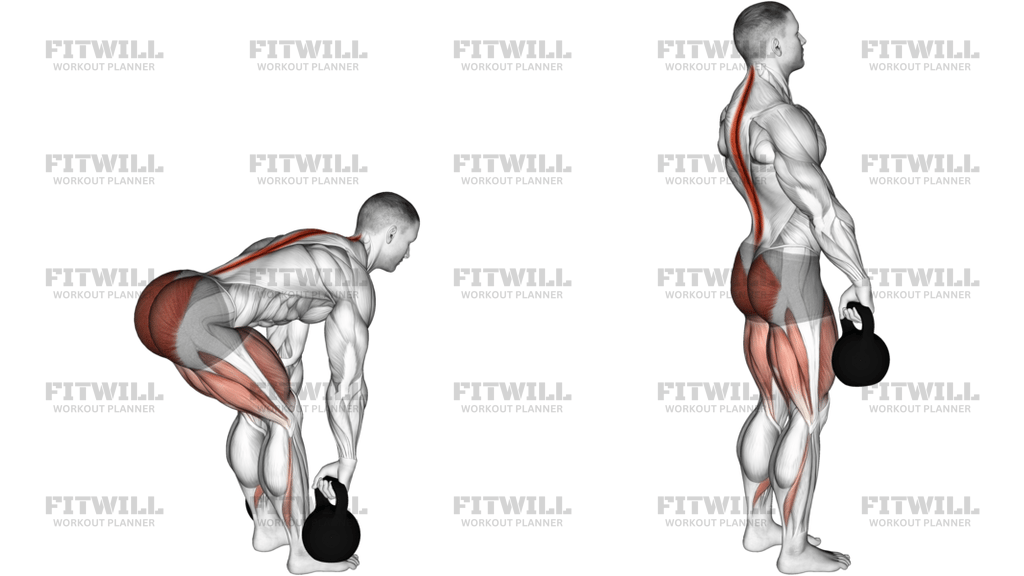
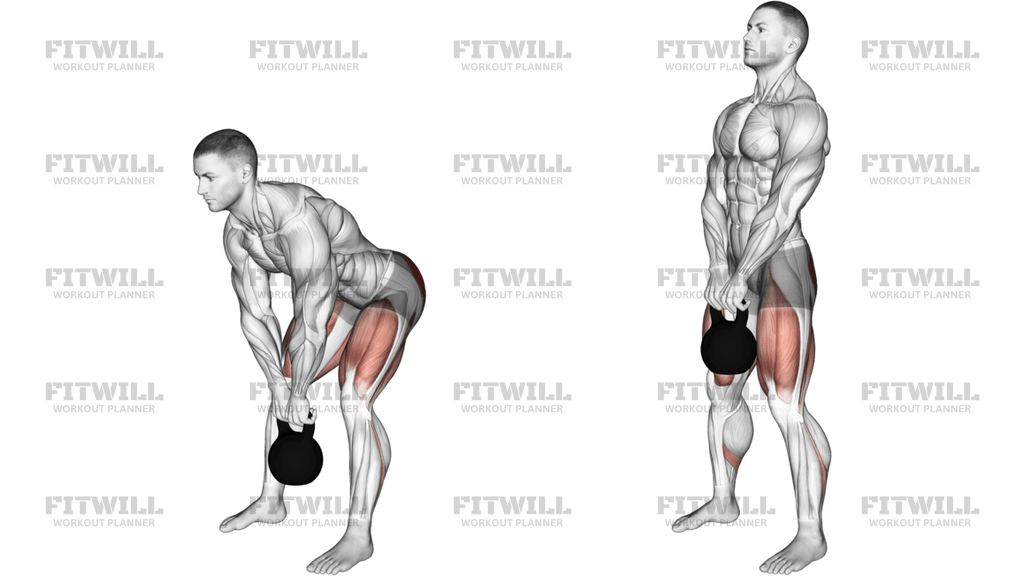
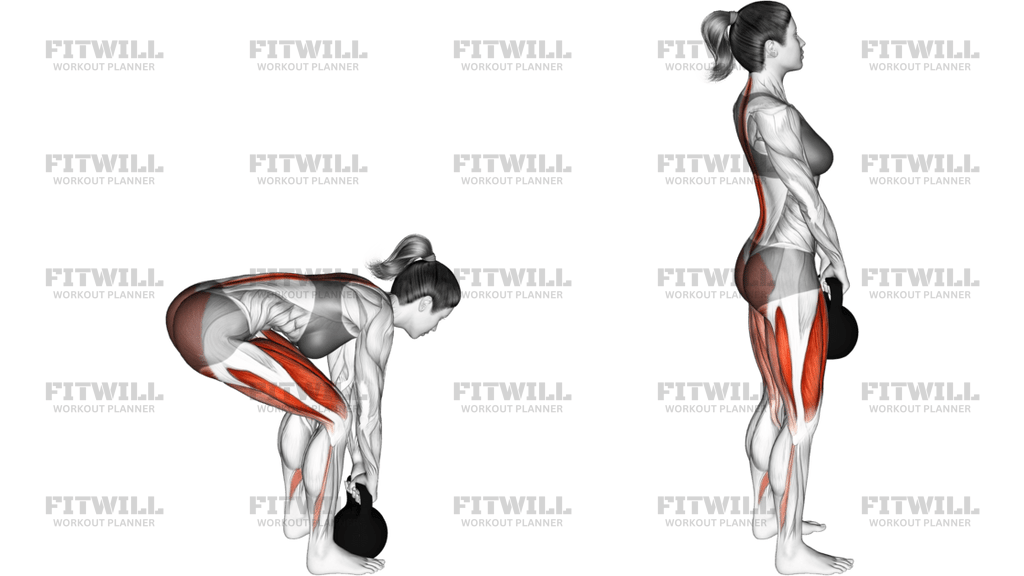
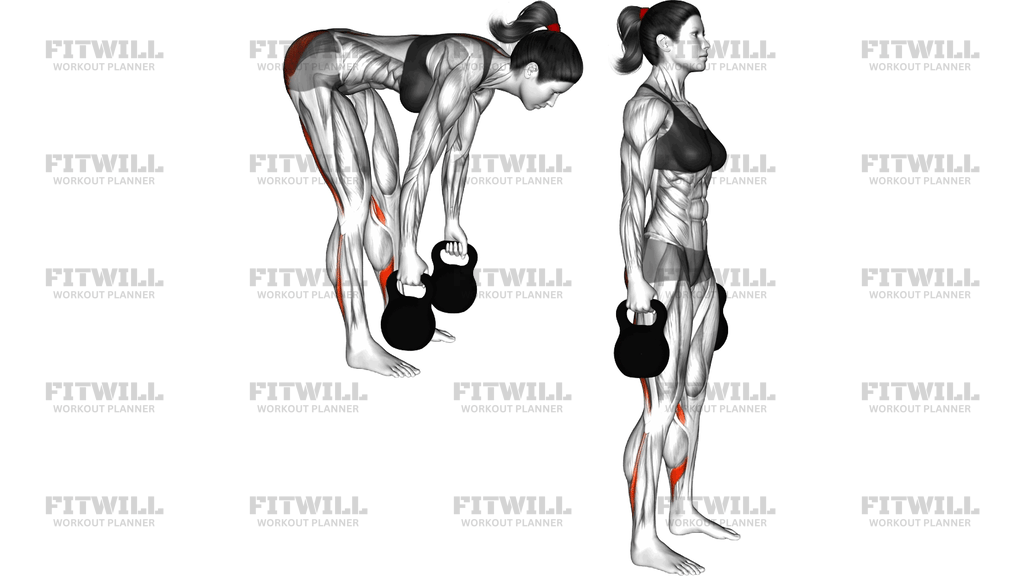
The Kettlebell Stiff Leg Deadlift is a hip hinge pattern performed with a kettlebell (or one in each hand) held at arm's length in front of the thighs. Unlike a conventional deadlift, you keep a slight, fixed bend in the knees and push your hips straight back, letting the kettlebell travel down close to your legs until you feel a strong stretch along the back of your thighs. The lift back to standing comes almost entirely from the hips, which is what makes this such a targeted posterior chain exercise.
This movement is especially useful for anyone who wants to build hamstring and glute strength without loading a barbell. Because the weight hangs from the hands rather than sitting in front of the shins, the kettlebell version is easier to set up and more forgiving on the lower back than a barbell stiff leg deadlift, making it a good entry point for lifters still learning to hinge. It also suits people who train at home with minimal equipment, since one or two kettlebells are all you need.
The main muscles worked are the hamstrings, which lengthen under load as you fold forward and contract to pull you upright. The glutes drive the final part of the lockout, the lower back works isometrically to hold your spine neutral, and your grip and upper back get steady work from simply supporting the weight through the whole set. You will typically feel the deepest stretch at the bottom, just before your torso approaches parallel to the floor.
Setup matters more than depth here. Your stance should be about hip width with the knees softly bent and staying put, your weight balanced over the middle of the feet, and your shoulders pulled back so the kettlebell hangs close to the body rather than drifting forward. If the weight swings away from your legs, the leverage shifts to your lower back and the hamstrings lose the tension you are chasing.
To execute well, think of the movement as closing a car door with your backside: initiate by pushing the hips back, keep a long flat spine, and only descend as far as your hamstrings allow while your back stays neutral. Drive the hips forward to stand tall, squeezing the glutes at the top without leaning back. Common use cases include hamstring hypertrophy work, glute development, hip hinge practice, and as a lighter accessory after heavier barbell deadlifts.
For safety, prioritize a neutral spine over reaching the floor — the kettlebell does not need to touch the ground. Start with a moderate weight you can control through a slow lowering phase, stop the set if your lower back rounds or aches, and avoid this lift on days when your hamstrings are severely sore from prior training.
[ Workout Log & Planner ]
Put your next workout in Fitwill
Keep your plan and training log ready when you are.


Instructions
- Stand with your feet about hip width apart and place one or two kettlebells on the floor just in front of you.
- Hinge down with a flat back and grip the handle(s) with your palms facing you, then stand up so the kettlebell(s) hang at arm's length in front of your thighs with your shoulders back.
- Set your knees to a slight bend — roughly 10 to 20 degrees — and hold that angle; the knees should not bend further or straighten during the set.
- Take a breath, brace your core, and pull your shoulder blades back so your spine stays long and neutral from head to hips.
- Push your hips straight back and let your torso fold forward, sliding the kettlebell(s) down close to the front of your legs.
- Lower until you feel a firm stretch in your hamstrings, usually when your torso is near parallel to the floor — do not round your back to reach lower.
- Drive your hips forward to return, keeping the kettlebell(s) against your legs, and stand fully upright.
- Squeeze your glutes at the top without pushing your hips past neutral or leaning backward.
- Exhale as you rise, inhale at the top, rebrace, and reset your shoulder position before the next rep.
- Finish the set by hinging down and setting the kettlebell(s) on the floor with control rather than dropping them.
Tips & Tricks
- If your lower back takes over, the most common cause is the weight drifting away from your legs — consciously drag the kettlebell down your shins as you hinge.
- A rounded back at the bottom usually means you are going deeper than your hamstrings allow; stop a few inches higher where your spine stays flat.
- Do not turn this into a squat — if your hips drop and your knees bend more as you descend, think about pushing the hips back toward a wall behind you.
- Keep the knee bend fixed for the whole set; changing the knee angle mid-rep converts the exercise into a regular deadlift and takes tension off the hamstrings.
- Control the lowering phase to 2–3 seconds; the stretch under slow tension is where most of the hamstring stimulus comes from.
- If your grip gives out before your hamstrings, use one kettlebell held with both hands or a mixed two-bell setup with a lighter pair rather than shortening the range.
- Avoid snapping into a big back arch at the top — finish standing tall with glutes engaged, hips in line with your shoulders and ankles.
- Keep your neck in line with your spine; looking up sharply at the bottom can encourage your upper back to round.
- Train barefoot or in flat shoes so your weight stays centered over the midfoot instead of shifting to the toes as you hinge.
Frequently Asked Questions
Which muscles does the Kettlebell Stiff Leg Deadlift work the most?
The hamstrings are the primary movers, working through a loaded stretch and then contracting to bring you upright. The glutes assist strongly at lockout, and the lower back, upper back, and grip hold isometric positions throughout.
How is the Kettlebell Stiff Leg Deadlift different from a conventional kettlebell deadlift?
In a conventional deadlift the knees bend more and the hips drop lower, spreading the work across the quads and the whole posterior chain. In the stiff leg version the knee angle stays nearly fixed, so the hamstrings and glutes do almost all of the lifting.
Should I use one kettlebell or two?
Either works. One kettlebell gripped with both hands is easier to keep close to your body and is a good starting point, while two kettlebells balance the load between sides but demand more grip strength and shoulder stability.
Do I have to touch the kettlebell to the floor at the bottom?
No. Descend only as far as your hamstrings stretch while your back stays neutral — for most people that is somewhere between shin height and just below the knee. Forcing extra depth by rounding is counterproductive.
Is this exercise safe for beginners?
Yes, provided you start light and learn the hip hinge first. The kettlebell version is actually one of the more beginner-friendly hinge variations because the weight hangs from the hands and the setup is simple.
How far should my knees bend during the Kettlebell Stiff Leg Deadlift?
A small, fixed bend of about 10 to 20 degrees is typical. The key is that the angle does not change during the rep — bending more as you lower turns the lift into a regular deadlift.
Why do I feel this more in my lower back than my hamstrings?
This usually means the kettlebell is swinging forward and away from your legs, or your back is rounding slightly at the bottom, which shifts load to the spinal erectors. Keep the weight sliding along your legs, brace harder, and shorten the range until you feel the hamstrings stretch.
What can I substitute if I don't have a kettlebell?
A dumbbell or pair of dumbbells works the same way, and a resistance band under the feet can also load the hinge. The kettlebell's handle placement simply makes it easy to keep the weight tight to the body.
How many reps and sets should I do for hamstring growth?
Three to four sets of 8 to 15 reps with a slow, controlled lowering phase works well. Use a weight that leaves your hamstrings — not your lower back — as the limiting factor.
Can I do the Kettlebell Stiff Leg Deadlift if my hamstrings are very tight?
Yes, but limit your depth to wherever your back stays flat, which may be well above parallel at first. Flexibility generally improves with consistent training through that partial range.