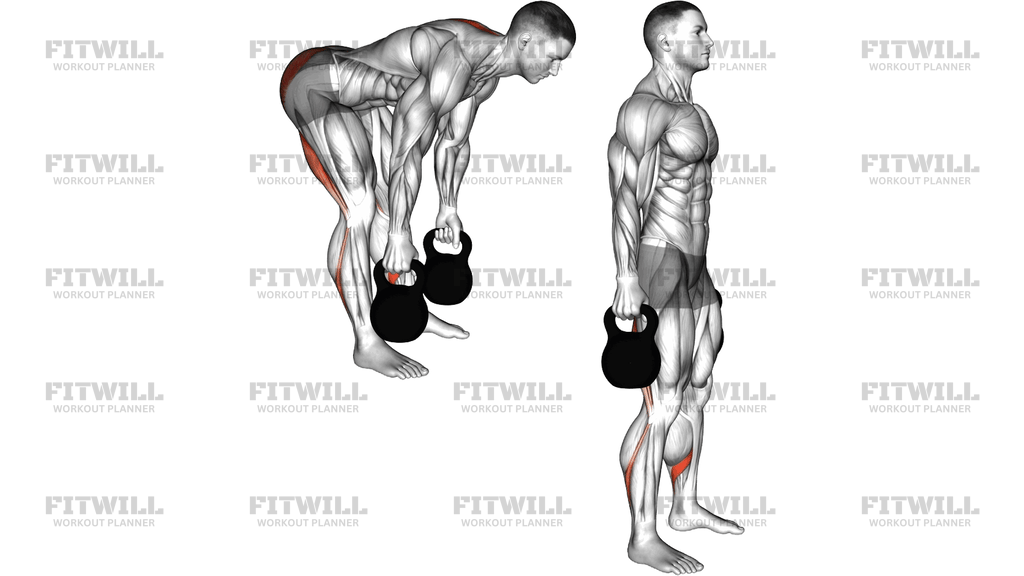
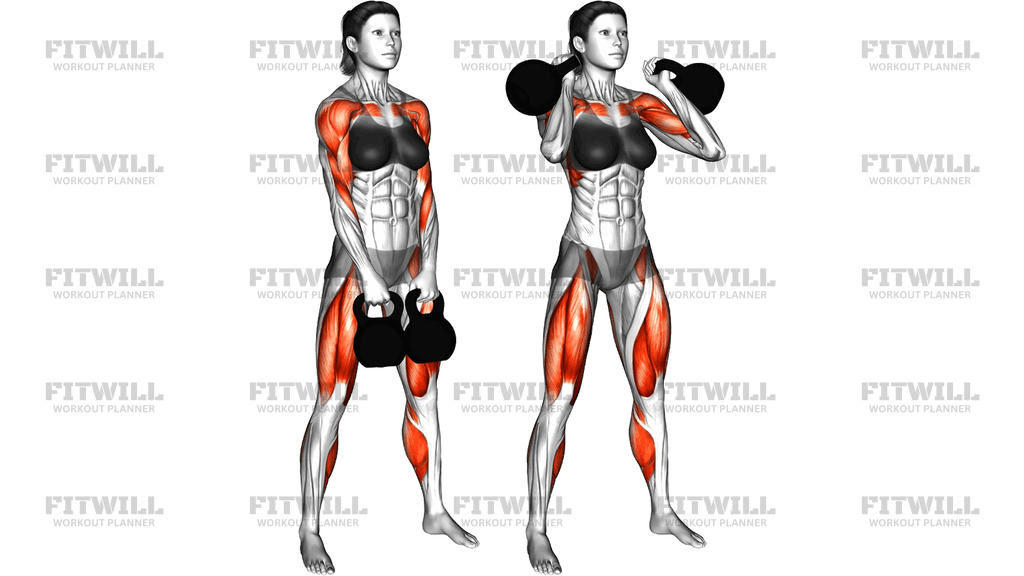
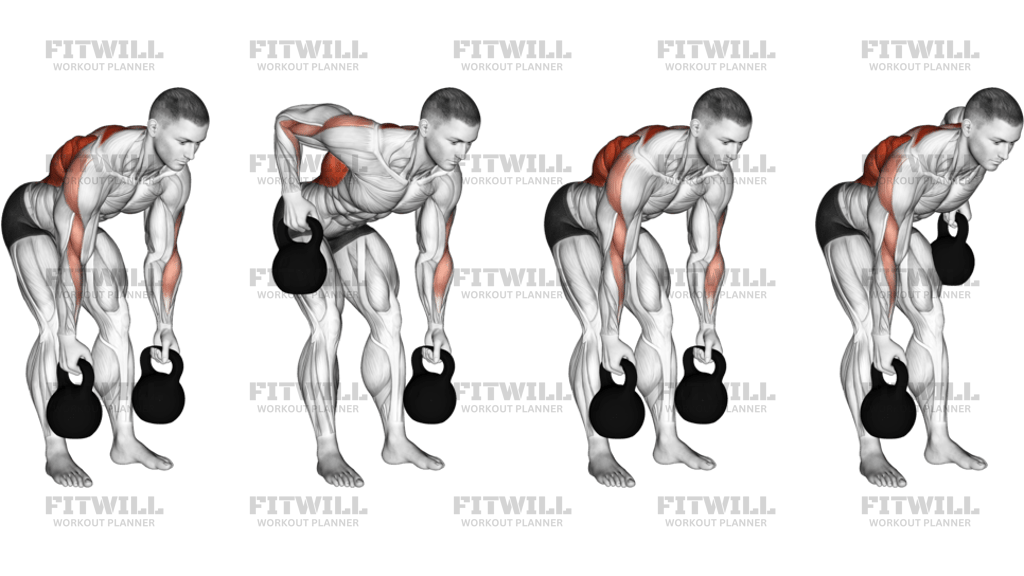
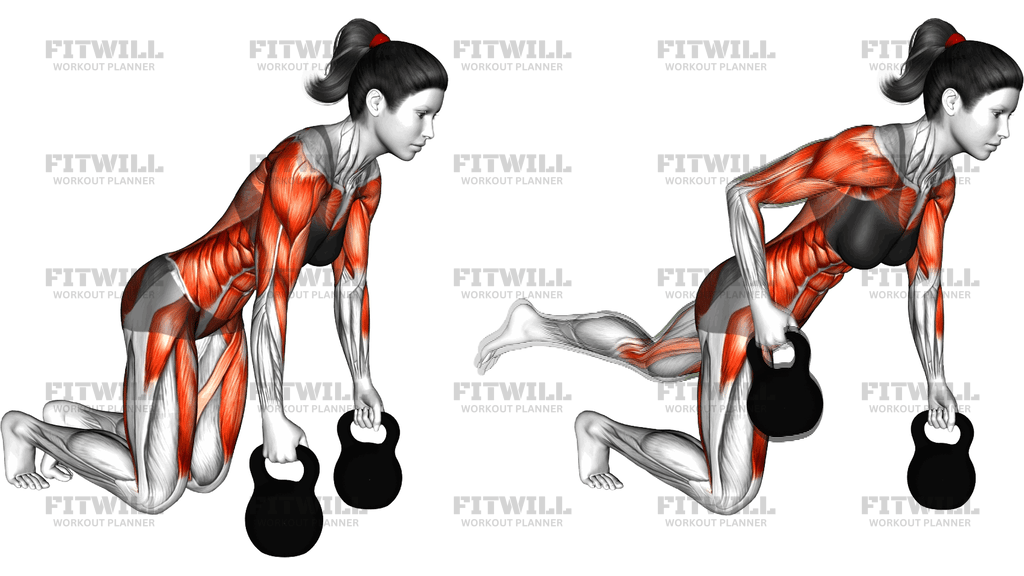
Kettlebell Straight Leg Deadlift
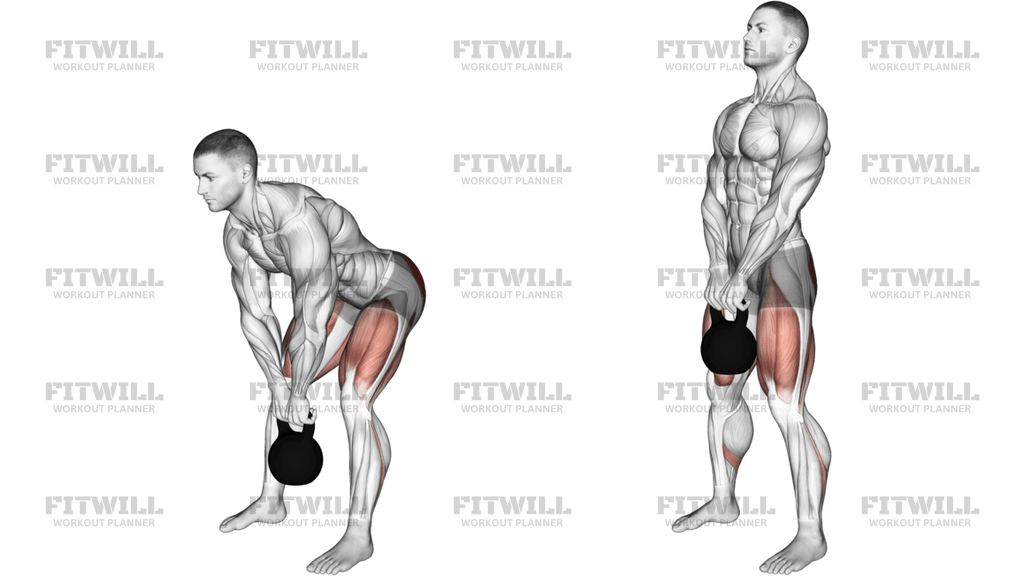
Kettlebell Straight Leg Deadlift is a hip-hinge exercise that loads the back of the body with a single kettlebell held close to the legs. It is useful for building hamstring strength, glute drive, and trunk stability while teaching you how to keep the torso organized under load. Because the weight hangs in front of the body, the setup matters: if the bell drifts away from your shins, the low back has to work harder and the hinge gets sloppier.
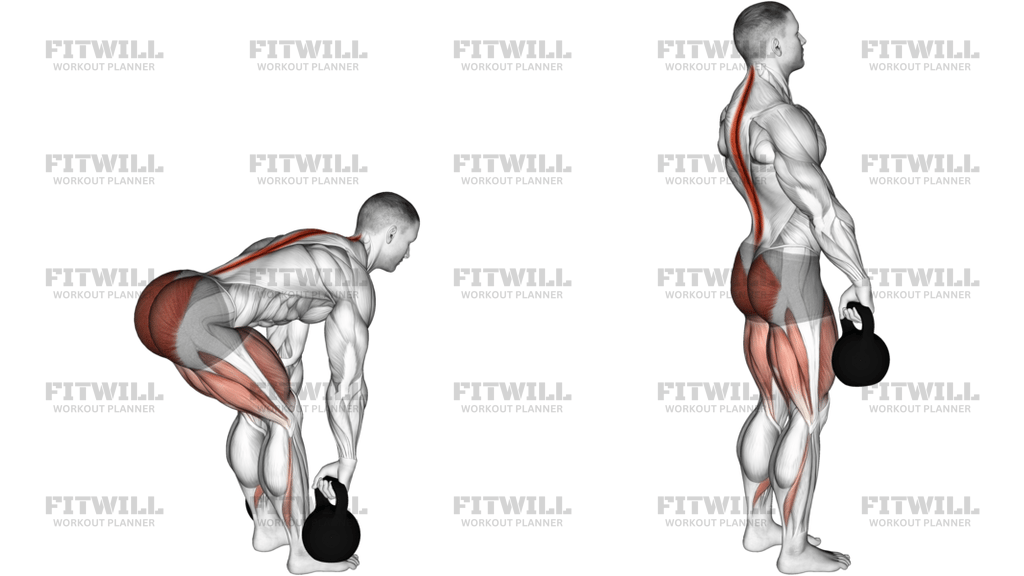
The movement starts from a standing position with a soft knee bend, a long spine, and the shoulders slightly in front of the hips before the descent begins. From there, the hips travel back while the chest stays open and the kettlebell slides down the front of the thighs. The goal is not to squat the weight down, but to keep the shin angle fairly quiet and let the hamstrings lengthen as the hips fold.
On the way up, drive the floor away, bring the hips forward, and finish tall without leaning back or shrugging the shoulders. The bell should stay close to the body from start to finish, and the shoulders should remain packed rather than rolling forward at the bottom. If the range gets so deep that the back rounds or the knees drift too much, shorten the descent and keep the rep crisp.
Kettlebell Straight Leg Deadlift is a strong choice for accessory work, hinge practice, warmups before heavier deadlifts, or lower-body sessions where you want controlled tension instead of explosive speed. It can help beginners learn how to hinge and brace, and it also gives experienced lifters a clean way to build posterior-chain volume without chasing maximal load. A smooth tempo, steady breathing, and a controlled return matter more than forcing extra range.
Treat each repetition like a precise hinge, not a reach for the floor. Keep the load appropriate enough that your hamstrings and glutes do the work while your torso stays stacked and your grip stays secure on the handle. If the movement starts to feel like a rounded-back pick-up, reset the stance, reduce the depth, and keep the kettlebell path tight to the legs.
[ Workout Log & Planner ]
Put your next workout in Fitwill
Keep your plan and training log ready when you are.


Instructions
- Stand with your feet about hip-width apart and place the kettlebell on the floor just in front of the middle of your stance.
- Hinge at the hips, keep a soft bend in the knees, and grip the kettlebell handle with both hands before you stand tall.
- Set your shoulders down and back, brace your midsection, and keep your neck in line with your spine.
- Push your hips back as you lower the kettlebell down the front of your thighs, keeping the bell close to your legs.
- Stop when you feel a strong hamstring stretch or when your torso is near parallel to the floor, whichever comes first.
- Drive through your heels and midfoot to bring your hips forward and return to standing.
- Finish tall with your glutes squeezed, ribs stacked over your pelvis, and the kettlebell hanging in front of your thighs.
- Lower the bell back down with control, reset your breath, and repeat for the planned number of reps.
Tips & Tricks
- Keep a slight knee bend throughout the set; locking the knees makes the hinge harder to control and shifts stress away from the hamstrings.
- Think about sliding the kettlebell down your thighs instead of reaching it toward the floor. A close path keeps the low back from taking over.
- If the bell drifts forward, the rep usually turns into a back lift. Reset the shoulders and keep the handle brushing the legs on the way down and up.
- Stop the descent when your spine wants to round, even if the bell has not reached the floor. Depth should match your hamstring mobility, not your ego.
- Exhale as you come back to standing and avoid overextending at the top. The finish should be tall, not leaned back.
- Use a kettlebell that lets you own the bottom position. If the grip starts to slip before the hips do, the load is too heavy.
- Keep the lats gently engaged so the kettlebell stays connected to your body instead of hanging loose in front of you.
- If you feel the movement mostly in your lower back, shorten the range and rehearse the hip hinge with your hips traveling farther back.
- A slower lowering phase makes this exercise much more effective for hamstrings and glutes than bouncing in and out of the bottom.
- Set the bell back down between reps instead of resetting from a rounded position if your setup gets messy.
Frequently Asked Questions
What does Kettlebell Straight Leg Deadlift train most?
It mainly trains the hamstrings and glutes, with the core and upper back working to keep the torso braced and the kettlebell close.
Should my knees be completely straight in Kettlebell Straight Leg Deadlift?
No. Keep a soft knee bend so the hips can hinge back while the hamstrings stay loaded without locking out the joints.
How low should the kettlebell go?
Lower it only as far as you can keep a long spine and a tight kettlebell path. For many people, that is around mid-shin, not all the way to the floor.
Why do I feel Kettlebell Straight Leg Deadlift in my lower back?
That usually means the hips are not traveling back enough or the bell is drifting forward. Shorten the range, keep the kettlebell close, and keep pressure in the heels and midfoot.
Is Kettlebell Straight Leg Deadlift good for beginners?
Yes. A light kettlebell and a smaller range of motion make it a good way to learn the hip hinge before moving to heavier deadlift variations.
How is Kettlebell Straight Leg Deadlift different from a kettlebell swing?
This version is controlled and slow, with no explosive snap at the hips. A swing uses speed and power, while Kettlebell Straight Leg Deadlift focuses on tension and position.
Should I hold the kettlebell with one hand or two hands?
Use both hands on the handle unless the program specifically calls for a single-arm variation. Two hands make it easier to keep the bell centered and the torso square.
Can I substitute a dumbbell for Kettlebell Straight Leg Deadlift?
Yes, a dumbbell works well if it lets you keep the same hip-hinge pattern and close path along the legs.