Exercise Ball Back Extension With Hands Behind Head
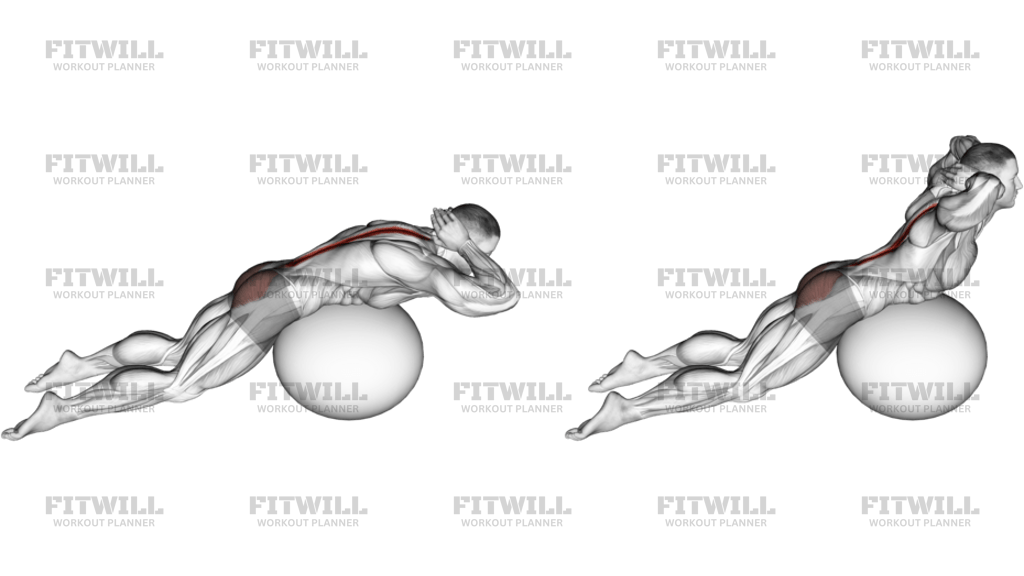
Exercise Ball Back Extension With Hands Behind Head is a prone trunk-extension exercise performed on a stability ball. You position the pelvis and lower abdomen over the ball, lock the feet on the floor, and lift the chest by extending through the spine and hips. The hands stay behind the head, which makes body control and neck position more important than on a version with the arms crossed.
This movement is used to train the spinal extensors, with the glutes and hamstrings assisting to keep the torso moving as one controlled line. Because the ball reduces the amount of fixed support, the exercise also asks the midsection and upper back to stay organized while the torso moves through extension and back down again. It is best thought of as a controlled posterior-chain strength and endurance drill, not a fast, swinging backbend.
The setup matters because the ball changes leverage. If your hips are too far forward on the ball, you lose stability; if they are too far back, you cannot extend cleanly. The ideal position lets you hinge from the hips with the trunk hanging slightly forward at the start, then extend until the torso is roughly in line with the legs. The finish should feel like a strong squeeze through the back and glutes, not a jammed lower spine.
Keeping the elbows wide and the chin neutral helps prevent the hands from pulling the head into flexion. The neck should travel with the torso instead of leading the movement. On the way up, exhale and lift under control. On the way down, lower slowly until the stomach and lower ribs are again supported by the ball. A short pause at the top is useful when you want cleaner reps and less momentum.
This exercise fits well in accessory work, warm-ups for a lower-body day, or conditioning sessions where you want more endurance in the back of the body without external loading. Beginners can use it if they can stabilize on the ball and keep the range small at first. The most common mistakes are overextending at the top, flaring the ribs, and turning the movement into a neck pull instead of a trunk extension.
Fitwill
Log Workouts, Track Progress & Build Strength.
Achieve more with Fitwill: explore over 9600 exercises with images and videos, access built-in and custom workouts, perfect for both gym and home sessions, and see real results.
Start your journey. Download today!




Instructions
- Place the stability ball under your lower abdomen and hips, then walk your feet back until your toes are on the floor and your legs are straight.
- Lie face down over the ball with your torso draped forward, feet set hip-width apart, and your hands lightly behind your head with elbows open.
- Brace your midsection so your ribs stay tucked and your lower back does not sag before you move.
- Start with your chest slightly below hip height and your eyes looking down toward the floor.
- Exhale and lift your chest by extending through your spine and hips until your torso is roughly in line with your legs.
- Keep your neck in line with your body and avoid pulling on your head with your hands.
- Pause for a moment at the top, squeezing your back and glutes without hyperextending.
- Inhale and lower slowly back over the ball until you are in the starting position again.
- Repeat for the planned number of reps with the same controlled range on every repetition.
Tips & Tricks
- Keep the ball under your lower abdomen and hip crease, not under your chest, so you can hinge cleanly instead of collapsing forward.
- If your neck feels tight, think about lifting the sternum rather than trying to look forward.
- Let the elbows stay wide; if they drift in, the hands are usually pulling the head down.
- Stop the lift when your torso is in line with your legs. Going higher usually turns the rep into a low-back squeeze instead of a controlled extension.
- Drive the feet gently into the floor to keep the ball from rolling while you move.
- Use a slow lowering phase so the torso does not drop over the ball between reps.
- Keep the ribs from flaring at the top; the goal is extension, not a full spinal crunch in reverse.
- Start with short sets if the ball feels unstable and add reps before you add speed.
Frequently Asked Questions
What muscles do Exercise Ball Back Extension With Hands Behind Head work?
The spinal erectors are the main target, with the glutes and hamstrings helping during the lift.
How should the ball be placed for this back extension?
Set the ball under your lower abdomen and hips so you can hinge from the torso without sliding too far forward.
Should I lift until I am fully straight or higher than straight?
Lift until your torso is roughly in line with your legs. Going higher usually adds lumbar compression without improving the rep.
Why are the hands behind the head instead of crossed on the chest?
This position makes the neck and upper back work harder to stay aligned, but it also means you must avoid pulling on the head.
Is this more of a back exercise or a glute exercise?
It is mainly a back-extension drill for the spinal erectors, with the glutes and hamstrings contributing to the lift.
Can beginners do this on a stability ball?
Yes, if they start with a small range, slow tempo, and a stable foot position before increasing reps.
What is the most common mistake with this movement?
Overextending at the top and turning the rep into a neck pull or a fast swing over the ball.
How can I make the exercise harder without changing the movement?
Use slower reps, longer pauses at the top, or a slightly longer set while keeping the same controlled range.