Exercise Ball Back Extension With Rotation
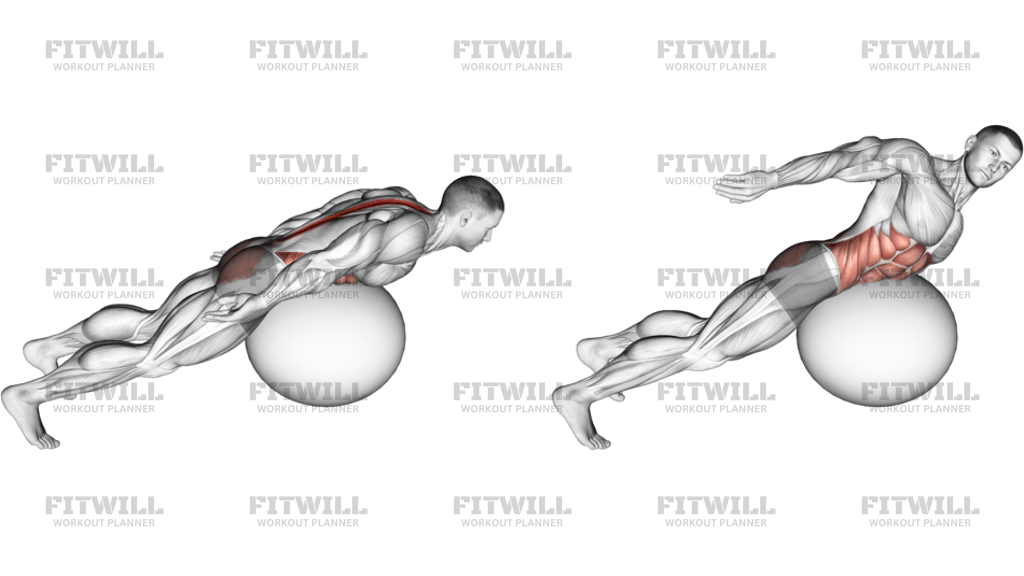
Exercise Ball Back Extension With Rotation is a stability-ball posterior-chain and trunk-control exercise. You lie face down with your hips and lower abdomen supported on the ball, then extend the spine and rotate the torso so one shoulder opens while the opposite side stays anchored. The movement is less about speed and more about controlling how the back, glutes, and obliques work together through a long, unstable lever.
Because the ball removes a lot of fixed support, the setup matters. Your hips need to stay centered on the ball so the lower back can extend without sliding forward or collapsing into the lumbar spine. The feet should be planted far enough back to create a steady base, and the torso should start long, braced, and slightly below horizontal before each rep begins.
At the top of the rep, the chest lifts, the spinal erectors finish the extension, and the trunk rotates under control rather than by yanking the arms or twisting the hips. The image shows a side-opening position that emphasizes thoracic rotation and anti-shift control through the pelvis. That combination makes the exercise useful for posterior-chain strength, rotational stability, and athletic conditioning.
This exercise is best used as accessory work, core training, or part of a back-focused session when you want quality tension instead of heavy loading. Keep the range pain-free and repeatable. If the movement turns into a neck crank, a hip swing, or a hard lumbar hinge, reduce the lift and make the rotation smaller until the body can stay organized on the ball.
[ Workout Log & Planner ]
Put your next workout in Fitwill
Keep your plan and training log ready when you are.


Instructions
- Position your hips and lower abdomen on the stability ball with your feet planted behind you and your torso hanging long over the front of the ball.
- Walk your feet back until the ball feels steady, then keep your glutes and legs lightly braced so your pelvis does not drift side to side.
- Start with your chest slightly below neutral, neck long, and your hands reaching back or lightly out to the sides as shown in the image.
- Brace your midsection, then lift your chest by extending through the upper back and lower back until your torso is close to straight.
- As you reach the top, rotate your torso so one shoulder opens toward the ceiling while the hips stay centered on the ball.
- Keep the rotation controlled and small enough that the movement comes from the trunk, not from swinging the arms or rolling the pelvis.
- Pause briefly in the extended and rotated position, then reverse the motion slowly without dropping your chest.
- Lower back to the start under control, keeping tension through the glutes, abs, and spinal erectors the whole way down.
- Reset your breath and repeat for the planned reps before carefully stepping off the ball.
Tips & Tricks
- Center the ball under your hips, not under your stomach, so you can extend without feeling like you are sliding forward.
- Keep your feet wide enough for balance but not so wide that the hips stop rotating with the torso.
- Think of lifting the sternum first and rotating second; if you twist first, the pelvis usually follows.
- Keep the neck in line with the spine and look slightly ahead of the ball instead of cranking the chin up.
- Use a small rotation if your low back feels jammed; the goal is clean thoracic opening, not a dramatic twist.
- Exhale as you come up and into the rotation so your rib cage stays controlled instead of flaring.
- Slow the lowering phase to keep the spinal erectors under tension and to avoid bouncing off the ball.
- If the ball rolls, shorten the range or move your feet back until the setup feels more secure.
- Stop the set when one side starts to collapse or the rotation becomes uneven from rep to rep.
Frequently Asked Questions
What muscles does Exercise Ball Back Extension With Rotation work?
It mainly trains the spinal erectors, obliques, and glutes, with the upper back and shoulders helping stabilize the torso.
Can beginners do this on a stability ball?
Yes, if the range stays small and the ball feels stable. Start with a simple back extension before adding much rotation.
How do I keep the ball from rolling during the rep?
Place your hips squarely on the ball, widen your stance slightly, and keep your feet planted before you lift and rotate.
Should the rotation come from my shoulders or my hips?
The shoulders and rib cage should rotate while the hips stay centered and mostly square to the floor.
How high should I lift my chest?
Lift until your torso is near straight and you can still keep the neck relaxed. You do not need to hyperextend past that point.
Why does this exercise involve the obliques?
The obliques control the turn at the top and help keep the trunk from wobbling as the chest opens on the ball.
What if I feel it mostly in my lower back?
Reduce the height of the extension, make the rotation smaller, and tighten the glutes so the movement is not all coming from the lumbar spine.
Where does this fit in a workout?
It works well as accessory back work, core stability training, or a lighter posterior-chain drill after your main lifts.