Dumbbell Standing Wrist Reverse Curl
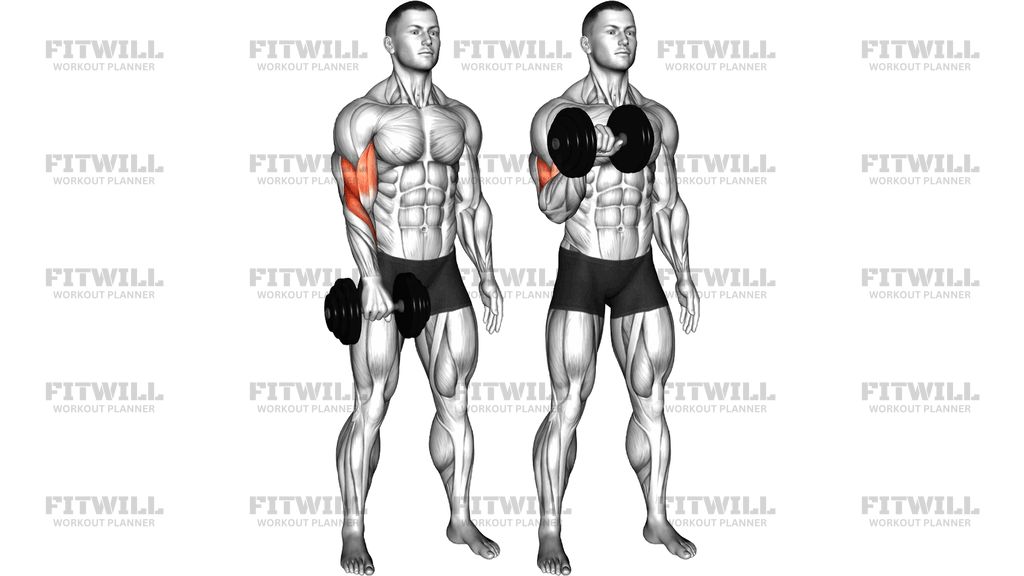
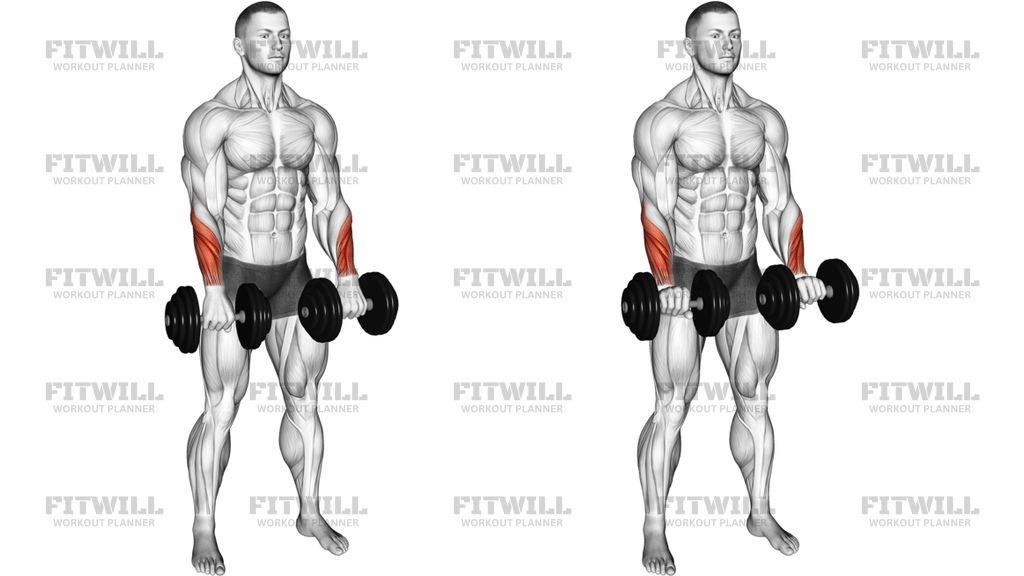
Dumbbell Standing Wrist Reverse Curl is a standing forearm exercise performed with a palms-down grip on dumbbells. The movement is most closely associated with reverse curling, where the elbows stay close to the sides and the dumbbells are lifted by bending the elbows while the wrists remain firm. It is a practical way to train the brachioradialis, forearm extensors, grip support, and the elbow flexors that help control a pronated curl.
The setup matters because a reverse curl becomes sloppy very quickly when the torso swings or the wrists collapse backward. Stand tall with your feet about hip-width apart, hold a dumbbell in each hand, and let the arms hang fully extended at your sides. The palms should face the thighs at the bottom, the shoulders should stay down, and the elbows should be pinned close to the ribs so the forearms do the work instead of the hips.
During each rep, curl the dumbbells upward in a smooth arc until the forearms are close to the upper arms. Keep the hands in a neutral line with the forearms rather than bending the wrists to fake extra height. Lower the weights slowly until the elbows are straight again and the tension stays on the forearms. A controlled tempo is more useful here than heavy load because the exercise is about strict leverage and position, not momentum.
This movement is useful when you want stronger forearms for pulling lifts, arm training, climbing, racket sports, or general grip endurance. It also works well as accessory work after back or arm sessions because it adds forearm volume without requiring a bench or machine. If the dumbbells are too heavy, the body will lean back and the wrists will flare, which shifts the stress away from the target muscles and into joint irritation.
Use it when you want a simple standing arm exercise that can be loaded progressively while still keeping the motion honest. Clean repetitions, a steady torso, and consistent wrist alignment matter more than range or speed. If the wrists or elbows feel irritated, reduce the load and shorten the set before form breaks down.
Fitwill
Log Workouts, Track Progress & Build Strength.
Achieve more with Fitwill: explore over 9600 exercises with images and videos, access built-in and custom workouts, perfect for both gym and home sessions, and see real results.
Start your journey. Download today!




Instructions
- Stand upright with your feet about hip-width apart and hold a dumbbell in each hand with a palms-down grip.
- Let both arms hang straight at your sides with the elbows close to your ribs and the shoulders relaxed.
- Brace your torso so your chest stays tall and your lower back does not swing to help the lift.
- Curl both dumbbells upward by bending the elbows, keeping the wrists aligned with the forearms.
- Bring the weights toward the front of your shoulders without letting the elbows drift forward.
- Squeeze briefly at the top while keeping the forearms and wrists stacked in line.
- Lower the dumbbells slowly until the elbows are fully extended and the arms are back by your sides.
- Repeat for the planned number of reps with the same strict body position on every rep.
Tips & Tricks
- Choose dumbbells light enough that your wrists do not bend back as the curl gets harder.
- Keep the elbows tucked; if they slide forward, the rep turns into a body-assisted front raise.
- Think about lifting with the forearms rather than squeezing the handles harder and harder.
- Do not let the dumbbells roll toward a hammer-grip position; the palms-down angle should stay consistent.
- Lower the weights under control so the forearms keep working through the full descent.
- A short pause at the top usually exposes whether you are using momentum or strict elbow flexion.
- Stop the set when you start leaning backward, shrugging, or losing the palms-down position.
- Use a moderate rep range if your goal is forearm size or endurance, since very heavy singles usually turn sloppy fast.
Frequently Asked Questions
What does the dumbbell standing reverse curl work?
It primarily targets the brachioradialis and forearm muscles, with the biceps and grip muscles helping to control the lift.
Can beginners perform this exercise?
Yes. Beginners usually do best with light dumbbells and a strict tempo so the wrists and elbows stay in a safe line.
Should my palms face up or down during the curl?
Palms should face down for the entire set. That pronated grip is what shifts the emphasis toward the forearms.
Why do my elbows keep drifting forward?
The load is usually too heavy or the pace is too fast. Keep the upper arms pinned near your sides and reduce the weight if needed.
Do I need to curl all the way to my shoulders?
No. Curl high enough to get a strong forearm contraction, but do not force extra height by losing wrist alignment or letting the torso swing.
Why do my wrists hurt on reverse curls?
The wrists are often bending back too far or the dumbbells are too heavy. Keep the knuckles stacked over the forearms and shorten the set if needed.
Is this the same as a hammer curl?
No. A hammer curl uses a neutral grip, while this exercise uses a palms-down grip that changes the forearm emphasis.
Where should I put this in my workout?
It works well near the end of an upper-body or back session as accessory forearm work, when you can keep the reps strict.