Forward Jump
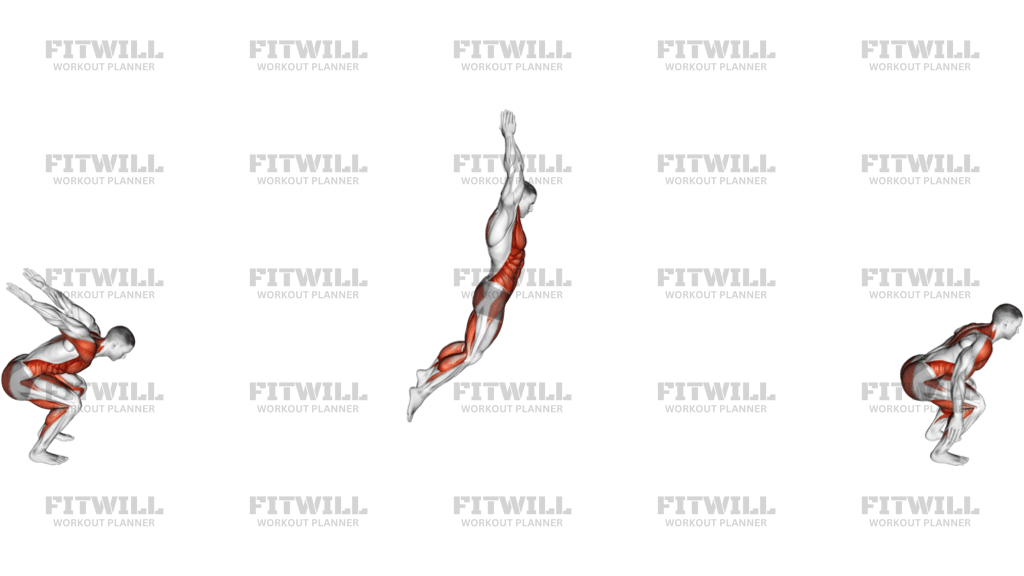
Forward Jump is a bodyweight plyometric drill for building lower-body power, coordination, and landing control. It teaches you to transfer force from the hips, knees, and ankles into a quick forward takeoff, then absorb that force quietly on the way down. Because it is a jump rather than a slow strength movement, the quality of each repetition depends on how well you load the legs before takeoff and how cleanly you stick the landing.
The movement is most useful when you want explosive athletic work without any equipment. It fits warmups, power blocks, conditioning circuits, and jump training progressions. The main training effect comes from the legs and glutes producing force against the floor, while the trunk keeps you organized in the air and during the landing. If the landing turns noisy or unstable, the jump is usually too large for the current level of control.
The setup matters more than many people expect. Start with feet about hip- to shoulder-width apart, knees soft, chest tall, and arms ready to swing behind you. From that athletic stance, load into a shallow squat, then drive the arms forward and up as you explode into the jump. The forward reach should come from a coordinated leg drive and arm swing, not from pitching the torso ahead of the feet.
A good Forward Jump finishes with the same quality it started with: balanced, controlled, and ready for another rep. Land on both feet with the knees tracking over the toes and the hips back enough to cushion the impact. Freeze the landing long enough to show control before resetting for the next jump. If you cannot land quietly and hold the position, shorten the distance or reduce the number of reps.
Forward Jump is also useful as a self-check for power and elastic control. Clean reps should feel springy on takeoff and stable on landing, with no collapsing knees, no heel slap, and no uncontrolled forward drift. Because the exercise is bodyweight, beginners can learn it safely by using small jumps and focusing on deceleration first, then gradually increasing distance as the mechanics improve.
[ Workout Log & Planner ]
Put your next workout in Fitwill
Keep your plan and training log ready when you are.


Instructions
- Stand tall with your feet hip- to shoulder-width apart, then soften your knees and hinge slightly at the hips.
- Let your arms travel behind your torso so you can use them to help drive the jump forward.
- Lower into a shallow athletic squat with your chest up and your weight centered over the midfoot.
- Swing your arms forcefully forward and up as you push through both feet to jump forward.
- Travel forward in one coordinated burst rather than reaching with your upper body first.
- Land on both feet with your knees bent and your hips back to absorb the impact quietly.
- Keep your knees tracking in line with your toes and hold the landing for a moment before resetting.
- Step or hop back to the start position under control, then repeat for the planned number of reps.
Tips & Tricks
- Think about jumping long, not just up; the takeoff should carry you forward without turning into a forward fall.
- Use a smaller jump if you cannot stick the landing with both feet flat and balanced.
- Let the arms load behind you before takeoff so the swing helps drive distance instead of starting from a dead stop.
- Keep the chest proud during the dip so the torso does not fold over the thighs before you leave the floor.
- Land softly through the balls of the feet first, then let the heels settle as the hips absorb the impact.
- If the knees cave inward on landing, shorten the jump and focus on driving the knees out in line with the toes.
- Stop the set when the landing gets loud or the torso keeps tipping forward, because both are signs the jump is too aggressive.
- Leave enough space in front of you so you never have to save the rep with a last-second stumble.
Frequently Asked Questions
What muscles does Forward Jump work?
It mainly trains the glutes, quads, hamstrings, and calves, with the core helping you stay braced in the air and on landing.
Is Forward Jump good for beginners?
Yes, as long as the jump distance stays small and the landing is quiet and stable. Beginners should master the squat-and-stick landing before trying to cover more ground.
How wide should my stance be before the jump?
A hip- to shoulder-width stance works well for most people. That gives you enough balance to load the legs without making the takeoff feel slow.
Should I land with bent knees or straight legs?
Land with bent knees and hips back so the legs can absorb force. Straight-legged landings are harsh and usually make the next rep less controlled.
Can I use my arms during Forward Jump?
Yes. The arm swing is part of the movement and helps create momentum, especially when you swing them back before takeoff and forward as you jump.
What is the most common mistake with Forward Jump?
People usually jump too far for their current control and then land with their torso pitched forward or their knees caving in.
How is Forward Jump different from a vertical jump?
Forward Jump emphasizes horizontal distance and controlled forward landing, while a vertical jump focuses more on height and straight-up power.
How many reps should I do?
Keep sets short, usually 3-6 quality jumps, so each rep stays explosive and the landing does not fall apart from fatigue.