Single Leg Foot Touch
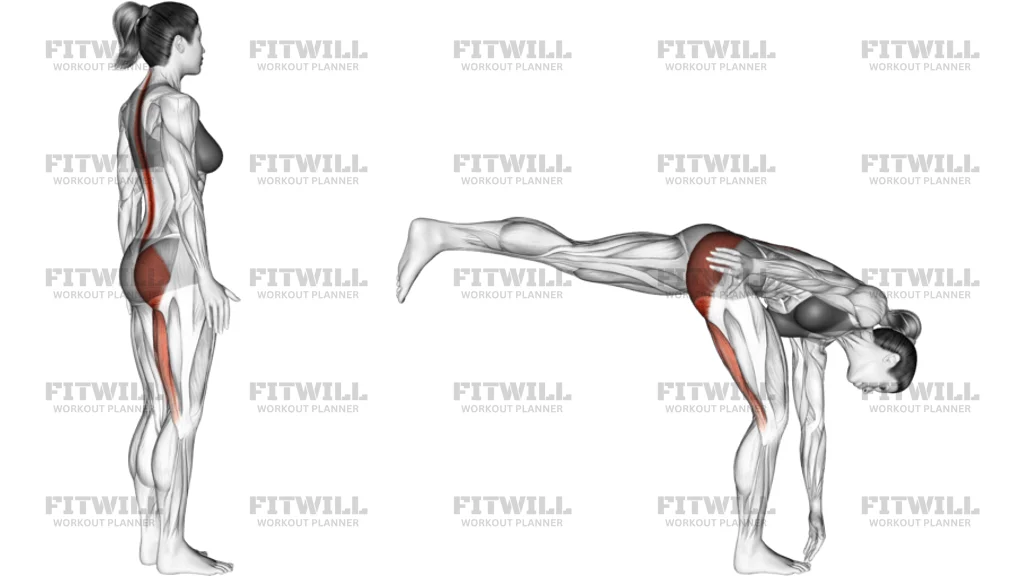
Single Leg Foot Touch is a bodyweight single-leg hip hinge that trains balance, hip control, and posterior-chain tension at the same time. The standing leg has to stabilize the pelvis and ankle while the torso folds forward and the free leg reaches back as a counterbalance. That combination makes it useful for warmups, movement prep, rehab-style conditioning, and accessory work when you want clean control instead of heavy loading.
The exercise is most effective when the setup is precise. Stand tall on one foot with a soft bend in the knee, ribs stacked over the pelvis, and the hips square to the floor. From there, hinge at the hip rather than collapsing at the waist. The goal is to keep the spine long while the torso tilts and the hand reaches toward the standing foot, shin, or floor without twisting open.
Single Leg Foot Touch is not about forcing a deep reach. It is about owning the range you can control. The standing foot should stay planted, the working hip should stay level, and the back leg should extend long behind you without swinging. If you rush the descent, the movement turns into a wobble drill instead of a quality hip hinge. Slowing the lower phase and briefly pausing near the bottom usually reveals whether the pattern is stable or compensated.
This exercise works best with bodyweight or very light external assistance if needed, because the challenge comes from coordination, not load. Use it to build glute and hamstring engagement, ankle steadiness, and better single-leg balance. Beginners can absolutely use it by shortening the range, touching higher on the shin, or holding a wall lightly for support. As control improves, the foot touch can get lower and the pause can get longer without losing hip alignment or control.
Treat each repetition as a balance test and a hip-hinge drill. The rep should start controlled, stay organized through the reach, and finish with a smooth stand back up. If the pelvis opens, the low back rounds, or the standing knee caves inward, the range is too far or the pace is too fast. Keep the movement clean and repeatable, and the exercise will do its job without needing extra complexity.
[ Workout Log & Planner ]
Put your next workout in Fitwill
Keep your plan and training log ready when you are.


Instructions
- Stand tall on one foot with a soft bend in the standing knee and the free leg relaxed behind you.
- Set your ribs over your pelvis, keep your hips square, and fix your gaze on a point ahead.
- Brace lightly, then hinge at the standing hip as the torso starts to tip forward.
- Let the free leg reach long behind you to counterbalance the reach.
- Reach your opposite hand toward the ankle, instep, shin, or floor near the standing foot.
- Lower only as far as you can without rotating the hips or rounding the low back.
- Pause briefly near the bottom if you can hold the position without wobbling.
- Drive through the standing foot to return to upright, then reset before the next rep.
Tips & Tricks
- Keep the standing foot active in a tripod: big toe, little toe, and heel should all stay rooted.
- Think hips back first; if your chest dives before the hip moves, the hinge usually turns into a back fold.
- A slight bend in the standing knee helps the glute and hamstring work without locking the joint out.
- Use the free leg as a counterweight, not as a high kick behind you.
- If balance breaks down, reach higher on the shin or hold a wall with one fingertip for reference.
- Keep the pelvis level so the working hip does not open outward as you descend.
- Move slowly enough that you could stop the rep anywhere on the way down.
- Exhale as you stand back up to keep the trunk from bracing too hard or losing position.
Frequently Asked Questions
What does Single Leg Foot Touch train most?
It mainly trains the standing glute, hamstring, and foot-and-ankle stabilizers, with the core helping keep the pelvis square.
Do I need to touch the floor with my hand?
No. Touch the shin, ankle, or foot only as low as you can while keeping your hips level and your spine long.
Which leg should feel the work most?
The standing leg does most of the work. The lifted leg is mainly there to balance the torso as you hinge.
Why do I keep wobbling on the way down?
Usually the standing foot is not staying active or the reach is too deep. Shorten the range and slow the descent.
Is this basically a single-leg deadlift?
The pattern is very similar, but this version is usually lighter and more balance-focused, with the foot touch acting like a control check.
Can beginners do this exercise safely?
Yes. Start with a shallow hinge, touch higher on the shin, and use a wall or rack lightly if you need balance help.
What is the biggest form mistake?
Letting the pelvis open or the low back round as you reach. The movement should stay square and controlled.
How do I make the exercise harder without adding weight?
Slow the lowering phase, pause near the bottom, reach a little farther, or reduce how much support you use.