Finger Flexor Stretch
Finger Flexor Stretch is a standing forearm mobility drill that lengthens the wrist and finger flexors while you keep the elbow straight and the shoulder relaxed. It is especially useful after heavy gripping, pulling, climbing, racket sports, or any session where the hands and forearms have been under constant tension.
The setup matters because small changes in elbow angle, wrist angle, and shoulder position decide whether the stretch stays in the forearm or leaks into the neck, thumb, or wrist joint. In the correct position, the tension should run along the palm side of the forearm, from the wrist toward the elbow, while the rest of the body stays quiet.
This stretch is meant to be controlled, not aggressive. One arm reaches forward, the opposite hand gently opens the fingers and extends the wrist, and the chest stays square so you are not twisting through the torso to manufacture more range. If you force the hand too far back, the joint can feel pinched before the muscles have a chance to lengthen.
Use a slow exhale to settle into the end range and give the forearm a few seconds to soften. A good rep feels like steady tissue tension, not a sharp pull or a numb, buzzing sensation. If the stretch changes from muscular tension to joint discomfort, reduce the angle immediately and reset.
Finger Flexor Stretch fits well at the end of a workout, between grip-heavy sets, or as part of a warm-up when the wrists and hands need to move better before loading. The goal is a repeatable, pain-free stretch that helps the forearm recover and move with less stiffness, not a max-effort position that makes the hand ache.
Fitwill
Log Workouts, Track Progress & Build Strength.
Achieve more with Fitwill: explore over 9600 exercises with images and videos, access built-in and custom workouts, perfect for both gym and home sessions, and see real results.
Start your journey. Download today!




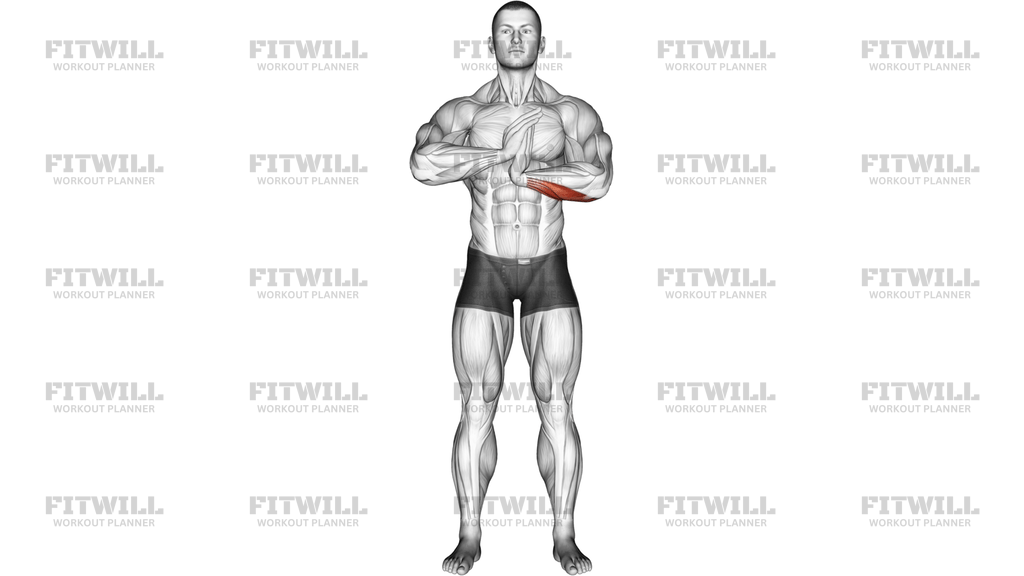
Instructions
- Stand tall with your feet about hip-width apart and keep your ribs stacked over your pelvis.
- Extend one arm straight in front of your chest at about shoulder height with the elbow fully straight.
- Open the working hand and let the fingers stay long so the opposite hand can grip them cleanly.
- Use the other hand to gently pull the fingers back and extend the wrist until you feel a stretch along the palm side of the forearm.
- Keep the shoulder down and avoid shrugging or rotating the torso toward the working arm.
- Breathe out slowly and settle into the stretch without bouncing or forcing the wrist deeper.
- Hold the position for 15 to 30 seconds, or as long as you can keep the stretch smooth and pain-free.
- Release the hand slowly, shake it out, and repeat on the other side for equal time.
Tips & Tricks
- Keep the elbow straight; a bent elbow shifts the stretch away from the forearm flexors.
- Pull back through the fingers, not by yanking hard on the thumb or the base of the hand.
- If the wrist feels pinched, lower the arm slightly and use less extension.
- Keep the shoulder blade gently set down so the neck does not take over the stretch.
- Stay square through the hips and chest instead of twisting to fake more range.
- A slower exhale usually lets the forearm relax more than a stronger pull.
- The stretch should run through the underside of the forearm, not create sharp pain in the wrist joint.
- Use the same hold time on both sides so one forearm does not stay tighter than the other.
Frequently Asked Questions
What does Finger Flexor Stretch target most?
It mainly targets the wrist and finger flexors on the palm side of the forearm.
Should my elbow stay straight during the stretch?
Yes. A straight elbow keeps the tension in the forearm and makes the stretch easier to control.
Where should I feel the stretch?
You should feel it along the underside of the forearm, from the wrist toward the elbow, not as a pinch in the wrist joint.
Do I need to hold this for reps?
No. This is usually held for time, most often around 15 to 30 seconds per side.
Can I use this after heavy pulling or gripping work?
Yes. It works well after rows, deadlifts, climbing, racket sports, or any session that leaves the forearms tight.
What if I feel tingling or numbness?
Back off immediately and reduce the angle. Tingling means the stretch is too aggressive or is irritating the tissues.
Can beginners do this stretch?
Yes, as long as they keep the pull gentle and avoid forcing the wrist into a painful position.
What is the most common mistake with this stretch?
People usually twist the torso or yank the fingers back too hard instead of holding a clean, square setup.