Wrist Extensor Stretch
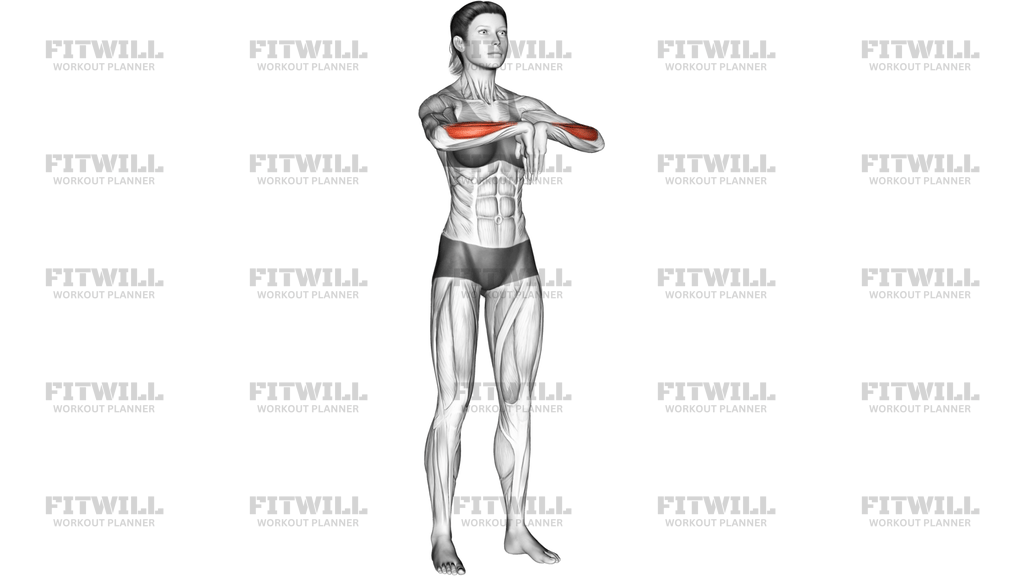
Wrist Extensor Stretch is a standing forearm stretch that targets the muscles on the back of the forearm, especially the tissues that help extend the wrist and fingers. In the image, one arm is brought across the chest at shoulder height while the other hand gently bends the wrist so the fingers point down. The goal is not to force a dramatic range of motion; it is to create a clear, repeatable stretch through the outside and top of the forearm without irritating the wrist or elbow.
This stretch is useful after heavy gripping, pressing, pulling, climbing, racquet sports, or long hours at a keyboard and mouse. It can also be used in a warm-up if the forearms feel stiff, but the emphasis should stay on gentle tension rather than a hard end-range hold. Because the arm stays elevated across the body, shoulder position matters too: if the shoulder shrugs or the torso twists, the line of tension changes and the stretch becomes less precise.
The setup should feel simple and controlled. Keep the stretching arm at chest height, the elbow mostly straight, and the opposite hand doing only enough work to guide the wrist into flexion. You should feel the stretch run through the top of the forearm and often near the outer elbow, where the extensor muscles attach. If the sensation shifts into sharp wrist pain, numbness, or tingling, back off immediately and reduce the amount of pull.
Good form comes from patient breathing and a relaxed shoulder girdle. Hold the end position long enough for the forearm to lengthen, then ease out and repeat on the other side with the same amount of time. The stretch is small but effective when it is symmetrical, unforced, and clean. It is especially helpful for people who want better wrist comfort, cleaner grip recovery, or a quick reset between training sets.
[ Workout Log & Planner ]
Put your next workout in Fitwill
Keep your plan and training log ready when you are.


Instructions
- Stand tall with your feet hip-width apart and raise one arm across your chest at shoulder height, palm facing down.
- Keep the stretching arm mostly straight and let the shoulder stay low instead of shrugging toward your ear.
- Reach across with the other hand and place it over the back of the stretched hand or fingers.
- Gently bend the wrist so the fingers point toward the floor and slightly toward your body.
- Pull only until you feel a clear stretch through the top and outer side of the forearm.
- Keep the elbow lifted at chest height and avoid letting the torso rotate with the pull.
- Breathe slowly and hold the stretch without bouncing or forcing the wrist farther.
- Ease out of the stretch, reset the hand, and repeat on the other side for the same amount of time.
Tips & Tricks
- The stretch should come from wrist flexion, not from yanking the fingers backward.
- Keep the shoulder down and the chest square so the forearm stays isolated.
- A small bend in the elbow is fine if a straight arm feels too intense at the outer elbow.
- If you feel the stretch mostly in the palm, reduce the amount of pull on the fingers.
- Pull gently enough that you can keep breathing instead of bracing against pain.
- Match both sides carefully; a tighter forearm often tempts people to over-pull the other side.
- Use this after grip-heavy work when the forearm feels short and overactive, not as a max-range test.
- Stop immediately if you get sharp wrist pain, tingling, or numbness.
Frequently Asked Questions
What does Wrist Extensor Stretch target?
It targets the extensor muscles on the back of the forearm, especially the area near the outer elbow and down toward the wrist.
Is this the same as a wrist flexor stretch?
No. This version stretches the muscles that extend the wrist and fingers, while a flexor stretch targets the palm-side forearm.
Do I need any equipment for this stretch?
No equipment is required beyond your opposite hand. A wall or stable stance can help if you want extra balance.
Should my arm stay straight or bent?
Keep the arm mostly straight for a stronger forearm stretch. A slight bend is acceptable if the elbow is sensitive.
Why do I feel this near the outside of my elbow?
The extensor muscles attach near the outer elbow, so tension often travels from that point down the forearm.
Can beginners do this stretch safely?
Yes. It is beginner-friendly because you control the intensity with your own hand and can make the pull very light.
When should I use this stretch?
It works well after pulling, pressing, climbing, racquet sports, or long desk sessions when the forearm feels tight.
What is the most common mistake?
Pulling too hard and twisting the torso instead of keeping the arm stable and letting the wrist do the work.