Standing Outer Hip Stretch
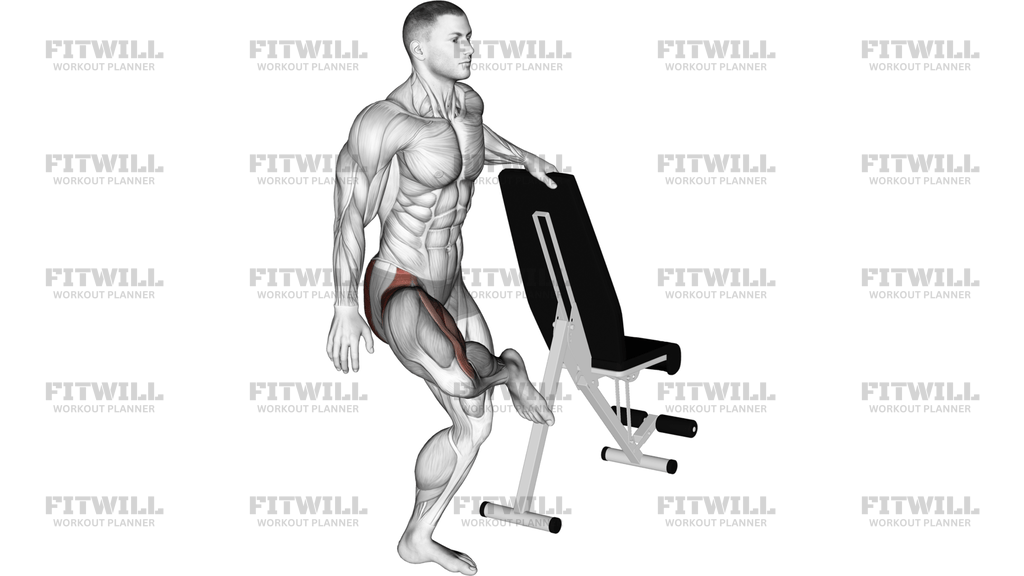
Standing Outer Hip Stretch is a standing figure-four style mobility drill for the outer hip, glutes, and deep rotators. It is usually done with body weight and a nearby bench, rack, or wall for balance. The goal is not to force the knee lower or chase a dramatic bend in the torso, but to create a clear stretch through the crossed leg's outer hip while keeping the standing side steady and organized.
This movement is useful when the hips feel tight after squats, running, cycling, long walks, or any session that leaves the glutes and lateral hip muscles feeling packed down. It can also be a practical warm-up or cooldown choice because it gives you a controlled way to open the outer hip without lying on the floor. The support hand matters: it lets you stay relaxed through the shoulders and ribs so the stretch stays in the hip instead of turning into a balance fight.
The best setup starts with one foot planted firmly, the opposite ankle crossed over the standing thigh just above the knee, and the lifted foot kept flexed. From there, sit the hips back and slightly down as if reaching for a chair, while keeping the chest long and the spine neutral. You should feel the stretch build across the glute and outer hip of the crossed leg, not a sharp tug in the knee or a pinch in the front of the hip.
Control matters more than depth. A small change in how far the hips sit back or how much the crossed knee opens can completely change the sensation, so use slow breaths and short holds to find a smooth, repeatable position. If the stretch disappears, you may be collapsing forward or unloading the standing leg too much; if it becomes uncomfortable, back out a little and keep the ankle flexed so the knee stays protected.
Standing Outer Hip Stretch works well as a single-side reset between lower-body sets, after conditioning, or as part of a mobility sequence before training. It is also easy to scale: keep one hand on support for balance, or reduce the range if your hips are stiff. The clean version should leave the outer hip open and the standing leg stable, with no need to bounce, twist aggressively, or force the knee farther than it wants to go.
Fitwill
Log Workouts, Track Progress & Build Strength.
Achieve more with Fitwill: explore over 9600 exercises with images and videos, access built-in and custom workouts, perfect for both gym and home sessions, and see real results.
Start your journey. Download today!




Instructions
- Stand next to a bench, wall, or rack and place one hand on it lightly for balance.
- Plant the standing foot firmly and bend that knee slightly without letting the arch collapse.
- Cross the opposite ankle over the standing thigh just above the knee and flex the lifted foot.
- Keep the crossed knee open enough to avoid pinching, but do not push it down with force.
- Sit the hips back and slightly down as if reaching for a chair behind you.
- Keep your chest tall and your spine long while you settle into the outer-hip stretch.
- Take slow breaths and hold the position for a few seconds without bouncing.
- Stand back up through the planted leg, uncross the ankle, and reset before switching sides.
Tips & Tricks
- Keep the lifted foot flexed so the crossed knee stays protected instead of hanging loosely.
- If balance is shaky, keep more weight in the standing heel and use the support hand instead of gripping hard.
- Think about moving the hips back first; folding the torso forward too much usually shifts the stretch out of the outer hip.
- A slightly bent standing knee is fine, but do not let it cave inward as you sink back.
- If you feel the stretch in the front of the hip rather than the glute, lower the crossed foot position or ease off the depth.
- Keep the ribs stacked over the pelvis instead of arching the lower back to fake more range.
- Use short pauses and repeat on both sides rather than forcing one long hold that changes shape halfway through.
- Stop if the crossed knee feels compressed or twisted; the sensation should stay in the outer hip, not the joint.
Frequently Asked Questions
What does Standing Outer Hip Stretch target most?
It mainly targets the glutes and deep outer-hip rotators of the crossed leg, especially the area around the lateral hip.
Can beginners perform this exercise?
Yes. Beginners usually do best with one hand on a wall or bench and a smaller range until balance and hip position feel steady.
Should my foot stay flexed during Standing Outer Hip Stretch?
Yes. Flexing the lifted foot helps protect the knee and keeps the figure-four position stable instead of letting the ankle collapse.
What is the biggest mistake in Standing Outer Hip Stretch?
Most people fold forward or twist the torso to force a bigger stretch. Keep the chest long and send the hips back instead.
Why does Standing Outer Hip Stretch use a support point?
The hand support lets you relax the upper body and keep your balance so the stretch stays focused in the hip instead of becoming a wobble.
Where should I feel Standing Outer Hip Stretch?
You should feel it across the outer hip, glute, or deep back pocket area of the crossed leg. Sharp knee pain or front-hip pinching means the setup needs to change.
How long should I hold each side?
Short holds of a few calm breaths work well. You should be able to repeat the position without losing shape or balance.
Can I use Standing Outer Hip Stretch after leg day?
Yes. It is a good cooldown option after squats, lunges, running, or cycling because it can reduce the locked-up feeling around the outer hip.