Sitting One Leg External Stretch
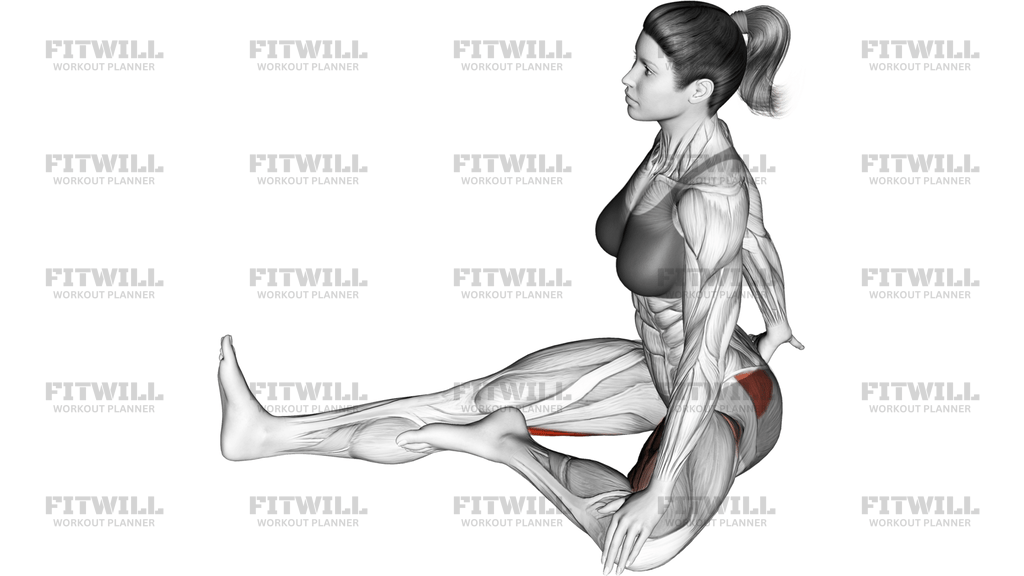
Sitting One Leg External Stretch is a floor mobility drill for the hips, outer glutes, and deep hip rotators. In the pictured position, one leg stays extended while the other leg folds out into external rotation, which opens the outside of the bent-leg hip and can also create a mild stretch through the groin and inner thigh of the straight leg if you lean forward slightly.
The point of the exercise is not to force the knee down. It is to place the pelvis, spine, and femur in a controlled position so the hip can open without the low back taking over. When the torso stays tall and the pelvis stays grounded, the stretch is usually felt in the back and side of the bent-leg hip, especially around the glute and the small rotators deep in the joint.
This stretch works best when you respect the starting position. Sit on the mat with enough space to unfold one leg straight and let the other knee open comfortably to the side. If your hips are tight, use your hands on the floor behind you for support and sit on a folded mat or towel so you can keep the spine long instead of collapsing. A small, clean setup change is usually more useful than trying to force a deeper angle.
From there, move slowly into the end range and let the breath do part of the work. A gentle forward lean from the hips can increase the stretch, but the motion should stay calm and smooth. If the knee, ankle, or front of the hip feels pinched, back off and adjust the angle of the folded leg rather than pushing through it. The stretch should feel like sustained tension and opening, not a sharp pull.
Use Sitting One Leg External Stretch as part of a warm-up, cool-down, or mobility block when you want better hip rotation before squats, lunges, running, or ground work. It is also useful for people who spend a lot of time sitting and feel stiff in the outside hip. The best result comes from repeatable holds, steady breathing, and a range you can keep for the full time without twisting or bouncing.
Fitwill
Log Workouts, Track Progress & Build Strength.
Achieve more with Fitwill: explore over 9600 exercises with images and videos, access built-in and custom workouts, perfect for both gym and home sessions, and see real results.
Start your journey. Download today!




Instructions
- Sit on the mat with one leg extended straight in front of you and the other knee bent out to the side, letting the sole of the bent foot rest comfortably near the inner thigh or groin.
- Plant your sit bones evenly, then use one or both hands on the floor behind or beside you so you can keep your chest tall.
- Keep the straight leg active with the toes pointed up and the knee facing the ceiling instead of letting the leg drift outward.
- Let the bent knee open only as far as the hip allows without pinching, twisting, or rounding your lower back.
- Hinge forward a few degrees from the hips if you want more stretch through the outer glute and deep hip rotators on the bent-leg side.
- Breathe out slowly and relax into the end range for a steady hold rather than bouncing or pulsing.
- Keep the stretch in the hip and outer glute, not in the knee or low back, and ease off if the sensation turns sharp.
- Return to a tall seated position with control, reset your posture, and switch sides for the same amount of time.
Tips & Tricks
- A tall spine usually gives a better hip stretch than slumping onto the floor.
- If the bent knee stays high, support yourself with your hands instead of forcing the thigh lower.
- Keep the straight leg active; a relaxed, collapsed leg often shifts the stretch away from the hip.
- A small forward hinge is usually enough. Reaching harder is more likely to round the back than open the hip.
- The stretch should land in the outside of the bent-leg hip or deep glute, not as pressure in the knee joint.
- Sit on a folded mat or towel if your pelvis cannot stay upright on the floor.
- Long exhales help the hip drop into the position without jerking the knee downward.
- Do not bounce at the bottom. A still hold is safer and more effective for this movement.
- If one side feels dramatically tighter, give it a few extra breaths rather than forcing more range.
Frequently Asked Questions
What does Sitting One Leg External Stretch target?
It mainly targets the outer glute and deep external rotators of the bent-leg hip, with some stretch through the inner thigh depending on how far you lean.
Where should I feel the stretch?
Most people feel it in the back or side of the bent-leg hip, not in the knee. A slight stretch in the groin or straight leg is also normal.
Should the bent knee touch the floor?
No. Let the knee open only as far as the hip allows. Forcing it down usually shifts stress to the knee or lower back.
How do I keep my back from taking over?
Sit tall, keep both sit bones grounded, and hinge from the hips instead of curling forward. Hand support behind you can help keep the torso organized.
Is this the same as pigeon pose?
It is a similar hip-opening pattern, but this seated version is easier to control and gives you a clearer way to support the torso with your hands.
Can beginners do this stretch?
Yes. Beginners should use a smaller range, support themselves with the hands, and stop well before any pinching or joint pressure.
What if I feel the stretch in my knee?
Back off the angle of the bent leg and reduce the forward lean. The sensation should stay in the hip and glute, not in the knee joint.
When should I use this stretch?
It fits well before squats, lunges, running, or floor training, and it also works well after lower-body work when the hips feel tight.
How long should I hold each side?
Hold long enough to relax into the position, usually around 20 to 45 seconds per side, with slow breathing and no bouncing.