Hip Thrusts
Hip Thrusts is a bench-supported glute exercise that trains hip extension with your upper back anchored on the bench and your feet planted on the floor. In the image, the torso starts close to a seated position with the shoulders supported on the bench, then the hips drive upward until the body forms a straight line from shoulders to knees. That setup makes the movement much more glute-focused than a floor bridge because the hips can travel farther and the top position can be loaded with more tension.
The main work comes from the glutes, with the hamstrings and core helping to stabilize the pelvis and keep the rib cage from flaring. Because the bench changes the leverage, small setup errors matter: if your feet are too far away, the hamstrings tend to take over; if they are too close, the knees travel too far forward and the force path feels cramped. A good Hip Thrusts rep starts with a stable upper-back contact point, a firm foot position, and a pelvis that stays organized as you move.
This exercise is useful for people who want stronger glutes for lifting, sprinting, jumping, or general lower-body strength. It is also a good choice when you want to train hip extension without the spinal loading of heavy squats or deadlifts. Bodyweight Hip Thrusts are especially helpful for beginners because they let you learn the path, lock in the top position, and feel the difference between glute-driven extension and low-back arching.
At the top of the rep, the hips should finish high without turning the movement into a lower-back bend. The goal is to squeeze the glutes, keep the chin slightly tucked, and stop once the torso is parallel to the floor or just above it. Lower under control until the hips are close to the floor or just above it, then repeat with the same foot pressure and torso angle instead of bouncing through the bottom.
Keep the set honest by matching the range of motion to what your pelvis can control. If you lose the bench contact, shrug the shoulders, or arch hard through the lower back, the load is too aggressive or the setup needs adjusting. Clean Hip Thrusts should feel like deliberate hip extension with stable support, not like a fast bridge or a lumbar extension drill. Done well, the movement is simple, repeatable, and easy to progress with tempo, pause length, or added resistance.
[ Workout Log & Planner ]
Put your next workout in Fitwill
Keep your plan and training log ready when you are.


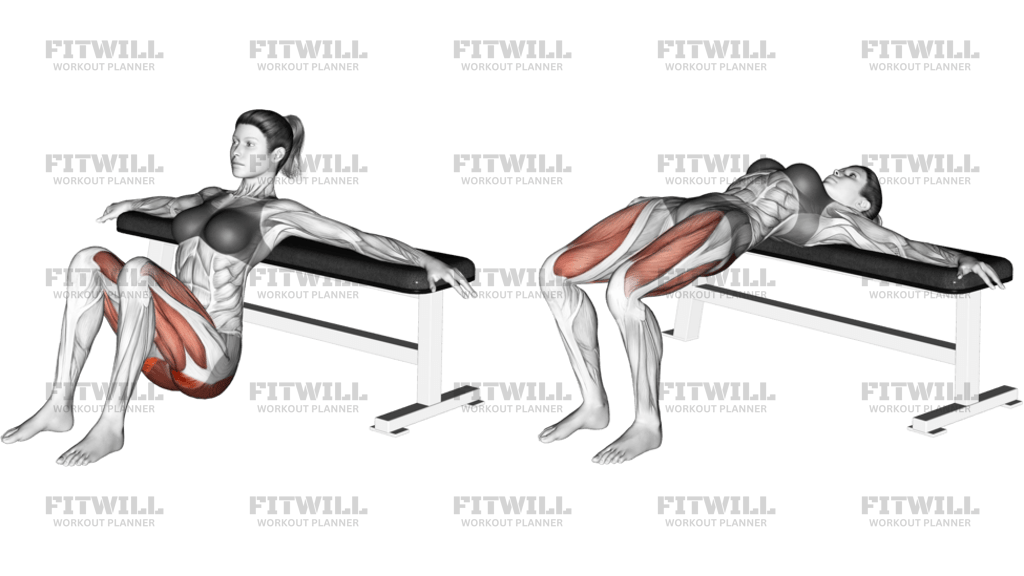
Instructions
- Sit on the floor with your upper back against the long edge of a bench and your feet flat on the floor.
- Bend your knees so your heels are under or slightly in front of them, and place your hands on the bench for balance.
- Lean back enough that your shoulder blades and mid-back stay supported on the bench while your chin stays slightly tucked.
- Brace your torso and keep your ribs down before you lift your hips.
- Drive through your heels and midfoot to raise your hips until your torso is parallel to the floor.
- Squeeze your glutes at the top without overarching your lower back.
- Lower your hips in a controlled arc until you return to the start with tension still in the glutes.
- Inhale on the way down, exhale as you thrust up, and reset your foot position if your knees drift or your back starts to arch.
Tips & Tricks
- At the top, your shins should be close to vertical; if they are angled far forward, slide your feet a little closer.
- Keep your ribs stacked over your pelvis so the finish comes from hip extension, not from flaring your chest.
- Press through the heels and midfoot, but do not let the toes lift enough to shift all the load into the hamstrings.
- Think about rolling the pelvis slightly backward at lockout to keep the glutes doing the work.
- If the bench is too high for comfortable support, use a lower bench so your shoulder blades can anchor without sliding.
- A short pause at the top makes bodyweight Hip Thrusts much harder than bouncing through reps.
- Keep your gaze forward or slightly up, not tucked hard into your chest and not looking behind you.
- Stop the set when your lower back starts to take over, because that usually means the hips are no longer finishing the rep.
Frequently Asked Questions
What muscles do Hip Thrusts work most?
Hip Thrusts primarily train the glutes. The hamstrings and core help stabilize the pelvis, and the upper back stays fixed on the bench.
Can beginners do Hip Thrusts with just body weight?
Yes. Body weight is a good way to learn the bench setup, foot position, and top-end glute squeeze before adding resistance.
Where should my shoulders be on the bench during Hip Thrusts?
Your shoulder blades and mid-back should rest on the bench edge so your torso can pivot around that support point. If you slide too far up or down, the movement becomes unstable.
How do I know if my feet are in the right place?
At the top of Hip Thrusts, your knees should stay roughly over your ankles and your shins should be close to vertical. If you feel the hamstrings cramping or the knees drifting too far forward, adjust your stance.
Should I arch my lower back at the top?
No. The top position should come from strong hip extension and a glute squeeze, not from bending your lower back into a big arch.
What is the difference between Hip Thrusts and a glute bridge?
Hip Thrusts use a bench so the shoulders are elevated, which gives you a larger hip range of motion than a floor glute bridge.
Why do my hamstrings feel this more than my glutes?
Your feet are probably too far from the bench, or you are not finishing with a glute squeeze. Bring the feet a little closer and lock the pelvis into a neutral, stacked position at the top.
Can I do Hip Thrusts without a bench?
Without the bench, the movement becomes a floor glute bridge. It is still useful, but it has less range of motion and a different leverage profile.