Rowing With Rowing Machine
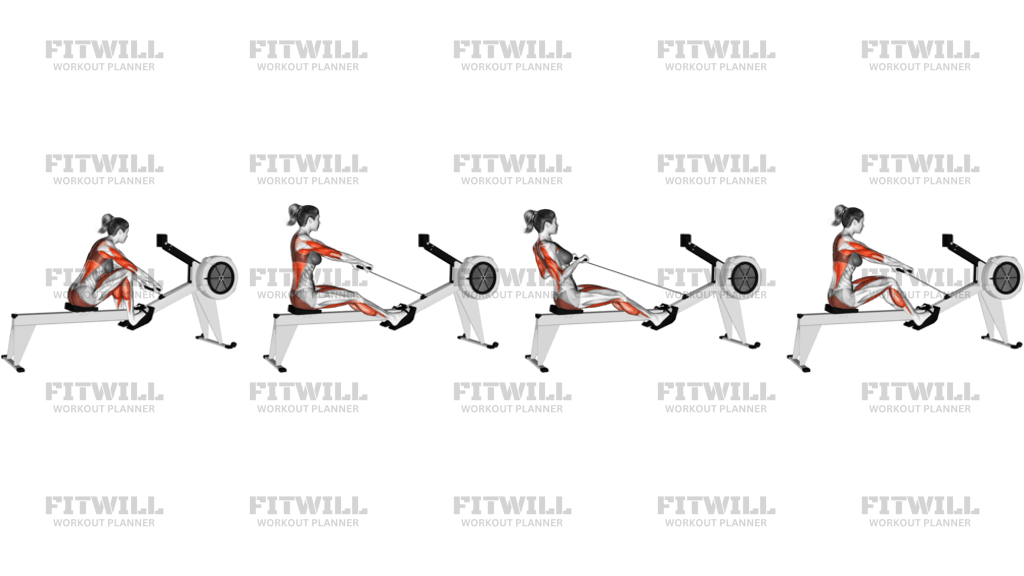
Rowing with a rowing machine is a seated cardio and conditioning exercise that combines leg drive, hip hinge, trunk stability, and upper-back pulling in one repeated stroke. The image shows the classic erg sequence: catch, drive, finish, and recovery. That sequence matters because the exercise is not just an arm pull. Most of the work starts from the feet against the footplates, travels through the legs and torso, and finishes with the handle near the lower ribs before the body returns smoothly to the front.
This movement trains coordinated power and endurance at the same time. The legs initiate the stroke, the torso transfers force, and the lats, upper back, biceps, and rear shoulders help finish the pull. The core stays active throughout to keep the spine long and the torso from collapsing when the handle moves away from the flywheel. When performed well, rowing is efficient, repeatable, and easy to scale from light warm-up work to harder conditioning intervals.
Setup is a major part of the exercise. Sit tall on the seat, secure the feet, and hold the handle with straight wrists and relaxed shoulders. At the front of the stroke, the knees are bent, the shins are close to vertical, the torso is slightly forward, and the arms are long. That position gives you a clean starting point without overreaching or rounding the lower back. If the catch is too cramped, the drive usually starts late and the recovery gets sloppy.
During the drive, press through the legs first, then open the hips, and only then finish with the arms. The handle should travel in a straight line toward the lower ribs or upper abdomen, staying close to the body instead of looping upward. On the recovery, reverse the order: extend the arms, hinge the torso forward, and let the knees bend last as the seat slides back toward the flywheel. Smooth timing matters more than speed; the stroke should feel powerful but controlled.
Use this exercise for aerobic conditioning, interval work, or a low-impact full-body session when you want a machine that rewards rhythm and technique. Keep the resistance high enough to feel the stroke but not so high that you have to yank with the arms or round the back. If the low back, shoulders, or grip become the limiting factor before the legs and lungs do, reduce the pace or load and clean up the sequence. Beginners can use the rowing machine effectively as long as they keep the stroke short, smooth, and organized from the start.
Fitwill
Log Workouts, Track Progress & Build Strength.
Achieve more with Fitwill: explore over 9600 exercises with images and videos, access built-in and custom workouts, perfect for both gym and home sessions, and see real results.
Start your journey. Download today!




Instructions
- Sit on the rowing machine seat and place both feet on the footplates, securing the straps so your heels stay planted.
- Hold the handle with both hands, keep your wrists straight, and sit tall with your shoulders relaxed.
- Slide forward into the catch position with your knees bent, shins close to vertical, and your torso slightly hinged forward from the hips.
- Brace lightly and begin the drive by pushing hard through your legs while the handle stays level and your arms remain straight at first.
- As your legs near extension, open your hips and let your torso lean back only slightly to transfer the force smoothly.
- Finish the stroke by pulling the handle toward your lower ribs or upper abdomen, keeping your elbows close to your sides.
- Pause briefly in the strong finish position without shrugging your shoulders or leaning back excessively.
- Recover in reverse order by extending your arms first, then hinging the torso forward, and finally bending the knees as the seat slides forward.
- Keep the stroke smooth and repeat for the planned time, distance, or number of strokes.
Tips & Tricks
- Think legs, body, arms on the drive, then arms, body, legs on the recovery.
- Keep the handle close to your body; a wide looping pull wastes force and usually means the shoulders are taking over.
- Do not yank early with the arms at the catch. If the handle moves before the legs do, the stroke loses power.
- Keep your chest proud and your lower back neutral as the seat rolls forward so the catch stays strong without rounding.
- A slight lean back at the finish is enough. Overreaching into a big recline turns the stroke into a lower-back exercise.
- Use the foot straps to keep the feet connected to the drive, especially if your heels try to lift at the start.
- Let the handle come back under control on the recovery instead of collapsing quickly toward the flywheel.
- If your grip fatigues before your breathing does, relax your hands and avoid squeezing the handle too hard.
- Choose a resistance that lets you keep the stroke sequence crisp; heavy resistance should never break the timing.
- If the seat feels rushed or bouncy, shorten the stroke slightly and smooth out the transition between phases.
Frequently Asked Questions
What does rowing with a rowing machine work?
It mainly trains the legs, glutes, back, lats, shoulders, arms, and core in one coordinated stroke.
Is the rowing machine mostly an arm exercise?
No. The drive starts with the legs, the torso transfers the force, and the arms only finish the pull.
How should the handle move on each stroke?
Pull it straight toward the lower ribs or upper abdomen, then return it forward under control on the recovery.
What is the correct sequence for the drive and recovery?
Drive with the legs first, then open the torso, then pull with the arms. On the way back, extend the arms, hinge forward, and bend the knees last.
What are the most common rowing-machine mistakes?
Common errors are yanking with the arms too early, rounding the lower back at the catch, and leaning back too far at the finish.
How should my feet be set on the footplates?
Strap the feet in firmly so you can push through the legs without the heels slipping or the seat feeling unstable.
Can beginners use this exercise?
Yes. Beginners usually do best with moderate resistance, a shorter stroke, and a slow, controlled rhythm.
How can I make the rowing stroke safer for my lower back?
Keep a neutral spine at the catch, avoid collapsing forward, and start each drive with the legs instead of reaching hard with the torso.