Dumbbell One-Arm Bent-Over Row
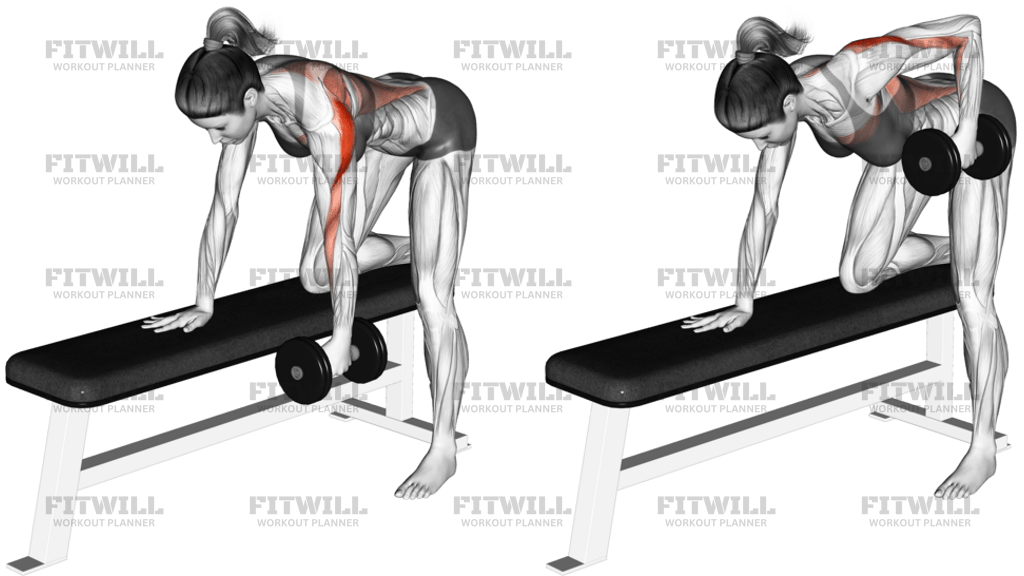
Dumbbell One-Arm Bent-Over Row is a supported single-arm pulling exercise that trains the back by rowing one dumbbell while the torso stays hinged and steady. In the pictured setup, the working hand hangs under the shoulder and the free hand braces on the bench, which lets you keep the trunk fixed and focus on pulling the elbow back instead of swinging the weight.
This exercise is usually used to build upper-back thickness, lat strength, and scapular control with a unilateral loading pattern. It is especially useful when one side is weaker or less coordinated, because each arm has to move and stabilize on its own. The row should feel like a back exercise first: the elbow drives the motion, the shoulder blade follows, and the wrist stays quiet.
The bench support matters because it removes a lot of cheating. When the torso is set at a firm hinge, the dumbbell can travel close to the ribs without turning the rep into a standing heave. A good rep starts with the spine long, the neck neutral, the shoulder relaxed away from the ear, and the dumbbell hanging fully before the pull begins. From there, the weight should travel in a smooth arc toward the hip or lower ribs, not straight up toward the shoulder.
Use a controlled tempo and a range you can own. If the dumbbell drifts away from the body, the torso rotates, or the supporting shoulder collapses, the load is too heavy or the setup is off. The lowered phase is where the back stays under tension, so do not drop the weight once the rep is finished. Keep the movement crisp enough to isolate the working side, but stable enough that the bench does most of the support work.
This row fits well in back training, upper-body hypertrophy work, or accessory strength blocks. It pairs naturally with presses, pulldowns, or rear-delt work, but it also stands alone when you want simple, honest pulling volume without much equipment. The main coaching goal is repeatable reps: stable hinge, clean pull, brief squeeze, and a controlled return every time.
Fitwill
Log Workouts, Track Progress & Build Strength.
Achieve more with Fitwill: explore over 9600 exercises with images and videos, access built-in and custom workouts, perfect for both gym and home sessions, and see real results.
Start your journey. Download today!




Instructions
- Set one hand on a flat bench and hinge your torso forward until your back is long and your free arm can hang straight down with the dumbbell.
- Plant the opposite foot firmly on the floor and keep the support side steady so your hips and shoulders stay square to the bench.
- Let the dumbbell hang under your shoulder with your palm facing in, neck neutral, and ribs tucked instead of flared.
- Brace your midsection, then pull the elbow back toward your hip or lower ribs without twisting your torso.
- Squeeze the shoulder blade back and down at the top, keeping the dumbbell close to your body.
- Pause briefly when the dumbbell reaches the side of your ribcage and the upper arm is just past your torso.
- Lower the weight slowly until the arm is fully extended and the shoulder stays controlled, not shrugged.
- Exhale as you row and inhale on the way down while keeping the bench hand and standing foot rooted.
- Finish the set by setting the dumbbell down before changing sides or standing up.
Tips & Tricks
- Think about driving the elbow behind you, not yanking the dumbbell with the hand.
- Keep the dumbbell close to the thigh and ribcage so the lat and upper back stay loaded instead of the front shoulder.
- Do not let the torso rotate open at the top; the bench should stabilize you, not just give you something to lean on.
- Finish each rep with the shoulder blade back and down, but do not over-squeeze into a hard shrug.
- Use a grip that keeps the wrist straight; if the wrist bends back, the pull usually gets sloppy.
- Choose a load that lets you lower the dumbbell under control for at least two seconds.
- Keep the standing foot active and the support knee or hand pressed into the bench to reduce body sway.
- If the low back feels stressed, raise the bench support or reduce the hinge angle before adding weight.
Frequently Asked Questions
What muscles does Dumbbell One-Arm Bent-Over Row work most?
It mainly targets the lats and upper back, with the rear shoulder, rhomboids, traps, and arm acting as support.
Can beginners perform this exercise?
Yes. A supported one-arm row is beginner-friendly as long as the bench setup is stable and the weight is light enough to keep the torso quiet.
Should I pull the dumbbell toward my chest or hip?
For this row, pulling toward the hip or lower ribs usually keeps the lat and upper-back line cleaner than pulling straight up toward the shoulder.
What is the most common mistake in the bench-supported row?
Rotating the torso to finish the rep is the big one. If your ribcage opens and your shoulders turn, the load is too heavy or the pull path is off.
Why does the bench support matter so much?
The bench removes a lot of cheating from the movement, so the back muscles have to do the work instead of momentum from the hips and trunk.
What should my arm do at the bottom of the rep?
Let the arm fully extend and the shoulder reach into a controlled stretch, but do not let the shoulder roll forward or the torso collapse.
Is this the same as a standing dumbbell row?
No. The bench-supported position makes this stricter and usually better for isolating the pulling side without using body English.
How do I know if the weight is too heavy?
If you have to yank the dumbbell, twist your torso, shrug the shoulder, or shorten the lowering phase, the load is too heavy for this version.