Vertical Leg Raise On Parallel Bars
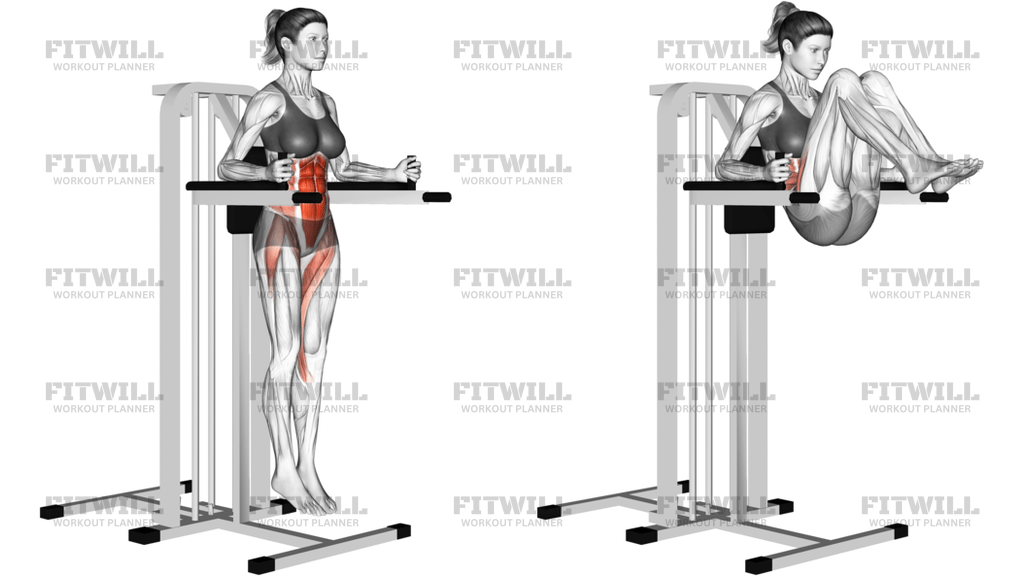
Vertical Leg Raise On Parallel Bars is a bodyweight core and hip exercise performed on captain's chair-style parallel bars. Your forearms support your body while the legs hang free, so the rep depends on controlled hip flexion rather than swinging the torso. It is a practical choice for building lower-abdominal control, hip flexor strength, and the ability to hold the pelvis steady under load.
The setup matters more here than it does in many floor exercises. Once the forearms are planted on the pads and the hands are locked around the handles, the shoulders should stay down and the torso should feel tall and quiet. That support lets the pelvis curl cleanly instead of letting the whole body sway. If the elbows slide, the shoulders shrug, or the neck tightens, the set usually turns into a swing before the abs get much work.
Each repetition should start from a still hang with the knees under the hips and the feet together. Exhale as you draw the knees toward the chest and let the pelvis tuck slightly so the lower abs finish the lift. The movement should look smooth and compact, with the legs rising in one controlled arc instead of snapping upward from momentum. Lower the legs slowly until the hips open again and the body is reset for the next rep.
This exercise is useful in core sessions, accessory blocks, conditioning circuits, and general strength programs when you want a bodyweight movement that is harder to fake than a simple floor crunch. Beginners can use the bent-knee version and keep the range short until the shoulders and grip stay steady. More advanced lifters can straighten the legs or slow the lowering phase, but only if the torso remains quiet and the lower back does not take over.
The main coaching goal is clean tension, not a bigger swing or a higher rep count. When the set starts to get sloppy, the forearms and lats are just holding you in place while the target muscles lose their job. Stop the set before the swing dominates, keep the breathing rhythmic, and treat every repetition as a controlled pelvic curl rather than a kick upward.
Fitwill
Log Workouts, Track Progress & Build Strength.
Achieve more with Fitwill: explore over 9600 exercises with images and videos, access built-in and custom workouts, perfect for both gym and home sessions, and see real results.
Start your journey. Download today!




Instructions
- Step onto the parallel bars and press your forearms firmly into the pads while wrapping your hands around the handles.
- Let your back rest lightly against the support pad, keep your shoulders down, and stand tall through the torso.
- Hang your legs straight down with your feet together, then set your pelvis so the lower back is not arched.
- Take a breath in, then brace through the lower abs before the first rep.
- Exhale as you lift your knees toward your chest and curl the pelvis up without swinging the torso.
- Bring the thighs as high as you can while the forearms and shoulders stay quiet.
- Pause for a moment at the top, keeping the knees close and the trunk still.
- Lower the legs slowly until they hang under control again and the hips fully reset.
- Repeat for the planned reps, then step down from the bars only after the body is still.
Tips & Tricks
- Keep your elbows pinned into the pads so the shoulders do not shrug as the knees rise.
- Think about curling the pelvis under at the top; that keeps the lower abs involved instead of turning the rep into a hip swing.
- If you start rocking, shorten the range and pause for a beat with the knees up before lowering.
- Bending the knees more makes the lever shorter and is the easiest way to keep the torso from swinging.
- Do not kick the feet forward to start the rep; the lift should come from a smooth tuck, not a snap.
- Keep the ribs down and the neck long so the upper body does not chase the knees.
- Lower for a slow count so the abs keep tension all the way back to the hang.
- Stop the set when your grip, elbows, or shoulders can no longer keep the torso still.
Frequently Asked Questions
What muscles does Vertical Leg Raise On Parallel Bars work most?
It mainly trains the lower abs and hip flexors, with the obliques and deep core muscles helping to keep the pelvis steady on the pads.
Can beginners perform this exercise?
Yes. Beginners usually do best with bent knees and a shorter range so the torso stays quiet and the shoulders can support the body cleanly.
Should I keep my knees bent or straight on Vertical Leg Raise On Parallel Bars?
Bent knees are easier and usually better for learning the movement. Straight legs make the lever longer and increase the demand on the abs and hip flexors.
What is the most common mistake on the parallel bars?
Most people swing their legs up instead of curling the pelvis. If the torso rocks, the set has turned into momentum work instead of a controlled raise.
How high should I raise my knees?
Lift them as high as you can without losing control of the ribs, shoulders, or lower back. A smaller but cleaner top position is better than forcing extra height.
Why do my hip flexors cramp during Vertical Leg Raise On Parallel Bars?
That usually means the rep is getting too fast or the range is too long. Shorten the lift, keep the pelvis tucked, and slow the lowering phase.
Is Vertical Leg Raise On Parallel Bars the same as a captain's chair knee raise?
Yes, it is the same basic movement pattern. The forearm pads and handles let you raise the knees while keeping the upper body supported.
How do I make the exercise harder without adding weight?
Straighten the legs more, pause longer at the top, or slow the descent. All three make the lever longer and demand more control from the abs.
Can I use this exercise if my grip or shoulders get tired first?
Yes, but reduce the set before the support work breaks down. If the grip slips or the shoulders shrug, the torso will start swinging and the rep quality will drop.