Lever Chest Press Plate Loaded
The Lever Chest Press Plate Loaded is a seated chest press machine that lets you train the pecs with a fixed path and a smooth, repeatable pressing arc. Because the handles travel on independent levers, the movement is stable enough for controlled strength work while still allowing each side to move on its own. That makes it useful for building pressing strength, chest size, and better left-to-right balance without having to manage a barbell.
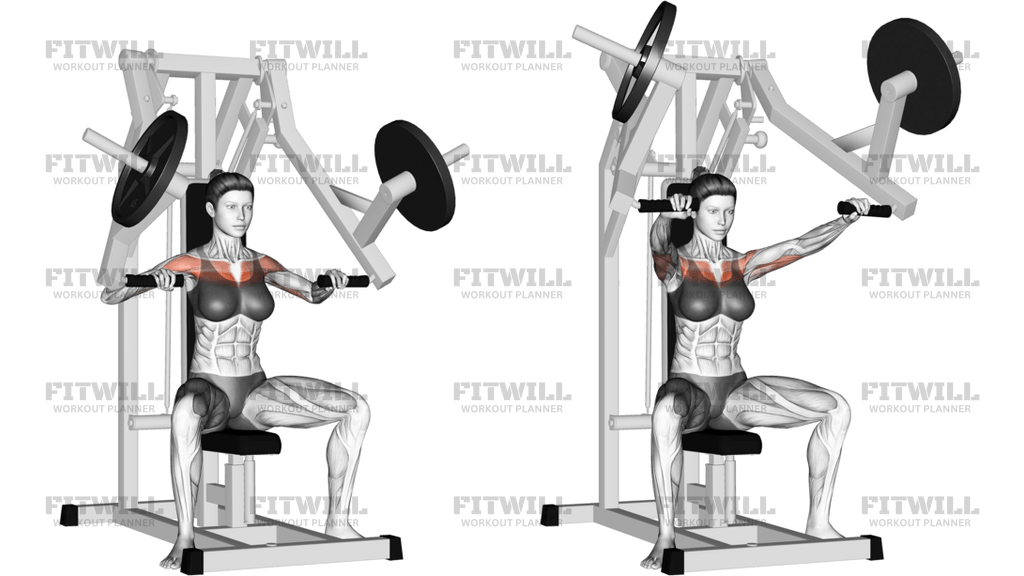
This exercise is primarily a chest movement, with the anterior deltoids and triceps helping finish the press and keep the handles moving cleanly. The image shows a seated position with the back supported and the handles starting around mid-chest level. That setup matters: if the seat is too high, the shoulders take over; if it is too low, the press angle becomes awkward and the pecs lose a clear line of force.
To do it well, sit tall with your upper back and shoulders anchored to the pad, then set your feet flat and brace before each rep. Press the handles forward in a slightly upward path until your arms are nearly straight without forcefully locking out. The return should be slow and controlled so the handles come back to chest level without your shoulders rolling forward or your ribcage flaring up to chase extra range.
This machine is a good choice for beginners, hypertrophy work, and accessory pressing on days when you want chest volume without the balance demands of free weights. It also works well later in a workout when your stabilizers are already tired, because the machine keeps the path honest and reduces cheating. Treat each rep as a chest-driven press, not a whole-body shove.
The biggest keys are seat position, elbow angle, and control through the return. Use a load that lets you keep the shoulder blades set against the pad and the handles moving evenly. If the motion starts turning into a shrug, bounce, or short-range push, the weight is too heavy or the seat is off. With the right setup, this press gives you a straightforward way to train the chest hard while keeping form easy to repeat.
[ Workout Log & Planner ]
Put your next workout in Fitwill
Keep your plan and training log ready when you are.


Instructions
- Adjust the seat so the handles line up around mid-chest and your elbows start slightly below shoulder height.
- Sit back against the pad, plant both feet flat, and keep your upper back and head supported.
- Grip the handles firmly with wrists straight and let the elbows open out naturally without flaring excessively.
- Take a breath and brace your torso before the press so your chest stays lifted without over-arching.
- Drive the handles forward and slightly upward in a smooth arc until your arms are nearly straight.
- Keep both sides moving evenly and avoid letting one shoulder reach ahead of the other.
- Pause briefly near full press without snapping into a hard lockout.
- Lower the handles under control until they return to chest level and the pecs stay loaded.
- Reset your breath at the bottom, then repeat for the planned reps.
Tips & Tricks
- If the handles start too high or too low relative to your chest, adjust the seat before adding weight.
- Keep your shoulder blades gently pinned to the pad so the press comes from the chest instead of a shrug.
- Do not turn the top half of the rep into a hard lockout; stop just short of forcing the elbows straight.
- Let the elbows track in line with the handles rather than drifting far behind the torso.
- Control the lowering phase all the way back to chest level so the pecs stay under tension.
- Use a grip width that lets your wrists stay stacked instead of bent backward.
- If one lever moves faster than the other, reduce the load and clean up the tempo.
- Keep your feet rooted so the torso does not slide forward as fatigue builds.
Frequently Asked Questions
What muscles does the Lever Chest Press Plate Loaded work most?
It primarily targets the chest, especially the pectoralis major, with the front shoulders and triceps assisting the press.
How should I set the seat on this machine?
Set the seat so the handles start around mid-chest, not up near your shoulders or down near your ribs.
Should my elbows flare out during the press?
A natural flare is fine, but keep the elbows from shooting too far back or pinching in tight. The goal is a smooth chest press path, not a barbell-style tuck.
Do I need to lock out at the top?
No. Press until the arms are nearly straight, then stop before aggressively locking the elbows or bouncing the handles.
Is this easier than a barbell bench press?
Usually yes, because the machine controls the path and removes much of the balance and stabilization demand.
What should I do if one side feels stronger than the other?
Slow the rep down and use a lighter load so both levers move at the same speed. Independent arms make side-to-side differences easier to notice.
Can beginners use this chest press machine?
Yes. It is a good beginner option because the fixed path makes it easier to learn chest pressing with control.
What is the most common mistake on this exercise?
The usual mistake is letting the shoulders roll forward or using too much load, which turns the movement into a short, sloppy push.