Cable Incline Fly On Stability Ball
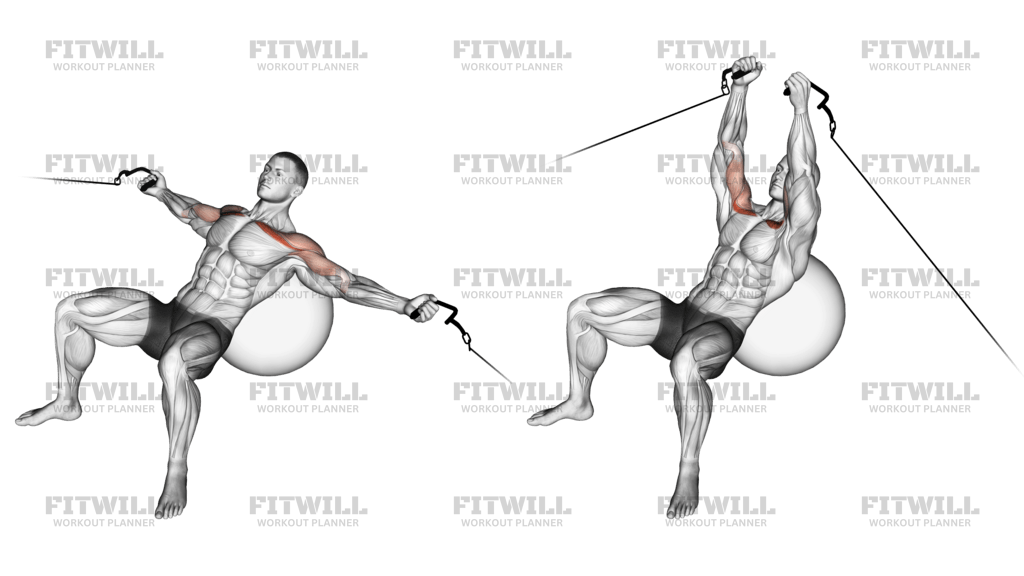
Cable Incline Fly On Stability Ball is a chest fly variation that combines cable resistance with the unstable support of a stability ball. The upper back rests on the ball while the hips stay lifted in a bridge, which makes the exercise feel like an inclined fly with extra core and balance demand layered on top of the chest work.
The cable keeps the pectorals under tension from the open-arm position through the squeeze at the top. That is why the setup matters so much here: if the feet are too narrow, the hips drop, or the shoulders lose position on the ball, the fly turns into a wobbly shoulder exercise instead of a controlled chest movement. When it is done well, the chest opens and closes through a smooth arc while the torso stays anchored.
Set the cables low, sit on the ball, and walk the feet out until the upper back and shoulders are supported while the hips can stay in a stable bridge. Start with the handles out to the sides and the elbows softly bent, then bring the arms together in a hugging arc over the upper chest. The finish should feel like a chest squeeze, not like the shoulders are reaching forward to touch the handles.
Cable Incline Fly On Stability Ball is useful when you want chest isolation with a little more trunk control than a flat bench fly provides. It can work well in accessory blocks, home-style cable setups, or sessions where you want to challenge stability without turning the movement into a press. The best reps are slow enough that the ball stays quiet, the ribs stay lifted but not flared, and the shoulders never drift into an uncomfortable stretch at the bottom.
If balance becomes the limiting factor, widen the stance, shorten the range, and reduce the load. The point is to keep tension on the chest while the body remains organized on the ball, not to see how much wobble you can survive.
[ Workout Log & Planner ]
Put your next workout in Fitwill
Keep your plan and training log ready when you are.


Instructions
- Set the cable handles low, sit on the stability ball, and walk your feet out until your upper back and shoulders are supported on the ball.
- Lift your hips into a stable bridge and plant your feet firmly so the ball does not roll as you move.
- Hold the handles with a soft bend in the elbows and start with the arms open wide to the sides of the chest.
- Set your ribs and core before the first rep so the torso stays steady through the fly.
- Sweep the arms together in a wide hugging arc until the hands meet or nearly meet above the upper chest.
- Pause briefly at the top while squeezing the chest, then keep the shoulders down and relaxed.
- Open the arms back under control until you feel a safe stretch through the chest without letting the shoulders collapse forward.
- Repeat for the set, then lower the hips and walk your feet back in before getting off the ball.
Tips & Tricks
- Use less load than you would on a bench fly; the ball makes the open position harder to control.
- If the hips drop, widen the feet and shorten the range before adding more weight.
- Keep the elbows softly bent and at nearly the same angle on both sides so the movement stays a fly, not a press.
- Do not let the shoulders roll far forward at the bottom; stop the stretch when the chest feels loaded but the front of the shoulder still feels safe.
- A slow return is more important than a big squeeze here because the ball rewards control more than force.
- If the neck feels tense, reposition your upper back slightly higher on the ball and let the head rest more comfortably.
- The hands should travel in a smooth arc, not in a straight line, so the chest stays in charge of the movement.
- If balance is shaky, use a wider foot stance and pick a lighter handle setting before trying to make the range bigger.
Frequently Asked Questions
What muscles does Cable Incline Fly On Stability Ball work?
It mainly works the chest, with the front shoulders and core helping stabilize the body on the ball.
Why use a stability ball for this fly?
The ball adds balance demand and a little extra core work while still letting the chest do the main job.
Is Cable Incline Fly On Stability Ball beginner friendly?
It can be, but it is easier to learn with very light resistance and a wide, stable foot position.
Should my elbows stay bent during Cable Incline Fly On Stability Ball?
Yes, keep a soft, consistent bend so the arms stay in a fly pattern instead of turning into a press.
How deep should I stretch at the bottom?
Only as far as the chest can open without the front of the shoulders feeling pinchy or the ball becoming unstable.
Can I replace this with a bench fly?
Yes, a bench fly is the more stable alternative if you do not want the extra balance challenge.
What is the most common mistake in this exercise?
Using too much weight and losing hip position so the ball starts wobbling through every rep.