Barbell Front Raise
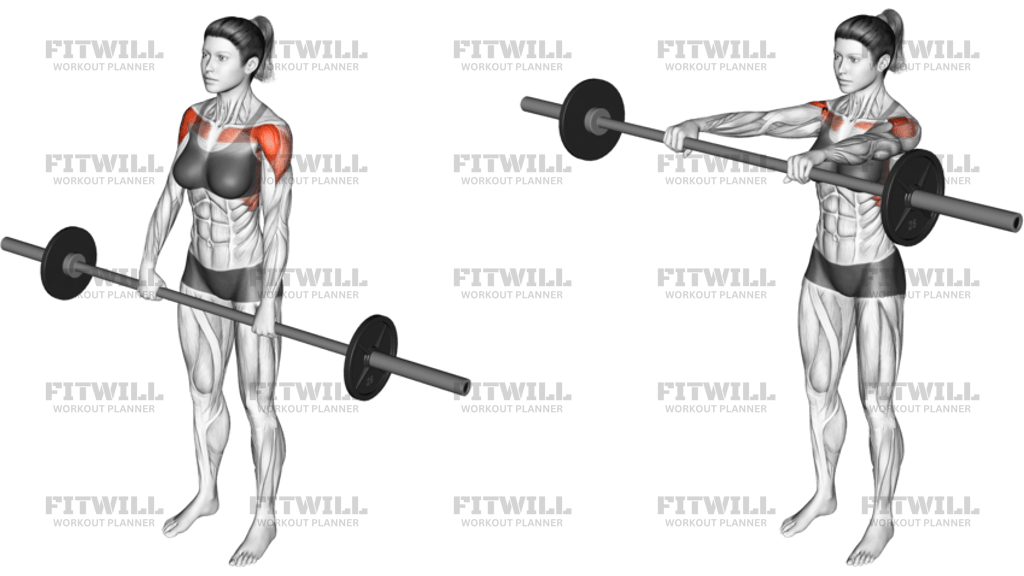
Barbell Front Raise is a strict shoulder isolation movement built around raising a barbell from the front of the thighs to shoulder height. It puts the most demand on the front shoulders while the upper back, arms, and core help keep the bar path smooth and the torso quiet. Because the lift is small and deliberate, the setup matters as much as the rep itself.
The exercise works best when the bar starts close to the body, the ribs stay stacked over the pelvis, and the shoulders do not roll forward at the bottom. A narrow-to-shoulder-width overhand grip keeps both hands even and helps the bar travel in a clean arc. That makes Barbell Front Raise useful as accessory work after pressing, as a shoulder warm-up with light load, or as a focused finisher when you want controlled front-delt tension without a lot of body movement.
The lift should feel like a steady forward sweep rather than a swing. Raise the bar in front of you until the upper arms are about parallel to the floor, then lower it with the same control. If the weight gets too heavy, the torso starts leaning back, the elbows bend and turn the movement into a partial upright row, or the shoulders shrug up to the ears. Those are all signs the load is too aggressive for this pattern.
Barbell Front Raise is most effective when the reps look almost identical from start to finish. Keep the bar close to the thighs on the way down, pause briefly at the top without bouncing, and keep the neck relaxed so the front shoulders do the work instead of the traps. That strict path is what makes the exercise useful for building clean shoulder control and reinforcing better pressing mechanics.
It is a practical choice for lifters who want direct front-shoulder work with simple equipment and a clear range of motion. Beginners can use it safely with a very light bar or empty barbell, but the motion should stay conservative and pain-free. If the shoulders feel pinchy overhead or the wrists struggle with a fixed bar, reduce the range, lighten the load, or switch to a more forgiving variation before the set turns sloppy.
[ Workout Log & Planner ]
Put your next workout in Fitwill
Keep your plan and training log ready when you are.


Instructions
- Stand tall with the barbell resting in front of your thighs, feet about hip-width apart, and an overhand grip just outside shoulder width.
- Let your arms hang straight with a soft bend in the elbows, wrists stacked over the bar, and the plates level on both sides.
- Set your ribs down, squeeze your glutes lightly, and keep your chest tall without leaning back.
- Brace your midsection before the first rep so the bar can rise without your torso drifting.
- Raise the bar in a smooth forward arc, keeping it close to your body as it travels upward.
- Stop when the bar reaches about shoulder height and your upper arms are roughly parallel to the floor.
- Pause briefly at the top without shrugging your shoulders or bending your knees to cheat the lift.
- Lower the bar along the same path under control until it returns to the front of your thighs.
- Inhale as the bar lowers, exhale as you lift, and reset fully before the next repetition.
- After the final rep, return the bar to your thighs and step out of the stance only when the weight is steady.
Tips & Tricks
- Use a much lighter load than you would for presses; this lift gets sloppy fast once momentum takes over.
- Keep the bar close to your thighs and lower abdomen on the way up and down so the arc stays strict.
- Lock the elbow angle in place with only a small bend; turning the movement into a row shifts tension away from the front shoulders.
- Stop at shoulder height rather than trying to lift higher, because extra height usually turns into trap shrugging.
- Keep your wrists neutral instead of letting them bend back under the bar.
- If your lower back arches to help the bar rise, shorten the range and squeeze your glutes harder.
- A one- to three-second lowering phase makes the set more effective than fast, swinging reps.
- If one side rises before the other, narrow the grip slightly and re-center the hands on the knurling.
- Use smaller plates if the bar feels awkward at the start; a cleaner path matters more than loading the sleeves.
Frequently Asked Questions
What does Barbell Front Raise train most?
It mainly targets the front shoulders, with the upper back, arms, and core helping stabilize the lift.
How high should I raise the bar in Barbell Front Raise?
Raise it to about shoulder height, then stop. Going higher usually shifts tension into the traps and makes the rep harder to control.
Should my elbows stay straight during Barbell Front Raise?
Keep a small, fixed bend in the elbows, but do not turn the lift into an elbow curl. The bar should travel as one controlled unit.
What grip should I use for Barbell Front Raise?
An overhand grip around shoulder width is the most practical choice. It keeps both hands even and makes the bar path easier to control.
Why do I feel Barbell Front Raise in my traps?
That usually means you are shrugging at the top or using too much load. Lower the weight and keep your shoulders down as the bar rises.
Is Barbell Front Raise good for beginners?
Yes, if the load is light and the range stays strict. Beginners should learn the path with an empty bar or very small plates first.
What is the biggest mistake in Barbell Front Raise?
Swinging the torso backward to start the rep. If your hips drive forward or your chest pops up, the weight is too heavy.
What can I do if the bar bothers my wrists or shoulders?
Reduce the load, keep the wrists stacked, and stop at a lower range. If it still feels awkward, a dumbbell or cable front raise is usually easier on the joints.